Reducing Use of Cement Semi-finished Product 'Clinker'
Europe Allows Up to 36% Supplementary Materials
Accelerating Digital Innovation with AI Application in Factory Operations
"Low-carbon cement using blended materials is expected to account for more than 90% within two years."
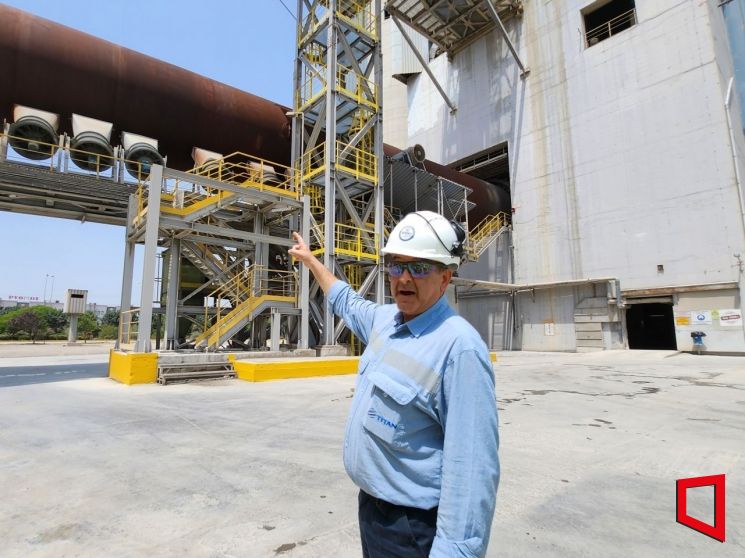 On the 20th (local time), Anastasios Selegidis, Minister of Finance, pointed to the kiln at the Titan Cement Efkarpia plant in Greece, explaining the reduction of carbon dioxide.
On the 20th (local time), Kalogerakos Angelos, the General Manager of the TITAN cement plant in Greece, expressed pride in carbon reduction efforts. TITAN is a major company with a total of about 240 production sites across Europe, North and South America, the Middle East, including Greece. The TITAN Efkarpia plant visited that day was located about a 35-minute drive from Thessaloniki, the second-largest city in Greece.
The most notable feature of this site was the increased use of blended materials in cement manufacturing. This is to reduce the amount of clinker, a semi-finished cement product. During the calcination process, the kiln is heated above 1450 degrees Celsius to produce clinker, which emits a large amount of carbon dioxide. Typically, about 700 kg of carbon dioxide is emitted per ton of cement produced. Of this, carbon dioxide generated from limestone used for clinker production accounts for 420 kg per ton of cement, making up 60% of the total. Angelos, the plant’s General Manager, explained, "Reducing limestone usage and increasing the proportion of blended materials is an effective method for carbon reduction."
Since 2017, the Efkarpia plant has been using various blended materials that can replace clinker, including waste concrete generated in Thessaloniki, as raw materials for cement. The blended material ratio is about 25%. Through continuous research and development (R&D), the plan is to gradually increase the use of blended materials. This is a completely different approach compared to the domestic cement market. In Europe, up to 10 types of materials such as blast furnace slag, waste concrete, limestone powder, fly ash, pozzolan, and burnt shale can be freely blended and used up to 36%. In contrast, the domestic cement industry typically uses only two out of four types of blended materials?blast furnace slag, fly ash, pozzolan, and limestone powder?up to a maximum of 10% under the Ordinary Portland Cement KS standard.
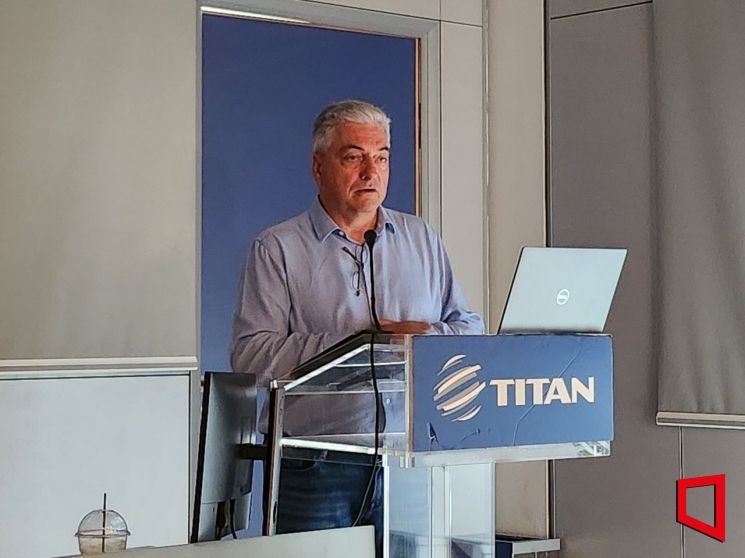 On the 20th (local time), Kalogherakos Angelos, the general manager of the Greece Titan (TITAN) cement plant, explained measures for carbon reduction.
The Efkarpia plant is also strengthening the recycling of circular resources, including biomass. Over five years from 2019 to last year, 185,000 tons of combustible waste from landfills were converted into alternative fuel, saving 120,000 tons of fossil fuels. Stroungaris Vasilis, the General Manager of the Efkarpia plant, emphasized, "Especially by using biomass alternative fuel, we recorded a reduction of 175,000 tons of carbon dioxide emissions, which is equivalent to blocking 60,000 vehicles from operating on the streets of Thessaloniki." It is estimated that the cost savings from carbon emission rights purchases exceeded 10 million euros (approximately 14.6 billion KRW). The recycling rate of circular resources is expected to exceed 65% within 2 to 3 years.
They are also accelerating digital innovation by applying artificial intelligence (AI) to real-time plant operations. On that day, five employees in the central control room were monitoring the optimization of processes in real time through data on monitors. About 3,000 sensors throughout the plant, including the kiln, send data every minute. Anastasios Selegidis, the Chief Financial Officer who has worked as an engineer at TITAN for 27 years, said, "AI data analysis can be used for problem-solving such as maintenance and fault prediction," adding, "Maximizing throughput and reducing energy consumption also lead to environmental friendliness."
TITAN aims to reduce greenhouse gas emissions to less than 130 kg per ton of cement produced by 2030. Compared to the global average of about 611 kg per ton of cement last year, this is a dramatically low figure. Currently, the Kamari plant is conducting the ‘iFESTOS’ project focused on greenhouse gas capture, which, if successful, will enable the capture of about 1.9 million tons of greenhouse gases annually and the production of 3 million tons of carbon-zero cement. For this, they received a subsidy of 234 million euros (approximately 343 billion KRW) from the EU Innovation Fund. Angelos, the plant’s General Manager, said, "Investment in carbon-neutral technology was possible thanks to the EU subsidy," and added, "We are also benefiting from the Greek government’s adjustments to tax rates and other measures."
© The Asia Business Daily(www.asiae.co.kr). All rights reserved.



















