Ministry of Industry Selected for 'Future Regional Energy Ecosystem Activation' Contest
Establishing Platform for Distributed Energy Resource Utilization and Demand Activation
Yongin City in Gyeonggi Province is set to establish a 'distributed energy' ecosystem centered around public office buildings.
On the 27th, Yongin City announced that it had secured 600 million KRW in national funding after being selected for the Ministry of Trade, Industry and Energy's '2024 Future Regional Energy Ecosystem Activation Project' competition. This project was prepared to improve regional energy supply and demand conditions and to discover and support new regional distributed energy industry models ahead of the implementation of the 'Special Act on the Activation of Distributed Energy' next month.
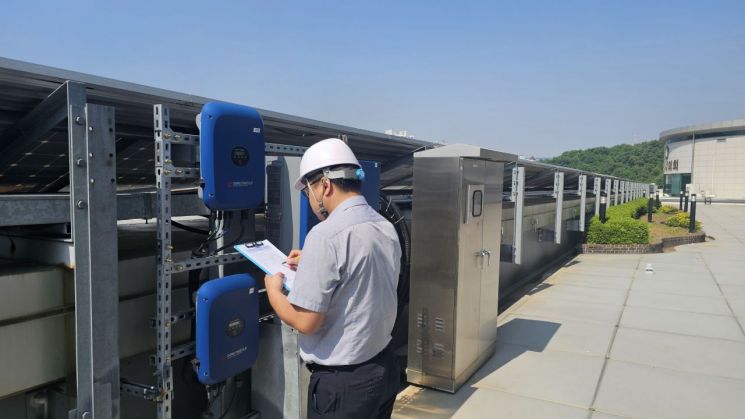
'Distributed energy' is a concept contrasting with the traditional centralized power supply system, where energy is produced and consumed near the usage area. Because the distance between energy supply and usage areas is short, large-scale transmission line facilities are not necessary, and since power sources are dispersed on a small scale, it has the advantage of supplying electricity more stably than centralized power systems.
The Electricity Business Act defines distributed energy as all power generation facilities of 40 MW or less, collective energy of 500 MW or less, district electricity, self-use power generation facilities, and other resources that produce and store energy near demand sites and contribute to resolving surplus power.
The city explained that it received high evaluations in the competition by proposing a business model that addresses regional energy issues by grouping facilities with similar energy consumption characteristics as resources to induce efficient power consumption and contribute to the stability of the power supply system. With this selection, the city will jointly build a region-led future energy integrated management platform with Parang Energy Co., Ltd. The project will invest a total of 1 billion KRW, with 600 million KRW from national funds and 200 million KRW each from the city and the business operator.
Through this project, the city plans to monitor renewable energy generation such as solar power installed in public office buildings and energy consumption in real time, and conduct efficient power management based on demand forecasting using the collected data. To this end, smart devices capable of continuous remote control will be installed in public office buildings to manage electricity used for lighting and heating/cooling equipment. Additionally, through collaboration between power system operators and demand management operators, a platform to support optimal energy use will be developed, and various solutions to reduce power consumption will be provided.
Furthermore, beyond public office buildings, the city plans to establish a foundation for participation in a demand response market where user groups with similar energy consumption characteristics can receive incentives proportional to their energy savings, aiming to improve regional energy self-sufficiency.
A city official stated, "We expect to establish a sustainable energy-saving system through platform construction," adding, "We will strive to respond to future changes in the power environment with efficient energy management measures and develop a model that can be exemplary and shared with citizens."
© The Asia Business Daily(www.asiae.co.kr). All rights reserved.

















