Suncheon Songgwangsa Yeongsanhwesangdo and Palsangdo
"Complete Set of Buddhist Paintings... Presenting a New Model"
The 'Suncheon Songgwangsa Yeongsanhoesangdo and Palsangdo,' representing the Palsangdo of the late Joseon period, has been designated as a National Treasure. The Cultural Heritage Administration announced on the 27th that the designation was finalized after gathering opinions from various sectors and deliberation by the Cultural Heritage Committee.
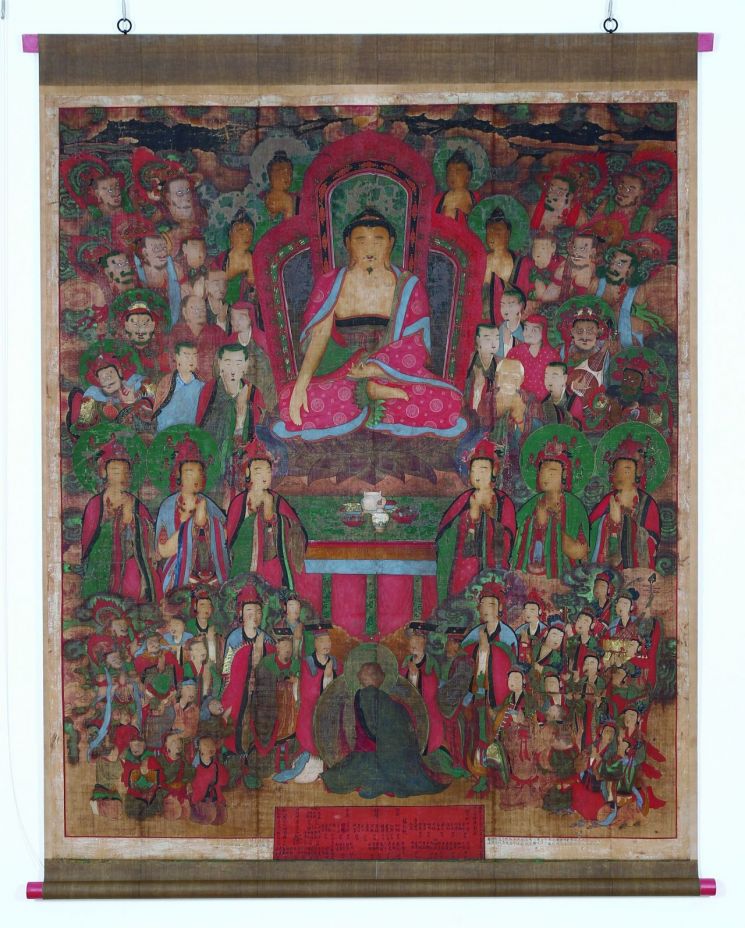
This Buddhist painting was designated as a Treasure in 2003. It was created as one panel of Yeongsanhoesangdo and eight panels of Palsangdo, enshrined in the Yeongsanjeon Hall of Songgwangsa. Palsangdo is a Buddhist painting expressing eight historical events from the life of Sakyamuni under eight themes. It is based on the concept of Palsang shared within the Buddhist cultural sphere.
The themes, iconography, and expression methods vary by country. In the early to mid-Joseon period, Palsangdo was mainly created by borrowing from the Wolinseokbo (月印釋譜) transformation paintings (visual representations that make the contents or doctrines of Buddhist scriptures easier to understand). In the late Joseon period, the iconography presented in Seoksseewonryueunhwasa-jeok became popular. The representative work of that time is the Suncheon Songgwangsa Palsangdo. Through the hwagi (records related to the painting’s creation, including the patrons and artists), the production date is confirmed as the first year of King Yeongjo’s reign (1725), and the painters including Uigyeom (義謙) are identified.
The Cultural Heritage Administration explained, "It is confirmed as the earliest work enshrining Yeongsanhoesangdo and Palsangdo simultaneously in one pavilion," and added, "Both Palsangdo and Yeongsanhoesangdo were created using the iconography from Seoksseewonryueunhwasa-jeok, making them complete as a unified set of Buddhist paintings." They further evaluated, "It is significant in presenting the diversity of Yeongsanhoesangdo and a new model of Palsangdo in the late Joseon period."
Another notable feature is that each panel of Palsangdo maintains unified brushwork and color centered on Yeongsanhoesangdo. The numerous figures composing the Palsang are also depicted with delicate brushstrokes. The Cultural Heritage Administration stated, "The spatiality is secured by using the pavilion and pine trees, and the transitions in time and space according to the events are naturally handled, demonstrating outstanding artistic value in composition and expression."
© The Asia Business Daily(www.asiae.co.kr). All rights reserved.
![Clutching a Stolen Dior Bag, Saying "I Hate Being Poor but Real"... The Grotesque Con of a "Human Knockoff" [Slate]](https://cwcontent.asiae.co.kr/asiaresize/183/2026021902243444107_1771435474.jpg)
















