Cost Covered by Development Gains of Upper Site, Feasibility Key
Estimated 32 Trillion KRW for National Railway Underground Project in Seoul
"Private Participation Should Be Encouraged by Building Restrictions and Floor Area Ratio Relaxation"
In January, the 'Special Act on Railway Undergrounding and Integrated Development of Railway Sites' was enacted, establishing an institutional foundation for railway undergrounding, but it is expected to require enormous project costs. The costs must be covered by the railway site development project without additional financial support from the government. Local governments are advised to carefully consider whether to proceed, as it may be difficult to gain residents' support if the project is deemed unfeasible.
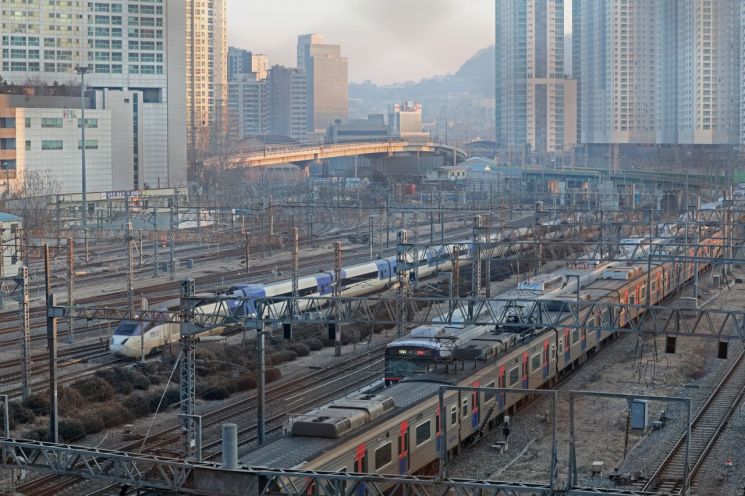
On the 26th, the National Assembly Legislative Research Office explained in its report titled "Railway Undergrounding Project, Insufficient with the Special Act Alone" that "although the institutional foundation has been established through the Railway Undergrounding Integrated Development Act, the railway undergrounding project must comprehensively consider legal, financial, technical, environmental, and social factors."
The Railway Undergrounding Integrated Development Act stipulates the establishment and implementation of various plans to promote integrated development. The project targets are lines designated according to the comprehensive plan for integrated development of railway undergrounding among high-speed rail and general railways (excluding urban rail). The act defines the integrated implementation of railway undergrounding and railway site development projects as 'railway undergrounding integrated development.' Railway site development projects include public housing projects, urban development projects, and station area development projects.
The costs required for implementing railway undergrounding integrated development are borne by the project implementer, and the principle is to cover the costs of the railway undergrounding project with the profits generated from the railway site development project. When the aboveground railway site is contributed to the project implementer, the implementer constructs the underground railway by issuing bonds secured by this site or through local government financial support. The project implementer sells the aboveground land to the private sector or develops the area adjacent to the railway site into high-density mixed-use developments, including housing, commercial, and office spaces.
In January, the Ministry of Land, Infrastructure and Transport presented railway undergrounding as one of the 'three major innovation strategies in the transportation sector' at a public discussion and announced a promotion plan. In March, it began establishing a comprehensive plan covering undergrounding routes nationwide, upper-level development concepts, and railway network restructuring. The ministry plans to select sections with high completeness among projects proposed by local governments as pilot projects.
Developing the aboveground sites created by railway undergrounding requires building new infrastructure, necessitating massive project investments. Seoul estimated the undergrounding project cost for 71.6 km of national railway sections within the city at 32.6 trillion KRW. Busan estimated 8.3 trillion KRW for the 19.3 km section from Hwamyung to Busan Station, and Daegu estimated 8.1 trillion KRW for the Gyeongbu Line.
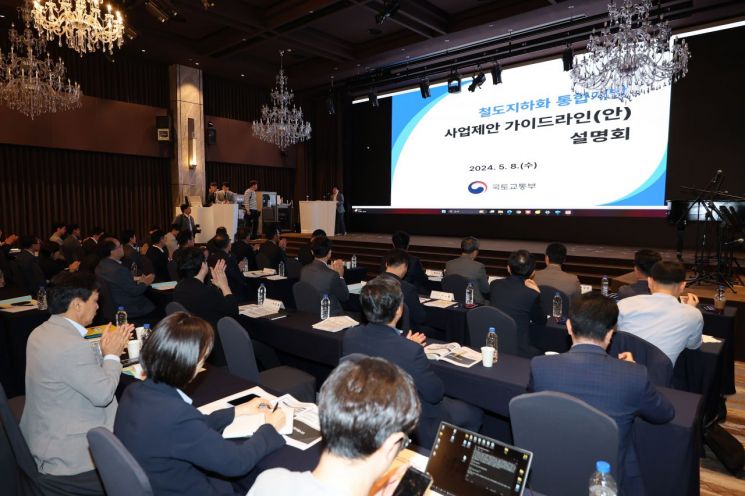 On the afternoon of the 8th, attendees are listening to explanations at the guideline briefing session for the integrated development project proposal of railway undergrounding held at Royal Park Convention in Yongsan, Seoul. (Photo by Yonhap News)
Since the costs of railway undergrounding must be covered by profits from upper-level site development, securing the feasibility of upper-level site development projects is essential. Recently, construction costs have risen, potentially increasing future project expenses, and there are concerns about whether demand for commercial facilities on the upper-level sites will be sufficient. The Railway Undergrounding Integrated Development Act does not include national-level financial support measures, except for contributions of national property.
Gu Se-ju, a legislative researcher at the National Assembly Legislative Research Office, explained, "If integrated development projects that lack sufficient feasibility are pursued, it is difficult to gain local residents' support, and social and economic costs may impose continuous burdens on residents." He added, "If the feasibility is judged to be significantly insufficient, local governments should reduce the project plan or refrain from implementation."
Most railway sites are narrow and elongated, making them unsuitable for standalone development. Local governments should establish specific utilization plans for the upper-level space, including areas adjacent to the railway site, and reflect them in the basic plan. Gu suggested, "Measures to induce private sector participation should be considered, such as relaxing building construction restrictions, easing floor area ratio and building coverage ratio limits, and reducing charges, which are special provisions under the Railway Undergrounding Integrated Development Act."
Improving the investment evaluation system that clearly reflects the effects of the railway undergrounding integrated development project is also necessary. The project is not subject to preliminary feasibility studies, which apply to new projects with total costs exceeding 50 billion KRW and national financial support exceeding 30 billion KRW. Since railway sites are national property, they can be seen as a form of indirect financial support, and it is pointed out that they should be utilized to realize public benefits.
Gu pointed out, "When local governments subsidize costs to project implementers, feasibility studies under the Local Finance Act must be conducted, reviewing not only economic feasibility but also social and environmental impacts such as benefits from upper-level site development, resolution of regional disconnections, and improvement of aging environments."
Railway undergrounding requires more technical considerations compared to new railway construction. Construction must proceed without affecting existing line operations, considering geological structures and underground facilities beneath the line. Since construction of railway lines in urban areas can cause traffic congestion and inconvenience to local residents, thorough preliminary investigations are necessary. Additionally, designing basic plans for each line to balance project feasibility and public interest is an important task for local governments.
Gu explained, "If only feasibility is excessively pursued, residents' quality of life, environmental protection, and consideration for socially vulnerable groups may be sacrificed." He added, "It is also necessary to consider ways to appropriately recover development profits from landowners in surrounding areas who do not directly contribute to the project but enjoy the benefits of integrated development."
© The Asia Business Daily(www.asiae.co.kr). All rights reserved.
!["The Woman Who Threw Herself into the Water Clutching a Stolen Dior Bag"...A Grotesque Success Story That Shakes the Korean Psyche [Slate]](https://cwcontent.asiae.co.kr/asiaresize/183/2026021902243444107_1771435474.jpg)

















