Rebuttal Statement Issued 1 Hour 30 Minutes After Foreign Media Report
Concerns Over HBM Deterioration... "Closely Cooperating While Conducting Technology and Performance Tests"
Samsung Electronics has strongly refuted foreign media reports claiming that it failed the quality test (qual test) for high-bandwidth memory (HBM) supplied to Nvidia, stating that it is "smoothly conducting tests for HBM supply with various global partners." It is considered unusual for Samsung Electronics to issue an official statement in response to media reports.
On the 24th, Samsung Electronics released an official statement saying, "We are currently working closely with multiple companies and continuously testing technology and performance," and "We are conducting various tests to thoroughly verify the quality and performance of HBM."
This response came after a foreign media outlet cited multiple anonymous sources reporting that Samsung Electronics had not yet passed the tests to supply HBM to the U.S. semiconductor company Nvidia due to issues such as heat generation and power consumption of the HBM.
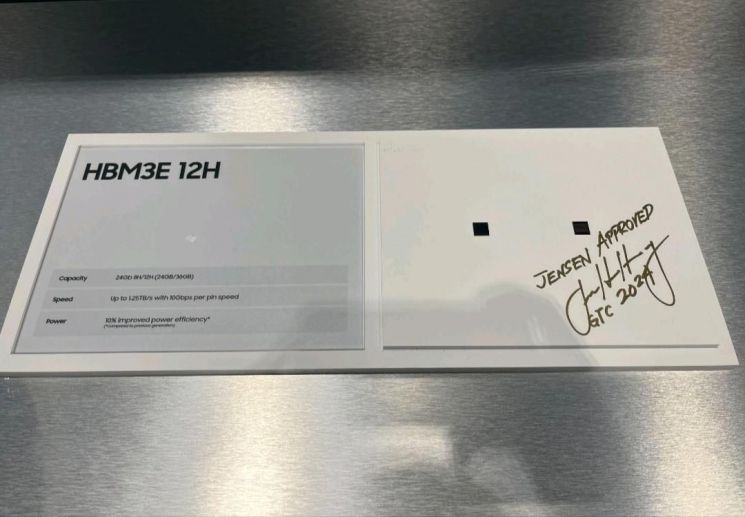
The media reported that in March, Jensen Huang, CEO of Nvidia, visited Samsung Electronics' booth at Nvidia's annual developer conference 'GTC 2024' and labeled the HBM3E 12-stack product as 'JENSEN APPROVED,' raising market expectations, but the results were different.
After confirming the report, Samsung Electronics quickly responded, seemingly dismissing concerns from the industry and investors. The official statement was issued 1 hour and 30 minutes after the foreign media report was released. Internally, there were differing opinions on whether to refute or add to the content, but it was decided to respond officially as the facts were deemed different.
Samsung's relatively swift response is interpreted as a judgment that the already relatively disadvantaged position in HBM could worsen. Sources say it is still unclear whether the pointed-out issues can be easily fixed, but investors are concerned that Samsung Electronics may fall further behind competitors SK Hynix and Micron Technology in the HBM field. Following the report, Samsung Electronics' stock price on the Korea Exchange fell by over 2%.
HBM is a semiconductor that stacks multiple DRAM chips vertically to enhance data processing performance. It is attached next to graphics processing unit (GPU) processors made by companies like Nvidia to increase speed, making it an essential semiconductor in the era of artificial intelligence (AI).
Since last year, Samsung Electronics has been striving to pass Nvidia's HBM3 and HBM3E tests and has developed the world's first 36GB capacity HBM3E 12-stack (H), sending samples to Nvidia.
 Samsung Electronics announced that its provisional consolidated operating profit for last year was 6.54 trillion KRW, and sales amounted to 258.16 trillion KRW. Operating profit decreased by 84.92% and sales decreased by 4.91% compared to the same period last year. The photo shows Samsung Electronics Seocho Building in Seocho-gu, Seoul, on the 9th. Photo by Kang Jin-hyung aymsdream@
The problem is that although Samsung Electronics is the world's No. 1 in the DRAM market, the leadership in the HBM market has been held by competitor SK Hynix, which has actively bet on HBM for the past 10 years.
SK Hynix has virtually monopolized the supply of HBM3 to Nvidia, which controls over 80% of the GPU market, and in March, it became the first memory company to mass-produce HBM3E (8-stack) products and began supplying them to Nvidia. According to Meritz Securities, SK Hynix's market share in the HBM market in the first quarter of this year was 59%, while Samsung Electronics held about 37%. Additionally, the latecomer Micron announced that it skipped HBM3 and started mass production of HBM3E 8-stack in February.
Samsung Electronics has no choice but to devote all efforts to strengthening its HBM competitiveness. This year, Samsung formed an HBM task force (TF), and recently, following an urgent call from Nvidia, HBM TF leader Hwang Sang-joon, Vice President and Head of DRAM Development, traveled to the U.S.
On the 21st, Samsung also made a sudden change in leadership of its Device Solutions (DS) division, responsible for semiconductor business, replacing President Kyung Kye-hyun with Vice Chairman Jeon Young-hyun. One of the Vice Chairman's key tasks is to regain leadership in the HBM market through passing quality tests of HBM3E and successful deliveries.
Industry insiders predict that since Nvidia is trying to reduce its dependence on SK Hynix, Samsung may be able to supply sooner than expected if it meets a certain level of performance.
In its statement, Samsung Electronics emphasized, "Samsung Electronics is continuously striving to improve quality and enhance reliability for all products," and "Through this, we plan to provide customers with the best solutions." It also requested caution in reporting, saying, "Reports related to tests at specific points raised by some may damage our image and credibility."
© The Asia Business Daily(www.asiae.co.kr). All rights reserved.


















