'Seonjae Upgo Twieo' 1.32 Million Views
'Nunmul-ui Yeowang' 2.05 Million Views, etc.
Secretly watching Korean content (K-content) in China is nothing new. People illegally enjoy Korean dramas, movies, and music, and even copy merchandise. There is growing criticism that copyright enforcement must be strengthened and government sanctions imposed.

'Pirate Viewing' on Chinese Video Platforms
Korean dramas and movies can be easily watched on Chinese video platforms such as Youku and Bilibili (the Chinese version of YouTube). Viewers can access everything from past popular works to the latest releases. As of the 24th , videos uploading all episodes of the tvN drama Seonjae Eopgo Twieo have over 1.32 million views on Bilibili. More than 40,000 comments have been posted. tvN's Nunmul-ui Yeowang has been viewed 2.05 million times. JTBC's Hero-neun Anibnida-man, which started airing on the 4th, has also recorded over 70,000 views.
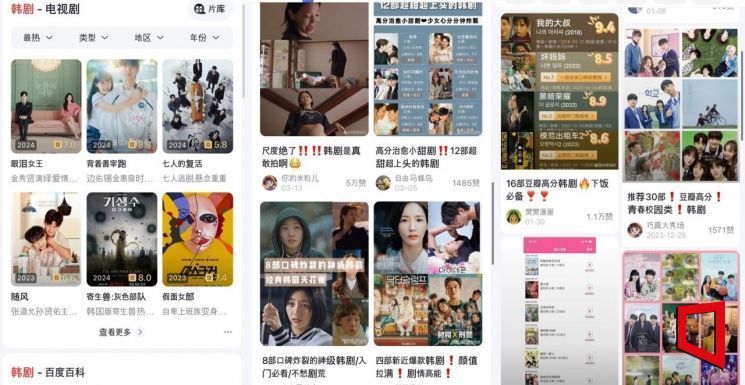
On the content review site Douban (豆瓣), films such as Pamyo, Seoul-ui Bom, and Beomjoe Dosi ? which have not even been released in China ? have ratings of 6.7, 8.8, and 7.2 respectively. These are works available only on specific OTT platforms, yet not only star ratings but also viewing impressions are posted on Chinese movie review sites. Titles like The Glory, Moving, and Squid Game are also representative examples of Chinese people's 'pirate viewing' content.
Why Do Chinese People Secretly Watch K-Content?
In 2016, the deployment of THAAD led to the imposition of the Hanhanryeong (ban on Korean dramas) within China. Previously, Chinese viewers could easily access Korean content approved by the National Radio and Television Administration, which monitors media, on Chinese TV channels. Many Korean actors appeared on Chinese variety shows, and there were numerous Korea-China co-produced films made by Korean directors and Chinese production teams.
However, after the Hanhanryeong was imposed, not only Korean dramas and variety shows but also Korea-China co-productions were completely blocked. The drama My Love from the Star was the last Korean drama broadcast on Chinese TV in 2016, and since Oh! Moon-hee in 2017, no Korean films have been released in China.

Because of the Great Firewall (China's government regulation of internet traffic between China and the rest of the world), overseas OTT services cannot be used in China. Although it is possible to bypass restrictions using VPNs (Virtual Private Networks) to officially subscribe to OTT platforms and access Korean content, there are so many free video platforms available simply by searching the title on Chinese search engines that 'pirate viewing' has become a customary practice.
Chinese people like Korean content because of the actors' acting skills and appearance, as well as the solid storylines. The sophisticated directing style, screen composition, and delicate emotional expressions that cannot be found in Chinese dramas are said to have captivated Chinese viewers. Shen Yifei (沈奕斐), a sociology professor at Fudan University, said through Bilibili videos, "When watching Korean dramas, the male leads look kindly at the female leads. Chinese women feel as if their own lives are improving when they see those looks." He further analyzed that the detailed composition and expression in Korean dramas are factors of their popularity. He explained, "The detailed emotional expressions and narratives move viewers. This is the power of emotion and the charm of Korean dramas."
Government Regulation, Strengthening Copyrights, and Establishing Content Protection Measures Are Needed
Kim Won-dong, head of the Korea-China Content Research Institute, said, "The popularity of Korean dramas in China feels even stronger than before the Hanhanryeong. Korean dramas, whether genre or contemporary, are of a high standard that can compete with any work worldwide. Chinese people like them because they are fun and of high quality." He added, "Illegal viewing is nothing new. I think it is better to maintain the momentum of the Korean Wave even in this way."
On the other hand, Professor Seo Kyung-duk of Sungshin Women's University emphasized the urgent need to establish content protection measures such as government regulation and copyright strengthening. He pointed out, "When the Chinese government was cracking down on the rampant copying of Bing Dwen Dwen, the mascot of the 2022 Beijing Olympics, they imposed restrictions. The Chinese government is aware that pirate viewing of Korean content is clearly wrong, but they are not paying attention." He explained, "Since the Hanhanryeong has not been lifted, it seems they consider secret viewing outside their scope of intervention."
Professor Seo advised that "If the Chinese government and media address the issue of secret viewing, regulatory measures could be introduced," and urged the Korean government and National Assembly to prepare long-term plans to protect Korean content. He stressed, "A system to protect content copyrights must be established to safeguard Korean content as it expands globally."
© The Asia Business Daily(www.asiae.co.kr). All rights reserved.
![Clutching a Stolen Dior Bag, Saying "I Hate Being Poor but Real"... The Grotesque Con of a "Human Knockoff" [Slate]](https://cwcontent.asiae.co.kr/asiaresize/183/2026021902243444107_1771435474.jpg)













