Presided over the '2nd Economic Issue Review Meeting' on the 23rd
Ordered the establishment of groundbreaking measures to strengthen system semiconductors
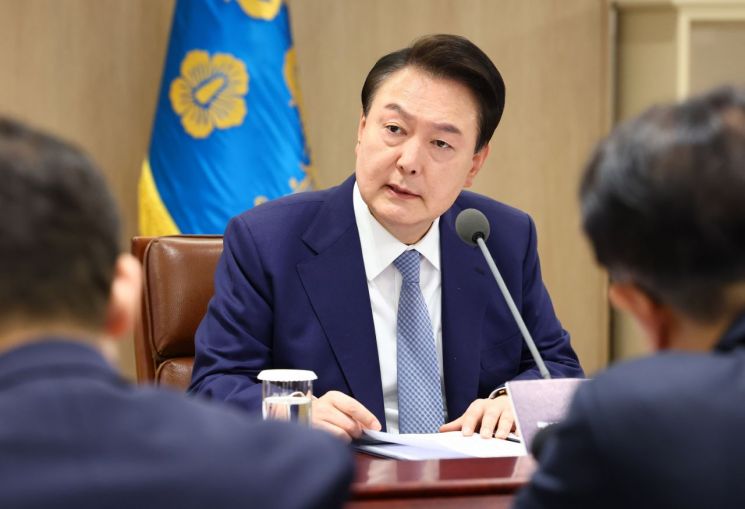 President Yoon Suk-yeol is speaking at the 2nd Economic Issue Review Meeting held on the 23rd at the Presidential Office building in Yongsan, Seoul.
 [Image source=Yonhap News]
President Yoon Suk-yeol chaired the "2nd Economic Issue Review Meeting" on the morning of the 23rd at the Yongsan Presidential Office in Seoul, focusing on the semiconductor industry, and stated, "We have created a comprehensive semiconductor industry support program worth 26 trillion won that encompasses not only finance, infrastructure, and research and development (R&D) but also support for small and medium-sized enterprises (SMEs) and mid-sized companies."
At the meeting, President Yoon said, "As everyone knows, semiconductors are a field where a national all-out effort is underway, and the outcome depends on who can produce the most advanced semiconductors with high-level information processing capabilities first," adding, "The government must firmly back semiconductor support that is not inferior to competing countries." The meeting was convened to discuss the comprehensive semiconductor industry support program, issues related to the semiconductor mega cluster, and plans to foster the system semiconductor industry.
First, 17 trillion won will be invested in large-scale facility investments by establishing a "Semiconductor Financial Support Program." President Yoon said, "We will establish a semiconductor financial support program worth 17 trillion won at KDB Industrial Bank," and added, "Since companies invest huge amounts of capital in facilities such as new factory construction and line expansion, liquidity problems arise, but these difficulties will be largely alleviated through the Industrial Bank's support program."
President Yoon particularly instructed the Ministry of Trade, Industry and Energy to prepare groundbreaking measures to strengthen system semiconductor capabilities, which will determine the future success of the semiconductor industry. However, after in-depth consideration of direct subsidies to semiconductor companies, the government decided not to provide direct financial support.
Yoon: "Rapid Development of Electricity, Water, and Road Infrastructure"
In his opening remarks, President Yoon said, "The semiconductor industry is the most important and certain foundation that enriches people's livelihoods and propels the economy forward," and promised, "The government and public sector will take responsibility for rapidly developing infrastructure such as electricity, water, and roads to ensure there are no setbacks in establishing the semiconductor cluster." He also emphasized, "We will create a 1 trillion won 'Semiconductor Ecosystem Fund' to support promising fabless (semiconductor design specialists) and materials, parts, and equipment (SoBuJang) companies to grow into global enterprises," and added, "Research infrastructure that can be jointly used, such as mini fabs (research facilities equipped with 300mm wafer process equipment for demonstrating semiconductor materials, parts, and equipment), will be swiftly expanded to the level desired by companies."
He further stated, "Countries around the world are currently waging industrial wars, staking their national fate on semiconductors," and urged, "I will personally tackle diplomatic issues, so ministers of each department must become strong supporters of our companies."
Regarding claims that semiconductor industry support equates to "tax cuts for large corporations," President Yoon explained, "If tax incentives lead to expanded corporate investment and increased profits, the public will enjoy more quality jobs, livelihoods will improve, and tax revenues will increase, so 'semiconductors are directly linked to people's livelihoods,'" adding, "More than 70% of this comprehensive semiconductor industry support program will benefit small and medium-sized enterprises and mid-sized companies."
President Yoon also ordered active measures to foster system semiconductors, whose global market share remains minimal compared to memory semiconductors. He said, "The future success of the semiconductor industry will be determined by system semiconductors, which account for two-thirds of the total market, but our fabless industry's market share remains at about 1%, and the gap with leading foundries persists," urging the Ministry of Trade, Industry and Energy to implement extraordinary measures to strengthen system semiconductor competitiveness.
Excluding Direct Subsidies Like the U.S. and Japan
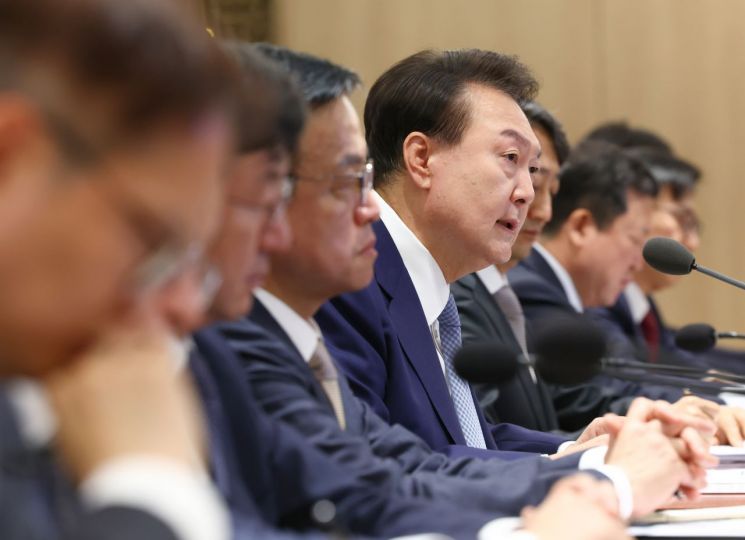 President Yoon Suk-yeol is attending and speaking at the 2nd Economic Issue Review Meeting held at the Yongsan Presidential Office Building in Seoul on the 23rd. [Image source=Yonhap News]
Meanwhile, although the government had considered providing direct subsidies through fiscal measures to foster the semiconductor industry, it decided at this meeting not to provide direct support. A senior official at the Presidential Office explained to Asia Economy, "Countries with semiconductor factories are South Korea and Taiwan, but they do not provide direct subsidies," and clarified, "Countries like the U.S. and Japan, which are trying to attract semiconductor factories, are the ones providing large-scale subsidies," highlighting the difference.
At the meeting, Deputy Prime Minister and Minister of Economy and Finance Choi Sang-mok presented the "Semiconductor Ecosystem Support Plan," and Minister of Trade, Industry and Energy Ahn Deok-geun gave a presentation on key semiconductor industry issues such as system semiconductors, according to a written briefing by Presidential Office spokesperson Kim Soo-kyung.
Minister of Land, Infrastructure and Transport Park Sang-woo stated that it usually takes about seven years from establishing an industrial complex development plan to land compensation and construction, but for the Yongin National Industrial Complex, planning and compensation will be pursued simultaneously to reduce this period by half. He also pledged to support the prompt relocation and expansion of National Road No. 45, which passes through the national industrial complex site. Additionally, he mentioned plans to significantly increase investment in cultural facilities that workers and local residents can use together within the industrial complex.
Minister of Environment Han Hwa-jin said that an integrated pipeline will be installed to supply water to both the Yongin National Industrial Complex and general industrial complexes within the semiconductor mega cluster, reducing costs and permitting burdens for companies and enabling more stable water supply.
Minister of Science and ICT Lee Jong-ho added, "The outcome of semiconductor competition ultimately depends on nurturing excellent talent," and said, "We will support the rapid development of necessary talent tailored to corporate demand by utilizing systems such as the contract quota system, and actively support public infrastructure like MoaFab that students can use."
© The Asia Business Daily(www.asiae.co.kr). All rights reserved.


















