Youth Restricted Rating Down 7.3 Percentage Points
Several Cases of Rating Upgrades
Post-Monitoring and Cumulative Penalty System Must Be Strengthened
Housewife Im Mo (47), who lives in Yeongdeungpo-gu, Seoul, was recently shocked while watching popular online video service (OTT) content with her elementary school-aged son. Shortly after the video started, characters were shown using drugs, and there were frequent lines that seemed to depict sexual crimes.
The content was rated 15+, meaning elementary school students could watch it with a guardian. Im said, "Judging by the level of content, it wouldn't be surprising if it were rated restricted for teenagers, so I checked the rating several times, wondering if I had misread it," adding, "I am worried that people are becoming desensitized to increasingly provocative videos."

As the 'OTT Self-Rating Classification System,' where OTT providers independently assign content ratings, marks its first year, concerns are emerging that OTT providers may relax evaluation standards when classifying their own content. Experts point out the need for appropriate regulation, such as the Korea Media Rating Board (KMRB) conducting post-monitoring to correct issues and actively reflecting these in the re-designation evaluations of providers.
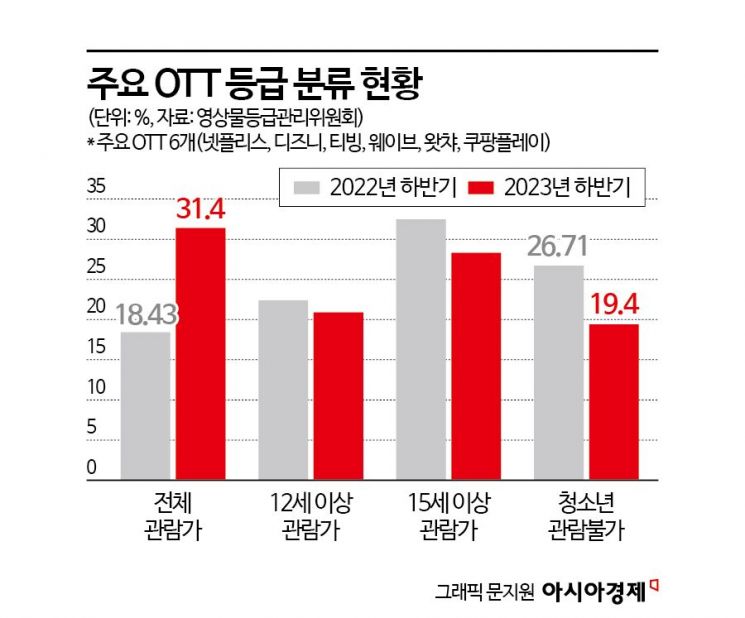
According to the 'Major OTT Rating Classification Status' announced by the KMRB on the 24th, the proportion of content rated 'Restricted for Teenagers' in the second half of last year was 19.4%, a 7.3 percentage point decrease compared to 26.7% in 2022. This is the first time since data collection began that the proportion of 'Restricted for Teenagers' content has dropped. During the same period, the proportion of 'General Audience' ratings increased by 13 percentage points from 18.4% in 2022 to 31.4% last year. The ratings for 12+ and 15+ age groups showed differences within 5%, maintaining similar levels to the previous year.
A KMRB official explained, "Since July last year, self-rating classification for Japanese video content has been allowed, and it is analyzed that the influence of Japanese animation has increased the overall 'General Audience' ratings," adding, "The decrease in original OTT content rated 'Restricted for Teenagers' last year also seems to have significantly reduced the overall proportion of 'Restricted for Teenagers' ratings."
The Ministry of Culture, Sports and Tourism amended the Enforcement Decree of the Film and Video Promotion Act (FVP Act) in February last year and implemented the OTT Self-Rating Classification System starting in March. This system transfers the authority to assign content ratings, previously held by the KMRB, to OTT providers who meet certain criteria. As the volume of OTT content increased, rating decisions took 2 to 3 weeks, so to enhance OTT competitiveness and efficiency, providers were allowed to classify ratings independently.
The problem is that OTT providers may relax standards regarding sexual content and violence to attract viewers. In fact, reviewing the 'KMRB Rating Adjustment Upward Recommendation Cases' released by the KMRB reveals several instances of inappropriate ratings since the system's implementation. For example, a reality program was rated 15+ by the OTT provider, but the KMRB classified it as 'Restricted for Teenagers' due to high sexual content. Similarly, a documentary about a site promoting infidelity was initially rated 15+ by the provider but was revised to 'Restricted for Teenagers.'
Experts say that the KMRB needs to strengthen post-monitoring and implement a cumulative penalty system as part of necessary regulation. Currently, the KMRB operates a 'General Public Monitoring Group' to review rating appropriateness after the fact, but its random selection method has limitations. Hyun Jae-Rae, a professor in the Department of Journalism and Communication at Sogang University, said, "The KMRB needs to examine each self-rated video more thoroughly than it does now," and suggested, "It is necessary to strengthen regulations by correcting inappropriate ratings and actively reflecting the results in the next provider re-designation process."
© The Asia Business Daily(www.asiae.co.kr). All rights reserved.
![Clutching a Stolen Dior Bag, Saying "I Hate Being Poor but Real"... The Grotesque Con of a "Human Knockoff" [Slate]](https://cwcontent.asiae.co.kr/asiaresize/183/2026021902243444107_1771435474.jpg)

















