"24-Hour Operation Model... Biggest Impact When Prices Rise"
"Differentiated Application by Scale Needed if Industry or Region Struggles"
The convenience store industry is closely monitoring the trends of the Minimum Wage Commission, which will decide next year's minimum wage. Since most convenience stores operate 24 hours a day, they are one of the industries most sensitive to minimum wage changes. The convenience store sector insists that the differential application of minimum wages by industry and region, which the business community has consistently proposed, must be enforced this time.
According to the business community on the 23rd, the Minimum Wage Commission held its first plenary meeting on the 21st in Sejong City to begin deliberations on next year's minimum wage. This meeting was a formality for introductions, and specific minimum wage proposals from both the business and labor sides are expected to be presented at the next meeting.
Next year's minimum wage, if increased by 140 won (1.42%) from this year's 9,860 won, will surpass 10,000 won. With recent inflation making it certain that the minimum wage will exceed 10,000 won, the business community demanded a differential minimum wage plan at the first meeting. On the other hand, the labor side is opposing this, calling it an unreasonable claim.
The convenience store industry is in urgent need of a differential minimum wage plan. A convenience store official said, "The minimum wage decision is a major concern for store owners every year, but this year, the focus is more on whether the differential plan will be enforced rather than the amount itself," adding, "Because convenience stores operate 24 hours unlike other franchises, the minimum wage system has a significant impact."
A convenience store owner stated, "For the past six years, there have been cases where part-time workers who work more hours earn more than the store owners," and added, "Currently, the situation is very serious."
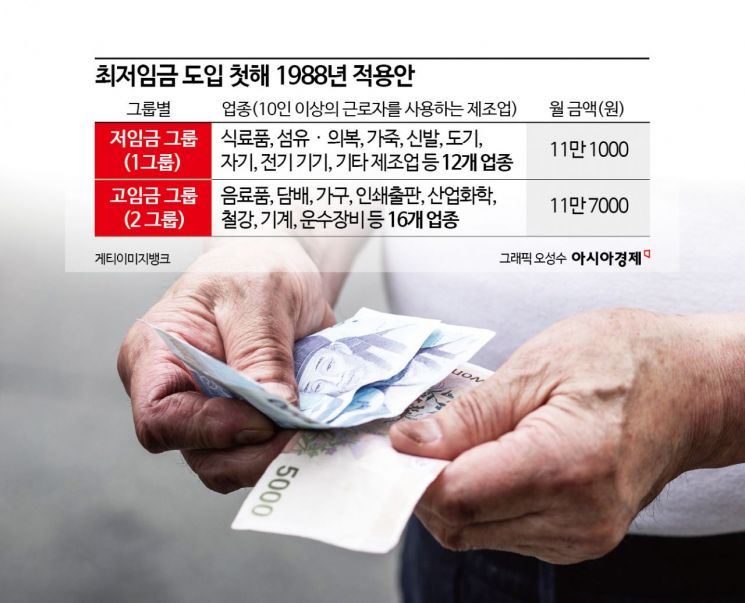
The differential application of minimum wages is effectively a defunct system. Article 4 of the Minimum Wage Act stipulates that minimum wages can be set differently by business type, but in reality, differential application was only implemented in the first year of the minimum wage system in 1988. However, it was applied only once that year and has not been implemented since.
Because of this, the business community has consistently advocated for differential application. Last year, they also pushed for differential minimum wages for convenience stores, food and lodging industries, and taxi transportation, but the proposal was rejected in the Minimum Wage Commission vote. However, this year, the situation has become more complicated as the Bank of Korea proposed in a March report to lift restrictions on foreign workers in the care service industry and apply differential minimum wages. Meanwhile, the labor side opposes differential application, arguing it contradicts the purpose of the minimum wage.
Within the industry, if differential application by industry and region is difficult, there is a growing call to at least introduce 'differential application by scale' for convenience stores. A convenience store industry official said, "In convenience stores, there is a significant difference in sales and workload between well-performing and underperforming locations," adding, "Using five employees as a standard, stores with high customer traffic could pay slightly more, and those with poor sales could pay slightly less, which would greatly help the convenience store industry."
© The Asia Business Daily(www.asiae.co.kr). All rights reserved.
![Clutching a Stolen Dior Bag, Saying "I Hate Being Poor but Real"... The Grotesque Con of a "Human Knockoff" [Slate]](https://cwcontent.asiae.co.kr/asiaresize/183/2026021902243444107_1771435474.jpg)











