Government Announces 'Comprehensive Support Plan for Semiconductor Ecosystem'
New 17 Trillion Won Low-Interest Loan Program Established with KDB Capital Injection
Amid intensifying global semiconductor competition, the government has prepared a comprehensive semiconductor support plan worth 26 trillion won. Instead of providing direct subsidies to companies, the government decided to focus on strengthening tax support measures, such as expanding the scope of tax credits. Additionally, through investment by the Korea Development Bank, a new loan program worth 17 trillion won will be established to offer preferential interest rates for semiconductor investment funds.
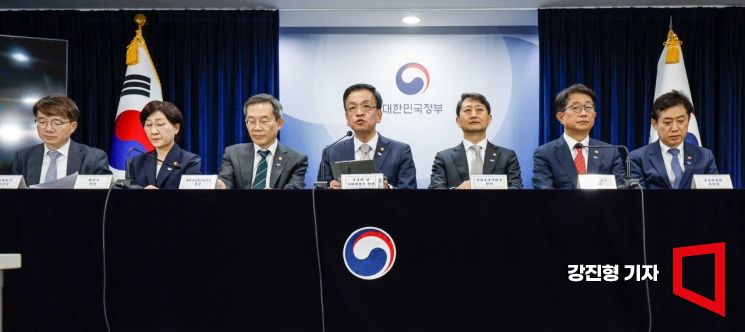 Choi Sang-mok, Deputy Prime Minister for Economic Affairs and Minister of Economy and Finance, is holding a briefing on the "Comprehensive Support Plan for the Semiconductor Ecosystem" at the Government Seoul Office in Jongno-gu, Seoul, on the 23rd. From the left are Kim Dong-il, Director General of the Budget Office at the Ministry of Economy and Finance; Han Hwa-jin, Minister of Environment; Lee Jong-ho, Minister of Science and ICT; Deputy Prime Minister Choi; Ahn Deok-geun, Minister of Trade, Industry and Energy; Park Sang-woo, Minister of Land, Infrastructure and Transport; and Kim Joo-hyun, Chairman of the Financial Services Commission. Photo by Kang Jin-hyung aymsdream@
On the 23rd, Choi Sang-mok, Deputy Prime Minister and Minister of Economy and Finance, held a joint briefing at the Government Seoul Office with the Minister of Science and ICT, the Minister of Trade, Industry and Energy, the Minister of Environment, the Minister of Land, Infrastructure and Transport, and the Chairman of the Financial Services Commission to explain the results of the 2nd Economic Issue Review Meeting and the ‘Comprehensive Semiconductor Ecosystem Support Plan.’
The government decided not to provide direct subsidies to the semiconductor industry for the time being. Instead, it will focus on expanding the scope of tax benefits. Deputy Prime Minister Choi said, “Countries without manufacturing facilities provide investment subsidies as incentives to build new ones, but in Korea, which already has manufacturing capabilities, tax support serves as a form of subsidy. Since Korea’s level of tax support is higher than that of any other country in terms of incentives, we will make efforts to expand the scope of application.” The government plans to extend the application period of tax credits for national strategic technologies and expand the scope of tax credits for semiconductor-related research and development (R&D). The purchase cost of semiconductor design software will be included in the scope of tax credits.
The government will operate a semiconductor financial support program totaling 18.1 trillion won over three years starting this year. Through investment by the Korea Development Bank, a new loan program worth 17 trillion won will be established to allow semiconductor investment funds to be borrowed at preferential interest rates. However, the exact scale of the KDB’s investment has not yet been finalized.
The semiconductor ecosystem fund, currently being raised at 300 billion won, will be expanded to 1.1 trillion won. Deputy Prime Minister Choi stated, “We will also pursue further expansion of the fund size according to future investment demand, and increase the support scale per company to help fabless, materials, parts, and equipment companies grow larger.”
Infrastructure support will also be strengthened to enable the rapid establishment of semiconductor mega clusters. The time required for industrial complex development in the Yongin semiconductor cluster will be reduced from the existing seven years to half, facilitating the smooth settlement and operation of semiconductor factories. Additionally, up to 50 billion won in national funds will be provided to support some of the basic infrastructure such as water supply, electricity, and roads.
More than 5 trillion won in funding will be invested in semiconductor R&D and workforce development. The R&D budget, which was 3 trillion won from 2022 to 2024, will be increased to over 5 trillion won for the next three years. This will strengthen R&D support to secure core semiconductor technologies, such as the commercialization of AI semiconductors. Deputy Prime Minister Choi said, “We plan to promptly complete the preliminary feasibility study for R&D projects such as advanced semiconductor packaging and mini fab construction, and reflect the results in the 2025 budget.”
The government plans to finalize the detailed contents of the semiconductor ecosystem support plan announced on this day by June. The ‘System Semiconductor Growth Strategy,’ a key challenge for Korean semiconductors, is also scheduled to be prepared by August.
© The Asia Business Daily(www.asiae.co.kr). All rights reserved.
![Clutching a Stolen Dior Bag, Saying "I Hate Being Poor but Real"... The Grotesque Con of a "Human Knockoff" [Slate]](https://cwcontent.asiae.co.kr/asiaresize/183/2026021902243444107_1771435474.jpg)
















