Wetland microorganisms capable of simultaneously decomposing methane (CH4) and nitrous oxide (N2O) have been discovered. Methane and nitrous oxide are recognized as major greenhouse gases. Considering this, the discovery of microorganisms that can decompose these substances simultaneously suggests potential contributions to future greenhouse gas reduction.
On the 23rd, the National Research Foundation of Korea announced that Professor Seong-Geun Lee's research team at Chungbuk National University succeeded in confirming the nitrous oxide removal ability of methane-oxidizing microorganisms and elucidating the underlying mechanism.
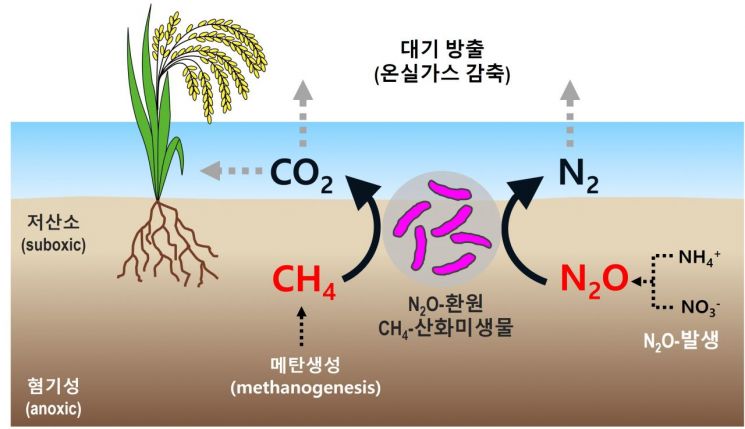 A schematic diagram of methane oxidation and nitrous oxide reduction by a single microorganism (methanotroph) in the natural ecosystem. Provided by the National Research Foundation of Korea.
Methane and nitrous oxide are representative greenhouse gases that cause significantly higher greenhouse effects than carbon dioxide.
Methane is an alkane compound composed of carbon and hydrogen, produced in nature by anaerobic (capable of living or functioning in the absence of oxygen) microorganisms. It has a greenhouse effect 25 times stronger than carbon dioxide.
Nitrous oxide is produced as a byproduct of nitrification and denitrification microbial metabolism in nature and has a greenhouse effect 298 times greater than carbon dioxide in the Earth's atmosphere.
For the greenhouse effect to disappear naturally, aerobic (capable of growing or living in the presence of air or oxygen) microorganisms must oxidize methane into carbon dioxide, and anaerobic microorganisms must reduce (respire) nitrous oxide into atmospheric nitrogen.
Generally, methane oxidation by microorganisms occurs under oxygen-present conditions, while nitrous oxide reduction occurs under oxygen-absent conditions.
However, methane-oxidizing bacteria have been observed in low-oxygen environments such as wetlands, rice paddies, forest soils, and geothermal habitats. They have even frequently been found in anaerobic environments without oxygen, which has been considered a mystery among researchers.
To elucidate this characteristic of methane-oxidizing bacteria, the research team analyzed the genomes of methane-oxidizing microorganisms inhabiting wetlands and extreme environments, and as a result, they discovered genes involved in nitrous oxide reduction in these microorganisms.
Through experiments, it was proven that methane-oxidizing bacteria possess both the ability to oxidize methane in aerobic environments and to reduce nitrous oxide in anaerobic environments.
Professor Seong-Geun Lee stated, “By utilizing the characteristics of the microorganisms identified in this study, it is expected to contribute to the development of technologies for reducing methane and nitrous oxide emissions in natural and artificial ecosystems.” He added, “The research team plans to continue studies to develop nitrous oxide-reducing strains that are insensitive to oxygen concentration, activate nitrous oxide removal under aerobic conditions, and enable application in various fields requiring greenhouse gas reduction.”
© The Asia Business Daily(www.asiae.co.kr). All rights reserved.

















