Warming Rate 2-3 Times Faster Than Other Areas
Orange Hue Change First Observed in 2018
Dozens of rivers in Alaska, located in the northwesternmost part of the United States and known for their clean and transparent waters, have turned a rusty orange color, raising concerns among experts. Specialists have analyzed that this phenomenon is due to the thawing of permafrost caused by global warming. On the 22nd (local time), the British daily The Guardian reported on research findings that as the permafrost layer beneath the surface in the Arctic region melts, minerals such as iron trapped in the soil are released, changing the color of the river water. The Arctic region is where global warming is progressing the fastest on Earth.
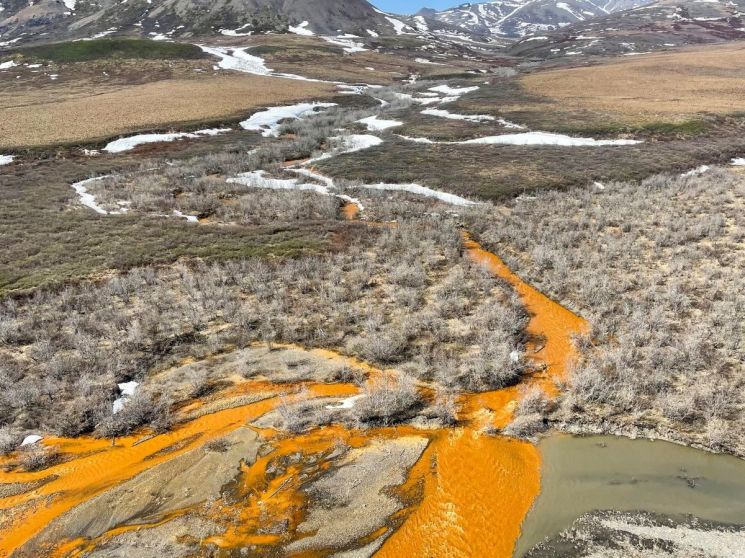 A river in the Brooks Range area of northern Alaska, USA, turned orange.
 [Photo by US Geological Survey (USGS)]
Brett Poulain, an assistant professor at the University of California, Davis (UC Davis), who led the study, pointed out, "We are currently witnessing an 'unexpected consequence' of climate change in some of the least polluted rivers in our country." Due to the thawing of the permafrost, minerals such as iron, copper, zinc, and cadmium in the soil react with oxygen, changing color, and as these components dissolve, the river water changes to a rusty color that is clearly visible even in satellite images.
Professor Poulain expressed concern, saying, "If these rivers mix with other rivers, these minerals could have a stronger impact on aquatic ecosystems."
The phenomenon of Alaska's rivers turning orange was first observed in 2018. At that time, scientists discovered that rivers in the Brooks Range area of northern Alaska had changed from their usual crystal-clear appearance to a pale orange color. Within a year, two native fish species completely disappeared from tributaries of the Akilik River in Kobuk Valley National Park.
Professor Poulain explained, "Our research shows that when the river water turns orange, large invertebrates and biofilms, which are essential foundations of the food chain on the riverbed, drastically decrease," adding, "This phenomenon can alter fish habitats." Discoloration caused by oxidation is generally considered a seasonal phenomenon occurring in midsummer, July and August, when the soil melts to its deepest layers.
However, The Guardian reported that scientists are now conducting research to properly understand the long-term effects of oxidation-induced discoloration occurring in permafrost areas, including polar regions such as Alaska, Canada, and Russia. Scott Zolkos, an Arctic researcher at the Woodwell Climate Research Center, said, "This region is warming at least two to three times faster than the rest of the Earth," and added, "We expect this type of change to continue."
© The Asia Business Daily(www.asiae.co.kr). All rights reserved.
![Clutching a Stolen Dior Bag, Saying "I Hate Being Poor but Real"... The Grotesque Con of a "Human Knockoff" [Slate]](https://cwcontent.asiae.co.kr/asiaresize/183/2026021902243444107_1771435474.jpg)
















