The Supreme Court's full bench has ruled that even a person who has already divorced and whose marital relationship has been dissolved can confirm the nullity of the marriage through litigation against their former spouse.
This is a precedent change after 40 years since the Supreme Court in 1984 rejected lawsuits for nullity of marriage by divorced spouses on the grounds that "there is no interest in confirmation as it is a confirmation of past legal relationships." It is also the first full bench ruling issued since Chief Justice Cho Hee-dae took office.
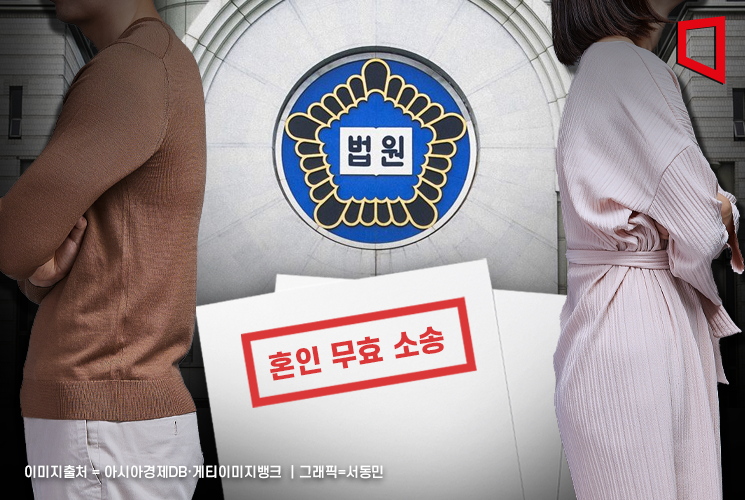
On the 23rd, the Supreme Court full bench overturned the appellate court's dismissal of A's claim in the appeal trial of the nullity of marriage lawsuit filed by A, who divorced, against former spouse B, and decided the case on its own. It canceled the first trial judgment that dismissed both A's principal claim (nullity of marriage) and alternative claim (annulment of marriage) and remanded the case to the Seoul Family Court.
The court stated, "Even after the marital relationship has been dissolved by divorce, it can be a valid and appropriate means to resolve numerous disputes related to legal relationships formed on the premise of marriage all at once, so there is an interest in seeking confirmation of the nullity of a marital relationship that existed for a certain period in the past," and explained that "the appellate court's judgment contains a legal error that misinterpreted the law and affected the judgment."
Furthermore, the court said, "This case is sufficient for the Supreme Court to directly try, so we will try it," and "by unanimous opinion of all participating judges, the first trial judgment is canceled and the case is remanded to the Seoul Family Court."
The court added, "The 1984 Supreme Court ruling that 'the mere fact that the female claimant is recorded in the family register as having married and divorced, which is disgraceful, does not affect the claimant's current legal relationship, and confirmation of the nullity of a marital relationship dissolved by divorce is a confirmation of past legal relationships and thus there is no interest in confirmation' is changed to the extent that it conflicts with this ruling's view."
As grounds for this judgment, the court cited ▲ the fact that null marriages and divorces have different legal effects ▲ the provision in the Family Litigation Act allowing lawsuits for nullity of marriage when the marital relationship is dissolved due to the death of one spouse ▲ the Supreme Court's recognition of interest in lawsuits for nullity of adoption filed after consensual termination of parent-child relationships ▲ and the necessity of filing a lawsuit for nullity of marriage to secure objective evidence for correcting family relation registers incorrectly recording null marriages.
First, the court pointed out, "Null marriages and divorces have different legal effects. That is, a null marriage has no legal effect from the beginning, whereas even if the marital relationship is dissolved by divorce, its effect applies only prospectively, so legal relationships formed on the premise of marriage before divorce remain valid."
It continued, "If the marriage is null, the prohibition on marriage between relatives stipulated in Article 809(2) of the Civil Act or the incest provisions in Article 328(1) of the Criminal Act do not apply, and joint liability for ordinary household debts under Article 832 of the Civil Act cannot be imposed," adding, "Therefore, even after divorce, there is practical significance in confirming the nullity of the marital relationship."
The court also said, "The Family Litigation Act provides regulations on filing lawsuits for nullity of marriage when the marital relationship is dissolved due to the death of one spouse," and "in light of the purpose of these provisions, it cannot be said that a lawsuit for nullity of marriage filed after divorce has no interest in confirmation simply because it concerns past legal relationships."
It further stated, "The Supreme Court recognized interest in confirmation in a lawsuit for nullity of adoption filed after consensual termination of parent-child relationships," and "such Supreme Court judgment can be equally applied when judging interest in confirmation in lawsuits for nullity of marriage filed after the marital relationship has been dissolved by divorce."
Finally, the court said, "To secure objective evidence for correcting family relation registers incorrectly recording null marriages, it is necessary to file a lawsuit for nullity of marriage."
The court explained, "A party who has received a nullity of marriage judgment can request correction of the family relation register, and the method and procedure are governed by Article 107 of the Act on Registration of Family Relations, etc. Considering these procedural provisions, a lawsuit seeking confirmation of nullity after the marital relationship has already been dissolved by divorce is necessary to secure objective evidence required for correcting the family relation register incorrectly recording the marriage history, and can be a valid and appropriate means to remove risks or anxieties related to current rights or legal status closely connected to the family relation register entries."
It added, "If the incorrect entry in the family relation register is regarded as merely disgraceful or an indirect or factual disadvantage, and interest in confirmation is denied in lawsuits seeking nullity of the recorded content to secure necessary evidence for correction, it would preemptively block the method for the court to judge the existence of grounds for nullity of marriage, resulting in citizens being unable to fully obtain legal remedies."
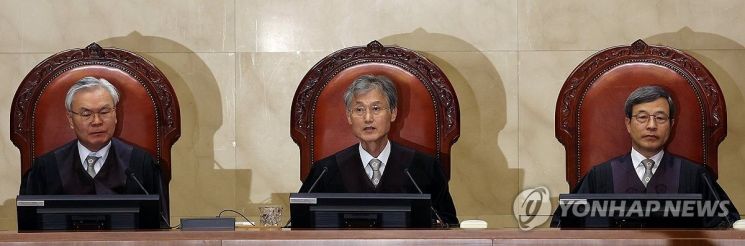 Chief Justice Cho Hee-dae and other Supreme Court justices are seated during the full bench ruling held on the afternoon of the 23rd at the Supreme Court courtroom in Seocho-gu, Seoul.
A, who married B in December 2001 and had one child, filed for divorce against B in November 2003, two years after marriage, and the mediation was concluded in 2004, with the divorce registration completed in October of the same year.
Fifteen years after the divorce, in 2019, A filed a lawsuit against B for nullity of marriage. In the complaint, A primarily claimed confirmation of nullity of marriage, arguing that "the marriage registration was made without substantial agreement on marriage under extreme confusion, anxiety, and coercion that prevented the determination of marital intent," and alternatively claimed annulment of marriage, arguing that "the marriage registration was made under coercion by the defendant while in a mental state incapable of determining marital intent."
The first trial court dismissed both A's principal claim (nullity of marriage) and alternative claim (annulment of marriage), following the previous Supreme Court precedent.
The Supreme Court in 1984 ruled in a lawsuit for confirmation of nullity of marriage filed by divorced wife C against her ex-husband that "a claim for nullity to restore honor of a marital relationship already dissolved has no interest in confirmation."
At that time, C cited the disgrace of being recorded as divorced in her family register as grounds for nullity of marriage, but it was not accepted.
The court at that time stated, "The appellate court recognized that the claimant and respondent were legally registered as spouses by marriage registration to the Seongbuk-gu Office in Seoul on February 9, 1968, and that consensual divorce registration was made on October 7, 1969. Based on these facts, the marital relationship between the claimant and respondent was dissolved by the divorce registration, and thus the claim for nullity of the marital relationship is a confirmation of past legal relationships. There is no evidence that it affects the claimant's current legal relationship. Therefore, the mere fact that the female claimant is recorded as having married and divorced in the family register, which is disgraceful, does not constitute interest in confirmation," it ruled.
It added, "The appellate court's decision was reasonable and acceptable, and there was no legal error such as misinterpretation of the law regarding interest in confirmation, factual error violating rules of evidence, lack of grounds, or contradiction in reasoning," and dismissed the appeal.
Based on this Supreme Court precedent, the first trial court ruled, "If the marital relationship has already been dissolved by divorce registration, confirmation of nullity of the marital relationship is a confirmation of past legal relationships and thus there is no interest in confirmation. Since mediation was concluded and divorce registration was made between the plaintiff and defendant in this case, and there is no evidence that it affects the plaintiff's current legal relationship, the principal claim for confirmation of nullity of marriage is inadmissible."
Furthermore, the court ruled, "Since the effects of divorce and annulment of marriage both extinguish the effect of marriage prospectively, if the parties have already dissolved the marital relationship by divorce, there is no interest in filing a lawsuit for annulment of marriage. Therefore, the alternative claim for annulment of marriage is also inadmissible."
A appealed, but the appellate court's judgment was the same.
In the second trial, A additionally argued that there is interest in confirmation of nullity of marriage because being recorded as a divorced woman in the family register (currently the family relation register) prevents her from receiving various support programs for single-mother families from the state or local governments, thus affecting her current legal relationship.
However, the court rejected this, stating, "Support programs for single-parent families under the Single-Parent Family Support Act are beneficial measures conducted by the state or local governments as part of child and family welfare projects to achieve policy objectives such as supporting the rights and independence of single-parent families. Considering factors such as income level and property of single-parent families, timing of mother's pregnancy and childbirth, child's age, and the state's financial situation, the scope and content of support may vary annually. Even if the plaintiff qualifies as a single mother in a single-parent family, whether support requirements and needs are met may affect the extent of economic support. Such circumstances alone do not directly change the plaintiff's specific rights and obligations, and there is insufficient evidence to recognize that the plaintiff or her child’s legal status changes simply because she is considered a single mother family."
A Supreme Court official stated, "This ruling is significant in that it affirms interest in confirmation as a means to comprehensively resolve legal disputes after divorce by confirming nullity of marriage, providing a method to correct family relation registers incorrectly recording null marriages that greatly affect the parties' status, thereby expanding remedies for parties and substantially resolving disputes related to citizens' legal lives."
He added, "As a result of this ruling, when seeking confirmation of nullity of a marital relationship already dissolved, interest in confirmation can generally be recognized without individually examining whether it directly and significantly affects current legal relationships, enabling substantial legal remedies for parties disadvantaged by family relation registers incorrectly recording null marriages, marking the significance of this precedent change."
© The Asia Business Daily(www.asiae.co.kr). All rights reserved.


















