Minister Cho Kyu-hong: "Please End Exhaustive Conflicts and Confrontations"
On the 23rd, the Ministry of Health and Welfare once again urged the medical community to engage in 'dialogue.'
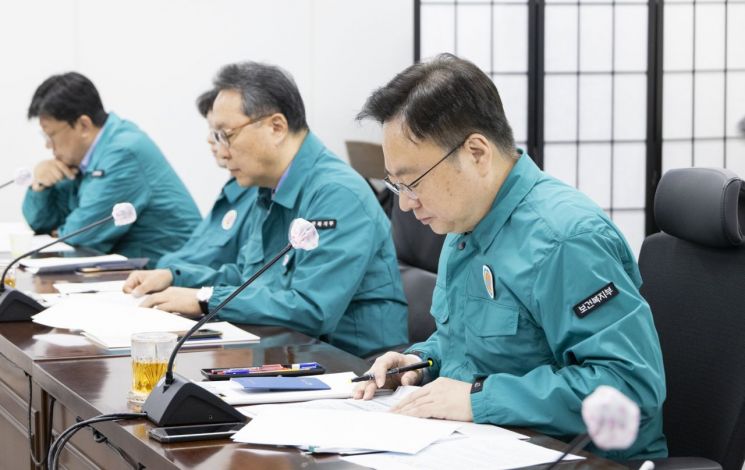
At the 47th meeting of the Central Accident Response Headquarters for the doctors' collective action, Minister of Health and Welfare Cho Kyu-hong stated, "The door to dialogue remains open, and the government is ready to engage in talks at any time without restrictions on the format or agenda," adding, "We hope the medical community will put aside futile conflicts and confrontations and participate in discussions on medical reform."
The day before, the Korean Medical Association (KMA), after holding meetings with medical school faculty groups and the Korean Academy of Medical Sciences, announced that "the medical community is ready to engage in dialogue with the government." While the government welcomed this, it emphasized 'unconditional dialogue' from the medical community. The demands previously set as conditions for dialogue, such as 'reconsidering the medical school expansion from the beginning' and 'a one-year postponement,' were declared unacceptable.
On the same day, following the convening of the Special Committee on Medical Reform's subcommittee on essential medical care and fair compensation, the government plans to hold the first meeting of the Medical Workforce Subcommittee tomorrow (the 24th).
Minister Cho said, "Through the Medical Reform Special Committee, we will strive to correct the long-distorted fee system and expand essential medical personnel to normalize the medical supply system."
The government also reviewed the status of the emergency medical system operation that day. According to the Ministry of Health and Welfare, as of the 22nd, the number of inpatients at all general hospitals, including tertiary general hospitals, increased by 6.5% compared to the previous week, reaching 93,811, which is 97.7% of the normal level. The number of patients admitted to intensive care units was 7,049 across all general hospitals, about 96% of the usual level, and 390 out of 408 emergency rooms operated without bed reductions. Among patients visiting emergency medical institutions, severe and emergency cases decreased by 0.5%, moderate cases by 5.1%, and mild cases by 5.9% compared to the previous week. Compared to the first week of February, which is considered a normal period, these figures represent decreases of 9.2%, 1.5%, and 18.3%, respectively.
The government plans to focus the capabilities of tertiary general hospitals on severe diseases such as cancer patients, while further strengthening support and improving systems so that patients with moderate or less severe conditions can receive care safely at general hospitals.
Minister Cho stated, "The government will closely monitor medical sites and continuously strengthen the emergency medical system to ensure that treatment for severe and emergency patients is not disrupted."
© The Asia Business Daily(www.asiae.co.kr). All rights reserved.

















