27th Corporate Briefing, 70 Companies Including Kakao Participating
Mayor Oh to Explain Development Methods and Support Details
Seoul Mayor Oh Se-hoon is taking the lead in attracting high-tech companies to promote economic development in the northeastern region of Seoul (including Dobong, Nowon, and Seongbuk districts).
The Seoul Metropolitan Government announced on the 23rd that it will hold the ‘S-DBC (Seoul-Digital Bio City) Corporate Briefing Session in the Changdong Vehicle Depot Area’ on the 27th at the large conference room on the 3rd floor of Seoul City Hall. About 70 companies are expected to attend, including major corporations such as Kakao, Hanwha, Shinsegae, Lotte, Dong-A Socio Holdings, Celltrion, Green Cross, and Samsung C&T, as well as mid-sized companies in future industries like digital bio and healthcare.
The city has gathered opinions that the rapid attraction of future high-tech companies is essential for the success of S-DBC and has been preparing an open-market style briefing session for companies over the past year.
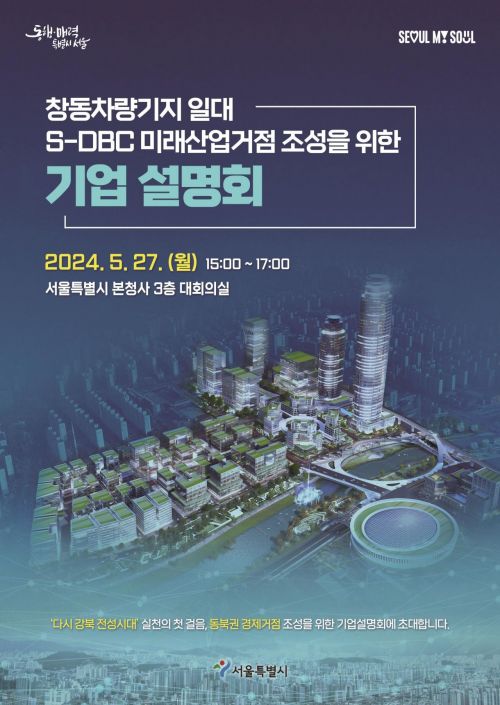
Mayor Oh will personally attend this briefing session to explain innovations in the S-DBC development method and key support measures. Following this, Kim Seung-won, head of Seoul’s Balanced Development Headquarters, will present detailed plans for development and public investment regarding mixed-use and corporate land, followed by a Q&A session. After the briefing, the city plans to establish development plans through consultations with companies wishing to move in.
S-DBC breaks away from the traditional business model where landowners or developers take the development profits, shifting to a structure that reinvests in attracting companies so that development profits can be shared with tenant companies that create jobs. This involves reinvesting development profits generated from rezoning the natural green area around the Changdong Vehicle Depot to a higher classification (such as semi-residential areas) and public contributions arising from the development of the ‘Balanced Development White Site’ back into companies.
S-DBC tenant companies will be supplied with ‘corporate land’ at cost price to alleviate the burden of land acquisition costs. Corporate land can be supplied through negotiated contracts via prior tenant agreements under the designation of a ‘general industrial complex.’ Tax benefits such as reductions in acquisition and registration tax (75%) and property tax (35%) will also be provided. For small and medium-sized enterprises, long-term lease land for 50 years will be prepared, with annual rent supplied at a low cost within 3% of the cost price.
Mixed-use land will be composed of various uses such as commercial, office, hotel, residential, finance, and international schools by applying Seoul’s ‘Balanced Development White Site.’ Through this, the plan is to create a ‘work-live-play economic job hub’ favored by businesspeople and young people. Mixed-use land will allow freedom in use, height, and density, with a floor area ratio increased by 1.2 times (from 800% to 960% in commercial areas), and public contributions will be minimized.
Public contributions from private development will be invested in building the ‘Seoul-type Lab Central’ to support companies and research. Additionally, support for general-purpose high-end equipment will help small and medium-sized enterprises and startups grow into unicorn companies.
The city expects that the northeastern region of Seoul will establish an ‘S-DBC-centered cluster’ extending from Hongneung to Sanggye and Uijeongbu, linked with the development of idle land in the northeastern metropolitan area.
The city stated, “Once the reconstruction and maintenance project of the ‘Sanggye Housing Development District’ around the Changdong Vehicle Depot, which is currently gaining momentum, is completed by 2030, it is expected to provide quality housing and a pleasant living environment for the workforce of tenant companies.”
Synergistic effects are also expected with startup and cultural facilities around Changdong Station, such as the ‘Seoul Arena.’ Seoul Arena is a music-specialized performance hall with about 20,000 seats, which began construction in November last year. Currently, the startup support complex ‘Changdong Aurene’ and the northeastern landmark ‘Seed Cube Changdong’ are in operation, and the AI Robot Science Museum and Seoul Photo Museum are scheduled to open in the second half of this year.
Transportation infrastructure is also a key factor. Currently, using the Metropolitan Area 1st Outer Ring Road, it is possible to reach Changdong and Sanggye from Incheon International Airport within an hour. Once the Metropolitan Area Express Train (GTX) lines B, C, and E open, it will be possible to reach Gangnam within 20 minutes and Songdo and Incheon within 50 minutes.
Two bridges aimed at improving east-west traffic connections and pedestrian accessibility within the Changdong and Sanggye areas are in the final stages of construction. The Changdong Station complex transfer center, scheduled to be completed with the opening of GTX-C, has completed its international design competition and is now undergoing full-scale design. The city plans to designate the Changdong Vehicle Depot area as an ‘urban development zone’ by the end of next year and start the development project in 2027 when the railway facilities are removed.
Mayor Oh said, “Change in the northeastern region is essential for Seoul’s sustainable growth,” adding, “We will make every effort to support the relocation of high-tech companies to Changdong and Sanggye by broadly providing groundbreaking deregulation and incentives for balanced development so that the northeastern area can be reborn as a vibrant economic city driving urban competitiveness rather than just a bedroom community.”
© The Asia Business Daily(www.asiae.co.kr). All rights reserved.
![Clutching a Stolen Dior Bag, Saying "I Hate Being Poor but Real"... The Grotesque Con of a "Human Knockoff" [Slate]](https://cwcontent.asiae.co.kr/asiaresize/183/2026021902243444107_1771435474.jpg)
















