Base Rate Held Steady for 11 Consecutive Times Amid Economic Improvement and High Inflation
Economic Growth Forecast Raised from 2.1% to 2.5% This Year, Inflation Forecast Maintained at 2.6%
Many Expect Bank of Korea to Cut Rates in Q4 Following US Rate Cut in Q3
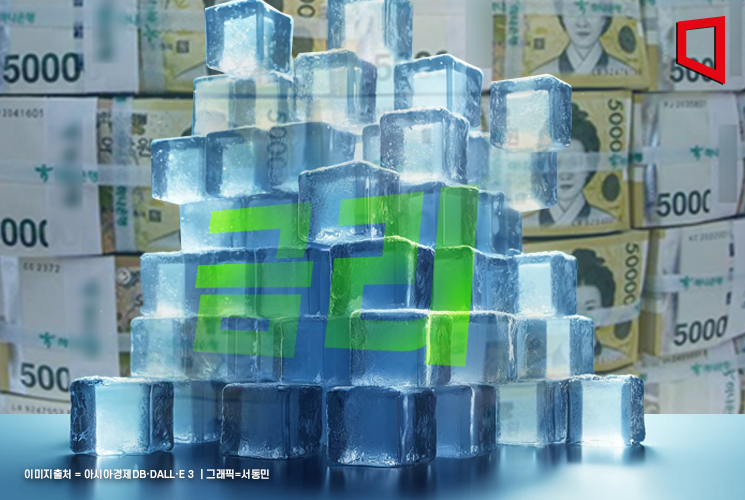
The Bank of Korea has kept its base interest rate steady at 3.50% for the 11th consecutive time. It judged that the time has not yet come to lower the base rate, as the Korean economy is performing better than expected and inflation remains at a high level. On the same day, the Bank of Korea significantly raised its economic growth forecast for South Korea this year from 2.1% to 2.5%.
The Monetary Policy Committee (MPC) of the Bank of Korea held a meeting on the morning of the 23rd at the Bank’s headquarters in Jung-gu, Seoul, and decided to keep the base interest rate at 3.50% per annum. The MPC has maintained the base rate unchanged for 11 consecutive meetings since February last year.
This year’s economic growth forecast for South Korea was sharply raised from the previous 2.1% to 2.5%, while the inflation forecast was maintained at 2.6%. The upward revision was driven by continued export improvements and a recovery in domestic demand.
Decision to Postpone Base Rate Cut Due to Economic Improvement and High Inflation
The MPC’s decision to hold the base rate steady was based on the assessment that inflation remains unstable. Consumer price inflation was 3.1% year-on-year in February and March, and 2.9% in April, still significantly above the Bank of Korea’s inflation target of 2%. High inflation continues due to rising prices of key agricultural products such as apples and pears, as well as international oil prices.
Kim Woong, Deputy Governor of the Bank of Korea, stated at an early-month inflation review meeting, "Future consumer price inflation is expected to show a slowing trend centered on core inflation," but also noted, "There is significant uncertainty related to the trajectory of oil prices amid geopolitical risks and the duration of strong agricultural product prices."
Kang Sung-jin, professor of economics at Korea University, said, "Inflation is the most important factor in deciding the base rate, and inflation is still not stable. If we lower the rate and widen the interest rate gap between Korea and the U.S., the exchange rate could rise, negatively affecting inflation."
The fact that South Korea’s economic growth rate is exceeding expectations this year also weakens the rationale for cutting the base rate. In the first quarter, South Korea’s economic growth rate was 1.3% quarter-on-quarter, significantly surpassing market expectations of around 0.6%. Strong exports, improved construction performance, and private consumption led to this surprising growth. Accordingly, the Bank of Korea raised its economic growth forecast for this year from 2.1% to 2.5% on the same day.
Earlier, the Organisation for Economic Co-operation and Development (OECD) and the Korea Development Institute (KDI) also raised their growth forecasts for South Korea this year from 2.2% to 2.6%. Moody’s raised its forecast from 2.0% to 2.5%, and the Korea Institute of Finance from 2.1% to 2.5%. Major global investment banks such as Goldman Sachs, JP Morgan, HSBC, and Nomura also revised South Korea’s growth forecast to around 2.5%. With the economy expected to perform better than previously predicted, there is little reason for the Bank of Korea to rush to lower rates.
An Jae-kyun, economist at Shinhan Investment Corp., analyzed, "With the first quarter economic growth rate coming in higher than expected, the need for the Bank of Korea to quickly cut the base rate has decreased compared to earlier this year."
Bank of Korea Expected to Cut Rates Only After U.S. Rate Cuts
The delayed expectation for a U.S. base rate cut is also a factor delaying the Bank of Korea’s rate reduction. Until last month, the market expected the U.S. Federal Reserve (Fed) to cut rates in the second quarter of this year. However, persistent high inflation has pushed the expected timing to the third quarter.
In March, U.S. personal consumption expenditures (PCE) rose 2.7% year-on-year, exceeding the market forecast of 2.6%. The slow pace of inflation easing has made the Fed cautious about cutting rates.
The minutes of the recent Federal Open Market Committee (FOMC) meeting, released the day before, were somewhat hawkish. Committee members expressed disappointment with first-quarter inflation indicators and projected, "It will take longer than expected to gain confidence that inflation is moving toward the 2% target." Fed Governor Christopher Waller also said in an interview on the 21st that, "Inflation indicators need to show a slowdown for about 3 to 5 months before a rate cut can be considered by year-end."
Many experts believe it would be burdensome for South Korea to cut its base rate before the U.S. does so amid uncertainty about U.S. monetary policy. The market consensus is that the U.S. will cut rates first in the third quarter, followed by South Korea lowering rates around the fourth quarter.
Joo Won, head of economic research at Hyundai Research Institute, said, "Our monetary policy is heavily influenced by the U.S., so it is unlikely that the Bank of Korea will cut rates ahead of the U.S. If the U.S. cuts rates as early as September, the Bank of Korea is expected to follow in October."
Park Chun-sung, head of macroeconomic research at the Korea Institute of Finance, also stated, "The biggest variable in our monetary policy is the U.S. base rate cut. We expect the U.S. to cut rates first in the third quarter, and South Korea to lower rates after confirming that."
© The Asia Business Daily(www.asiae.co.kr). All rights reserved.
![Clutching a Stolen Dior Bag, Saying "I Hate Being Poor but Real"... The Grotesque Con of a "Human Knockoff" [Slate]](https://cwcontent.asiae.co.kr/asiaresize/183/2026021902243444107_1771435474.jpg)
















