Regarding the direction of reform for the National Pension Service, there was a clash between the argument to switch to a 'fully funded' system and the opinion that government funding should be injected. Shin Seung-ryong, a research fellow in fiscal and social policy at the Korea Development Institute (KDI), argued that the burden should not be passed on to future generations, while Jeong Se-eun, a professor at Chungnam National University, pointed out that the benefit level should be further strengthened.
These arguments were made at a policy forum held on the 23rd at the Korea Press Center in Jung-gu, Seoul, under the theme of 'Desirable Directions for National Pension Reform.' The forum was jointly hosted by KDI and the Korean Economic Association.
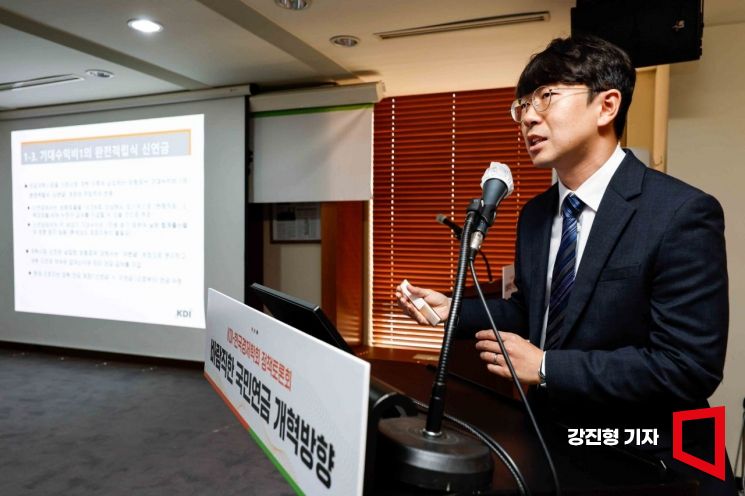 Shin Seung-ryong, Associate Research Fellow of the Fiscal and Social Policy Research Department at KDI, is attending the "National Pension Reform Direction Forum" hosted by KDI and the Korean Economic Association at the Press Center in Jung-gu, Seoul on the 23rd, presenting on the topic "Plan for Structural Reform of the Fully Funded National Pension." Photo by Kang Jin-hyung aymsdream@
Research Fellow Shin, who was the first presenter that day, proposed, “In South Korea, which has the world's lowest fertility rate, the pension fund will be depleted and intergenerational equity will be severely impaired if only parametric reforms of the National Pension are implemented. Therefore, we should operate a new fully funded pension separately from the old pension, which is unaffected by fertility rates.” Shin had previously announced a 'National Pension Structural Reform Plan' on February 21, urging reform toward a fully funded system.
A fully funded system means that the insurance premiums one pays are returned to oneself as a pension. Currently, the National Pension is a 'partially funded' system that partially reflects a pay-as-you-go system, where pensions are paid from the premiums of future generations. When workers pay premiums, some are accumulated in the fund, and some are spent on pension benefits for the elderly. Due to the low birthrate and aging population trend, the burden on each worker inevitably increases. Shin argues that to reduce the burden on future generations, the system must be converted to a fully funded one.
Shin explained that the fully funded system is the method with the least pension burden. He said, “The current National Pension, which is based on intergenerational solidarity through a pay-as-you-go system, is mathematically proven to have a long-term expected rate of return below 1. In the long term, if the fund's investment return rate exceeds the nominal growth rate, it is possible to maximize the fund and investment returns through a fully funded pension, thereby minimizing the national burden.”
When reform begins with a fully funded system, the National Pension will be divided into a new pension and an old pension. All premiums paid from the start of the reform will be accumulated in the new pension and applied under the fully funded system. For the old pension, benefits will be paid according to the benefit formula based on the expected rate of return before the reform.
However, to move toward a fully funded pension, the fiscal management method must be further discussed. Shin analyzed, “The fiscal burden of the old pension will occur at about 3-4% of GDP from the 2040s and will disappear to within 0.1% of GDP by the 2090s. By utilizing the difference between the fund's investment return rate and government bond interest rates before the fund is depleted, more efficient fiscal input is possible.”
Shin emphasized, “Any increase in premium rates that is not fully funded is perceived as an extension of a Ponzi scheme. Even though there is already a fund exceeding 1,000 trillion won, to persuade additional fiscal input, the philosophy of a fully funded pension fund is necessary.” He added, “We must not pass the responsibility for optimistic pension reform onto future generations.”
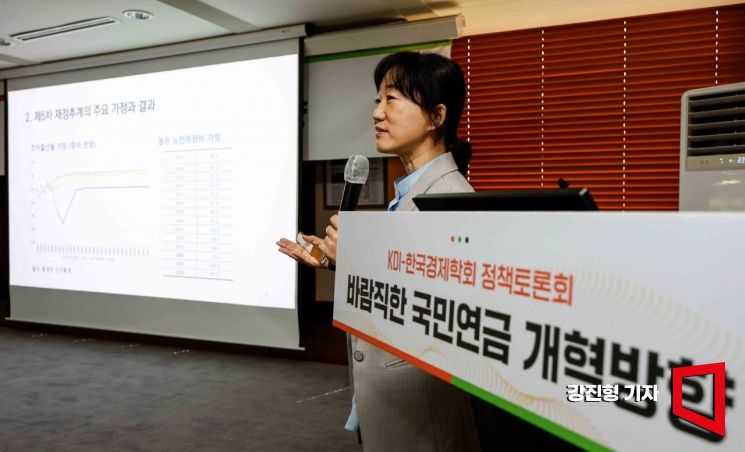 Professor Jeong Se-eun of Chungnam National University is attending the "National Pension Reform Direction Forum" hosted by KDI and the Korean Economic Association at the Press Center in Jung-gu, Seoul on the 23rd, presenting on the topic "The 5th National Pension Financial Projection and Rational Pension Reform Measures." Photo by Kang Jin-hyung aymsdream@
On the other hand, there was a completely opposite voice prioritizing the strengthening of benefit levels. Professor Jeong said, “With the current benefit level of the National Pension, it is difficult to provide even a minimum stable old-age income guarantee when combined with the Basic Pension, so it is necessary to strengthen the benefit level. Strengthening the public pension is more advantageous than the Basic Pension, which is 100% funded by taxes, in terms of fiscal stability and public persuasion.”
Professor Jeong argued, “We need to recognize that the National Pension system is a welfare system for old-age income security, not a savings tool, and reform the system itself that relies solely on premiums for fiscal stability. The high-benefit structure where one receives more than one pays has already been mostly resolved through pension reform.”
She also proposed that discussions on National Pension reform should include whether and how to inject government funds. Professor Jeong said, “It is necessary to include government funding for generous guarantees to early subscribers, premium support for low-wage workers and small self-employed individuals, and premium support for military service and childbirth. Achieving fiscal stability of the National Pension solely through premium adjustments overlooks the important goal of strengthening benefits.” She added, “Fair distribution of the National Pension burden should not be limited to intergenerational equity issues.”
Research Fellow Shin and Professor Jeong also had differing perspectives on the problems of the pension system. Shin focused on the fact that even if the premium rate is raised to 18% and a 40% income replacement rate is applied, the fund will be depleted by 2080, and the premium rate will inevitably rise to 34.9%. In contrast, Professor Jeong expressed concern that if the National Pension benefit level is not strengthened, elderly poverty will not improve in the future, and the old-age dependency ratio (the number of elderly supported by 100 working-age people) will soar to 110.3 by 2080.
© The Asia Business Daily(www.asiae.co.kr). All rights reserved.
![Clutching a Stolen Dior Bag, Saying "I Hate Being Poor but Real"... The Grotesque Con of a "Human Knockoff" [Slate]](https://cwcontent.asiae.co.kr/asiaresize/183/2026021902243444107_1771435474.jpg)

















