"Low Earth Orbit Communication Market Blossoms by 2030"
Aligned with Standardization Efforts, Preliminary Feasibility Study Passed
11 Core Technologies to be Secured Over 6 Years
The path for low Earth orbit (LEO) satellite communication business, applicable to 6th generation (G) communication technology industries such as autonomous driving and UAM (Urban Air Mobility), has opened in South Korea. Until now, LEO satellite communication markets have been dominated by global companies like Starlink, led by Elon Musk.
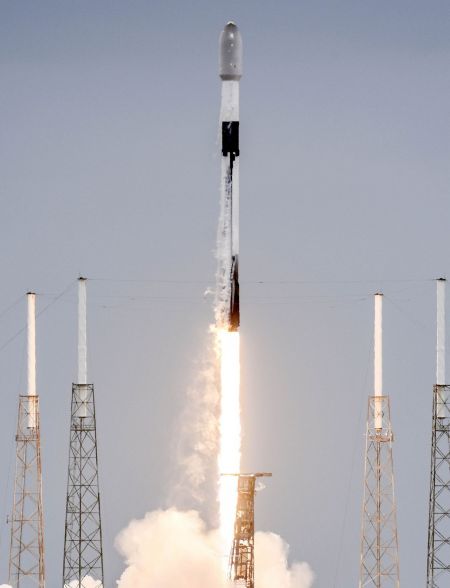
On the 23rd, the Ministry of Science and ICT announced that the "Technology Development Project to Secure Competitiveness in the LEO Satellite Communication Industry" passed the preliminary feasibility study at the National Research and Development Project Evaluation Committee. The total project budget is 319.99 billion KRW (300.35 billion KRW in national funds), and it will be carried out over six years from next year until 2030.
This project involves launching two LEO communication satellites based on 6G standards and establishing a pilot network of LEO satellite communication systems, including ground stations and terminal stations.
LEO satellites (altitude 300?1500 km) are closer to Earth compared to geostationary satellites (altitude 36,000 km), enabling high-speed communication with low latency. Currently, global companies with massive capital and technological capabilities, such as Starlink, provide LEO satellite communication services based on non-standard proprietary specifications, leading the market.
LEO satellite communication is gaining attention as a non-terrestrial network (NTN) that can expand communication service areas beyond the limitations of terrestrial networks to maritime and aerial environments without restrictions. Accordingly, the global mobile communication standardization organization 3GPP is also working on standardizing LEO satellite communication.
The Ministry of Science and ICT expects the LEO satellite communication market to fully blossom based on standards by the 2030s. The ministry stated, "Considering that the development of LEO satellite communication systems and satellite launches typically take more than five years, now is the right time for domestic companies to prepare for entering the 6G standard-based LEO satellite communication market."
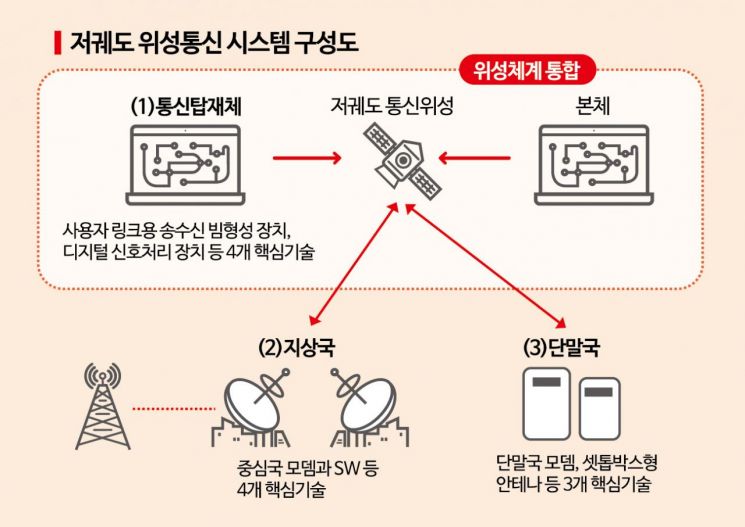
The Ministry of Science and ICT plans to secure 11 core technologies in the fields of communication payloads, ground stations, and terminal stations. Specifically, considering the characteristics of LEO communication satellites rapidly orbiting the Earth while providing communication, technologies such as ▲ satellite tracking and communication link formation ▲ signal error compensation due to satellite movement ▲ handover between satellites ▲ inter-satellite relay and traffic distribution for satellite-to-satellite links will be developed.
Last September, the government announced the "Satellite Communication Activation Strategy" as a blueprint for satellite communication policies in preparation for next-generation networks at the Emergency Economic Ministerial Meeting. This project is a core task to implement that strategy, and passing the preliminary feasibility study marks the first step toward domestic technological independence in LEO satellite communication.
Ryu Jae-myung, Director of the Network Policy Office at the Ministry of Science and ICT, stated, "If South Korea expands its firmly established technological capabilities and development experience in mobile communications, where it is a global leader, to satellite communications, the country can sufficiently secure global competitiveness." He added, "We aim to enhance the competitiveness of the domestic satellite communication industry and inject new vitality into South Korea’s digital and space economy."
© The Asia Business Daily(www.asiae.co.kr). All rights reserved.


















