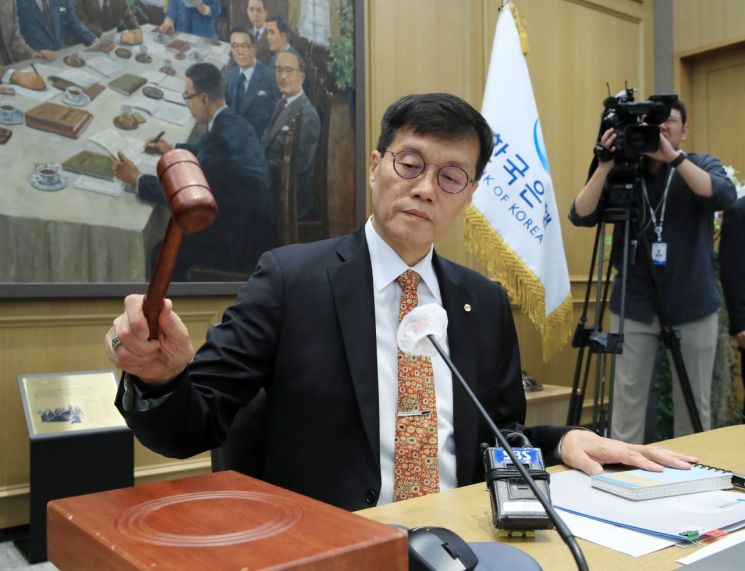
The Bank of Korea has kept the base interest rate steady at 3.50% per annum. This marks the 11th consecutive freeze since February last year. The country's economic growth forecast for this year has been revised upward to 2.5%. As the timing of the U.S. interest rate cuts has been delayed and inflation remains at a high level, coupled with the first quarter economic growth rate significantly exceeding expectations, the urgency to lower interest rates has diminished.
The Monetary Policy Committee (MPC) of the Bank of Korea announced on the 23rd at 9 a.m. at the Bank's headquarters in Jung-gu, Seoul, that it would maintain the base rate at 3.50% per annum. Since raising the rate from 3.25% to 3.50% by 0.25 percentage points in January last year, the Bank has kept the rate unchanged for 1 year and 4 months.
The decision to hold the base rate steady this month was influenced by uncertainties surrounding the U.S. Federal Reserve's (Fed) monetary policy. The U.S. Personal Consumption Expenditures (PCE) price index, a key inflation indicator closely watched by the Fed when making policy decisions, rose by 0.5% in January this year and increased by 0.3% for two consecutive months in February and March, raising concerns about persistent high inflation. Fed officials indicated in the Federal Open Market Committee (FOMC) minutes released on the 22nd (local time) that "it will take longer than expected to be confident that inflation is moving toward the 2% target," suggesting that interest rate cuts will be delayed beyond initial expectations.
Persistently high inflation was also a major factor leading to the freeze. The Bank of Korea maintained its consumer price inflation forecast for this year at 2.6%. Although consumer prices rose by 2.9% year-on-year last month, falling back into the 2% range for the first time in three months, it still exceeds the Bank's inflation target of 2%. Professor Kang Sung-jin of Korea University’s Department of Economics said, "Price stability is the most important factor in interest rate decisions, and inflation is still at a high level."
On the same day, the Bank revised its economic growth forecast for this year upward by 0.4 percentage points from 2.1% to 2.5%, reflecting the first quarter growth rate significantly exceeding expectations. South Korea's first quarter economic growth rate recorded 1.3% quarter-on-quarter, far surpassing market forecasts of 0.5% to 0.6%. Governor Lee Chang-yong also hinted at the growth rate adjustment during a press conference earlier this month, stating, "Last year's growth rate was around 1.4%, but that growth was achieved in the first quarter," and added, "The issue is how much to revise upward; technically, we cannot avoid revising the GDP growth rate upward."
With the reduced need for interest rate cuts to stimulate the economy, it is expected that rate cuts will only be possible after inflation is controlled and the U.S. lowers its base rate. Professor Kang said, "If we lower rates preemptively ahead of the U.S., the interest rate gap will widen further, which could push up exchange rates and inflation again," adding, "Interest rates can only be cut once inflation stabilizes in the low to mid 2% range."
© The Asia Business Daily(www.asiae.co.kr). All rights reserved.

















