Carbon Neutrality Goal for Battery Materials by 2035
POSCO Future M has received international standard carbon footprint verification for its cathode and anode materials products.
On the 22nd, POSCO Future M announced on the 23rd that it received the international standard 'ISO 14067' carbon footprint verification certificate from the Korea Quality Foundation for cathode materials PN6, PN8, and natural graphite anode materials at the POSCO Center in Gangnam-gu, Seoul. PN6 and PN8 are cathode material products manufactured by POSCO Future M with nickel content of 60% and over 80%, respectively.
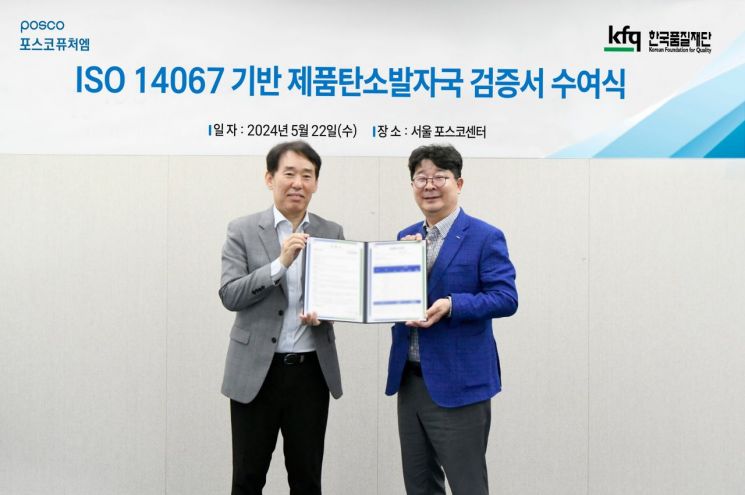 At the 'ISO 14067' verification award ceremony held on the 22nd at the POSCO Center in Gangnam-gu, Seoul, Um Ki-cheon, Head of the Energy Materials Division at POSCO Future M (right in the photo), and Song Ji-young, CEO of the verification agency Korea Quality Foundation, are taking a commemorative photo. Photo by POSCO Future M
The carbon footprint refers to the amount of carbon emissions generated throughout the entire product life cycle, including raw material mining, transportation, and production. ISO 14067 is an international standard for the objective measurement of carbon footprints. The Korea Quality Foundation evaluates compliance with ISO 14067 during the carbon emission measurement process of companies or organizations and issues carbon footprint verification certificates.
According to the European Union (EU) battery regulation implemented in February, from 2025, measurement and reporting of battery product carbon footprints will be mandatory. Failure to comply will effectively make it difficult to conduct business activities in the global market. POSCO Future M plans to expand its presence in the global market by enhancing trust through transparent disclosure of its carbon emission management system to stakeholders via carbon footprint verification of cathode and anode materials.
Additionally, the carbon footprint verification data for cathode and anode materials will be utilized for analyzing production processes to reduce carbon emissions, introducing energy-saving technologies, and managing carbon footprints for next-generation products such as high-nickel single-crystal NCMA (Nickel-Cobalt-Manganese-Aluminum) and NCA (Nickel-Cobalt-Aluminum) cathode materials in the future.
POSCO Future M is actively promoting the transition to low-carbon fuels and improving energy efficiency through process improvements, aiming to achieve carbon neutrality in its battery materials business by 2035.
© The Asia Business Daily(www.asiae.co.kr). All rights reserved.

















