Ali-Temu Combined Payment Amount Down 26% Compared to Previous Month
BC Card Sales Also Drop 40%
Attributed to Repeated Detection of Harmful Substances
Industry analysis revealed that sales and user numbers of so-called C-commerce (Chinese e-commerce) companies such as AliExpress and Temu declined in April. This is interpreted as being influenced by the base effect of the large-scale discount event held the previous month, as well as news that harmful substances exceeding the standard levels were detected in accessories and baby products sold on C-commerce platforms.
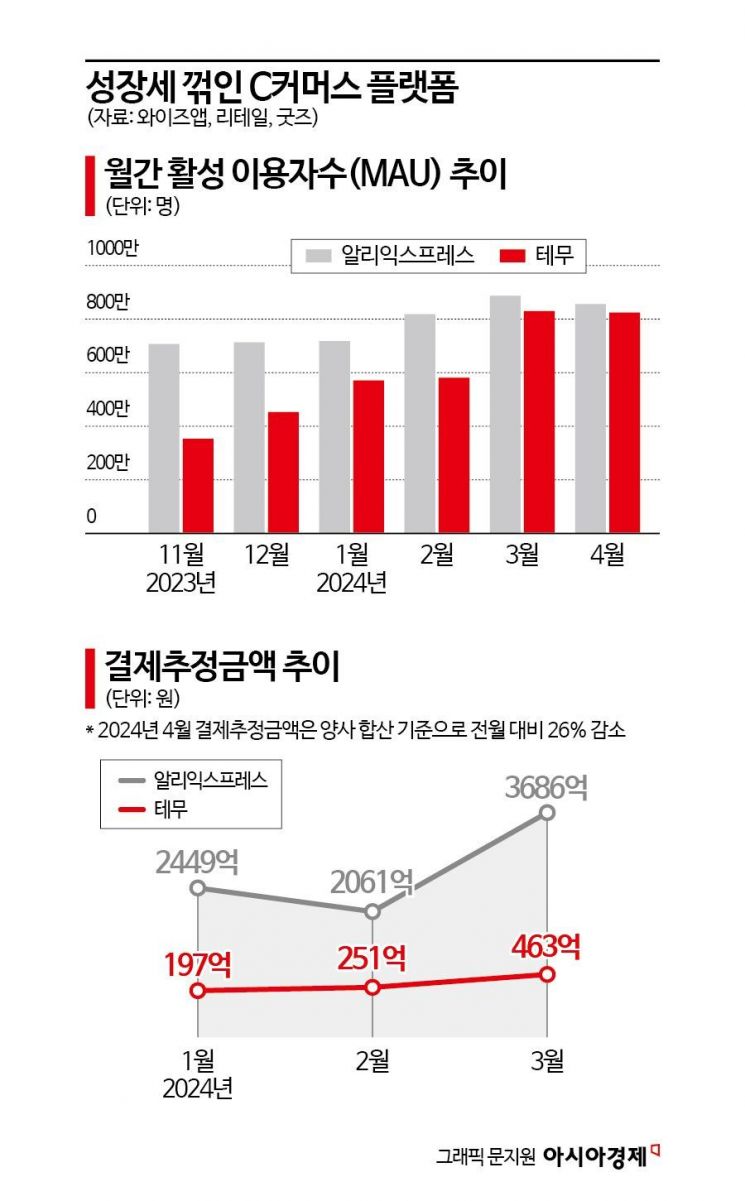
According to WiseApp, Retail, and Goods, an application (app) and retail analysis service, the combined estimated payment amount for Ali and Temu last month decreased by 26% compared to the previous month. Considering that WiseApp estimated the monthly payment amounts for Ali and Temu in March to be 368.6 billion KRW and 46.3 billion KRW respectively, the estimated payment amount for last month is approximately 307 billion KRW combined for the two platforms.
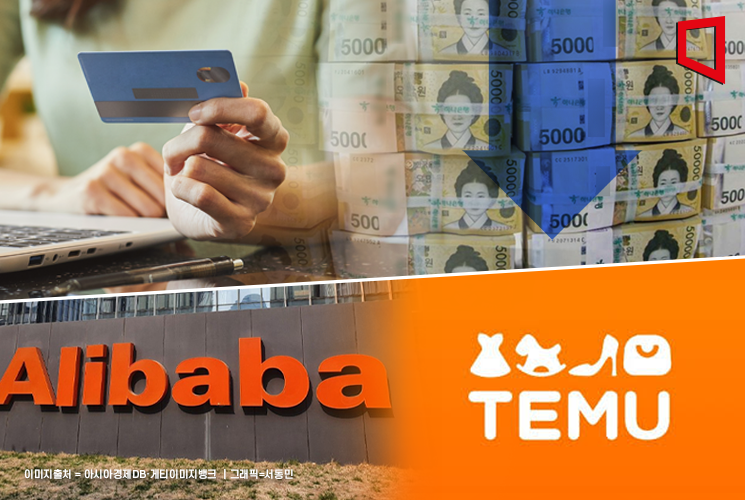
The decrease in payment amounts on C-commerce platforms is also confirmed by data from credit card companies. BC Card's analysis of C-commerce payment data for last month showed a 40.2% decrease in sales compared to March, the previous month. When setting October of last year as 100, BC Card's sales index for C-commerce surged to 238.8 in March this year but dropped to 142.9 last month. In particular, payment amounts for low-priced products under 5,000 KRW decreased by 55.2% compared to the previous month.
The number of users of C-commerce apps, which had been increasing monthly, also slightly declined. According to WiseApp, Retail, and Goods, the monthly active users (MAU) of Ali and Temu in April were estimated at approximately 8.589 million and 8.239 million respectively. Considering that the MAU for Ali and Temu in March were about 8.87 million and 8.3 million respectively, this is interpreted as a halt in user growth and a shift to a decline.
This decrease in user numbers is believed to be influenced by reports that some products sold on C-commerce platforms contained harmful substances exceeding the standard levels. The Korea Customs Service analyzed the components of 252 ultra-low-priced children's products sold on Ali and Temu and found that 38 products, accounting for 15%, contained harmful substances exceeding domestic safety standards. The harmful substances detected in these products included cadmium, lead, and phthalate-based plasticizers.
In the investigation results announced by the Seoul Metropolitan Government on the 16th, one type of children's headband was found to contain phthalate-based plasticizers DEHP and DBP at levels up to 270 times the standard. In children's watches, DEHP was detected at five times the standard level. Phthalate-based plasticizers are endocrine-disrupting substances that affect reproductive functions and can cause irritation to the eyes and skin upon contact.
The base effect of the large-scale discount event held by Ali in March also appears to have manifested. Ali conducted the '100 Billion Festa,' a 14th anniversary discount event, starting in March. This event symbolized providing benefits worth 100 billion KRW to domestic customers. In the early stages of the event in March, Ali held time-limited deals selling fresh foods such as eggs, bananas, mangoes, strawberries, and Korean beef at a special price of 1,000 KRW.
Due to the dramatic discounts promoted by Ali, word of mouth spread mainly online, causing a surge in the number of customers using Ali. According to WiseApp data, Ali's MAU in March, when the event started, was 8.3 million, a 42.9% increase compared to the previous month. During the same period, the estimated payment amount also surged by 78.9% to 368.6 billion KRW from 206.1 billion KRW the previous month. In April, as the scale of the discount event decreased compared to the previous month, the number of customers slightly declined.
Meanwhile, on the 13th, Ali and Temu signed a voluntary agreement with the Korea Fair Trade Commission to work on blocking harmful products. Under this agreement, the Fair Trade Commission and the two companies will monitor whether harmful products are being distributed and sold based on the information collected. If harmful products are confirmed to be distributed or sold through monitoring results, the government will provide the relevant information to Ali and Temu to induce sales blocking. Ali and Temu will also autonomously block sales if harmful products are found during their own monitoring.
The Korea Consumer Agency has also started testing the safety of children's products, cosmetics, and automotive products sold on Ali and Temu in accordance with the agreement. For products confirmed to be harmful through testing, the Consumer Agency plans to establish a 'hotline' with Ali and Temu to request blocking and deletion.
© The Asia Business Daily(www.asiae.co.kr). All rights reserved.
![Clutching a Stolen Dior Bag, Saying "I Hate Being Poor but Real"... The Grotesque Con of a "Human Knockoff" [Slate]](https://cwcontent.asiae.co.kr/asiaresize/183/2026021902243444107_1771435474.jpg)

















