Ministry of Land Announces '1st Phase New Town Pilot District Selection Plan'
Favorable for Integrated Reconstruction Promotion and Higher Resident Consent Rates
Park Sang-woo "Sequential Maintenance... Efforts to Stabilize Jeonse Market"
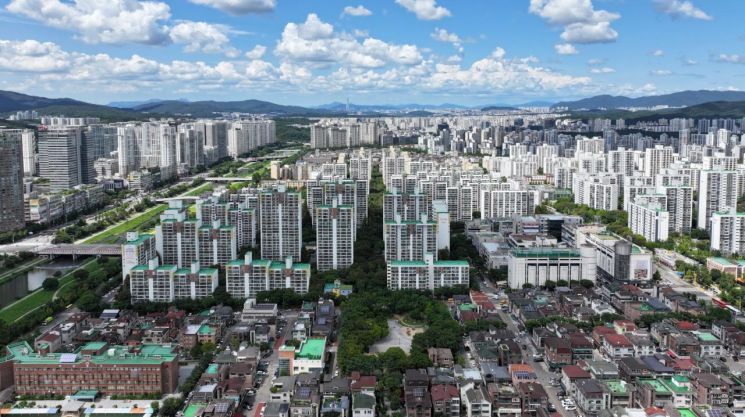
The government will designate a total of 26,000 households + α in the first-generation new towns (Bundang, Ilsan, Pyeongchon, Sanbon, Jungdong) this year as pilot zones for the redevelopment of aging planned cities. If multiple complexes come together to promote integrated reconstruction and achieve a high resident consent rate, the likelihood of being selected as a pilot zone increases. The government plans to promote a certain volume of pilot projects annually, considering market conditions, and establish relocation measures to prevent instability in the jeonse (long-term lease) market.
Targeting 10-15% of All Redevelopment Housing
On the morning of the 22nd, Park Sang-woo, Minister of Land, Infrastructure and Transport, announced the 'First-Generation New Town Pilot Zone Selection Plan' at the Government Seoul Office, stating, "This year, it is expected that 10-15% of all housing subject to redevelopment will be designated as pilot zones."
In terms of the number of households, this amounts to around a maximum of 39,000 households. By new town, approximately 8,000 households in Bundang, 6,000 in Ilsan, and 4,000 each in Pyeongchon, Jungdong, and Sanbon will be selected, with the possibility of designating an additional 1-2 zones (within 50% of the standard volume) as needed. This is because the number of households varies by zone, and a single zone may exceed the standard volume, allowing for flexibility. In Bundang, a total of about 12,000 households are expected to be designated.
The designation authority lies with each local government. It is principle to set the number of households within the standard volume presented, considering the housing stock and supply-demand outlook of each new town. Local governments select pilot zones based on a single criterion regardless of the type of project or housing, ranking by highest scores. Infrastructure redevelopment types without housing redevelopment and relocation support types are designated as special redevelopment zones separately from pilot zones.
The selection criteria are based on the 'standard evaluation criteria' presented by the Ministry of Land, Infrastructure and Transport, with local governments allowed to adjust detailed scoring. The Ministry explained that since the pilot zone contest will be held before the basic plan is established, the evaluation criteria were prepared quantitatively.
Consent Rate is Crucial
First, residents who wish to apply for the pilot zone contest must obtain consent from at least 50% of all landowners within the zone and at least 50% of landowners in each complex. Resident consent is the most important evaluation item, with a score of up to 60 points. The minimum score is 10 points, and a consent rate of 95% or higher can receive full marks. A Ministry official said, "There is a separate resident consent form stipulated in the enforcement rules. Self-reported consent rates are difficult to recognize legally."
Additionally, the urgency of improving residential environments such as parking spaces per household within the integrated zone (10 points), the necessity of revitalizing urban functions (10 points, qualitative evaluation possible), and the ripple effects of redevelopment promotion (20 points) are examined. The ripple effects are evaluated in detail by the number of housing complexes participating in integrated redevelopment (5 points for one complex, 10 points for four or more complexes) and the number of households participating in integrated redevelopment (2.5 points for fewer than 500 households, 10 points for 3,000 or more households).
Each local government of the first-generation new towns will finalize and announce the contest guidelines, including special redevelopment zone proposals, pilot zone selection criteria, consent form formats, and collection methods by August 25. After receiving proposals in September, evaluations and consultations will be conducted, and pilot zones will be finalized in November. Once designated as a pilot zone, the right to apply for special redevelopment zones is granted, and if selected as a special redevelopment zone, special measures such as relaxation or exemption of safety inspections, changes in land use zones, and increased floor area ratios can be received. These are measures to shorten the reconstruction period as much as possible. The pilot zones designated this year will complete the relevant procedures by 2025, establish implementation and management disposition plans in 2026, and begin construction in 2027. Move-in is targeted for 2030.
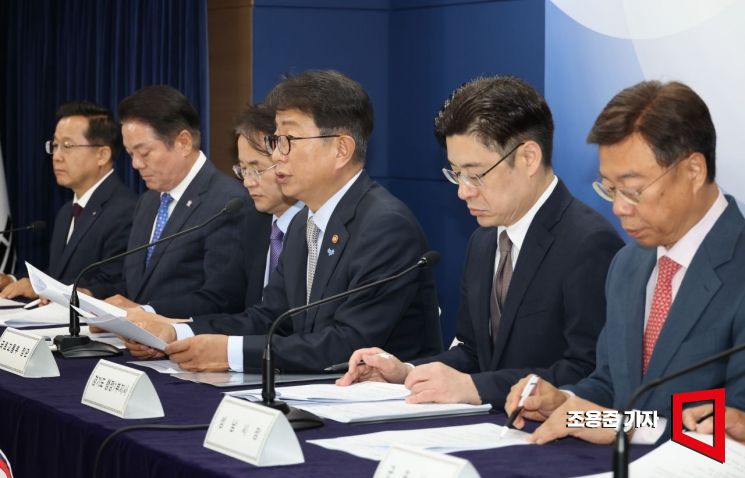 Minister of Land, Infrastructure and Transport Park Sang-woo is answering reporters' questions after announcing the plan to select pilot districts among the first-generation new towns (Bundang, Ilsan, Pyeongchon, Sanbon, Jungdong) at the Government Seoul Office in Jongno-gu, Seoul on the 22nd. The briefing was attended by the First Deputy Governor of Gyeonggi Province, the mayors of Goyang, Seongnam, Anyang, Bucheon, Gunpo, and the president of LH. Photo by Jo Yong-jun jun21@
Efforts to Stabilize the Jeonse Market Due to Relocation
Minister Park said, "To support and manage pilot zones, we plan to introduce a 'collaborative future city redevelopment model' where residents, local governments, and public institutions work together from planning to completion," adding, "We will form a consultative body involving stakeholders and experts to closely support the entire project process, shorten various administrative procedures, and promptly mediate conflicts arising during the project."
In addition, the Ministry of Land, Infrastructure and Transport stated that it will strive to stabilize the jeonse market by managing redevelopment demand so that it does not occur all at once. According to the phased and sequential plan, one of the purposes of the 'Special Act on Redevelopment and Support of Aging Planned Cities' enacted on the 27th of last month, the entire new town will be orderly redeveloped. Development projects around the new towns will be appropriately managed so that relocation demand can be absorbed in the jeonse market, and market trends and housing supply-demand trends will be monitored to expand new supply if necessary.
Minister Park said, "If market instability occurs, we will manage annual redevelopment volumes and permit volumes, disperse relocation timing, and prepare stabilization measures for the jeonse market by region," adding, "Relocation measures will be included in the basic plan for each new town, and resident opinions will be sufficiently reflected in this process to establish relocation measures that meet resident needs."
© The Asia Business Daily(www.asiae.co.kr). All rights reserved.


















