Volpara Acquisition by New Zealand Multinational Completed
Enables Autonomous AI Development... Secures Over 100 Million Data
Intervention Beyond Diagnosis to Entire Treatment Process... Potential for 'Cardiovascular Disease'
Volpara with Over 2,000 US Clients... Also Sells Lunit Products
Medical AI company Lunit has embarked on securing new growth engines through the acquisition of overseas companies. This acquisition is described as a 'three birds with one stone' deal that simultaneously expands the core analytical functions of medical AI technology, secures a product lineup covering the entire diagnostic process, and establishes a distribution network to sell these products.
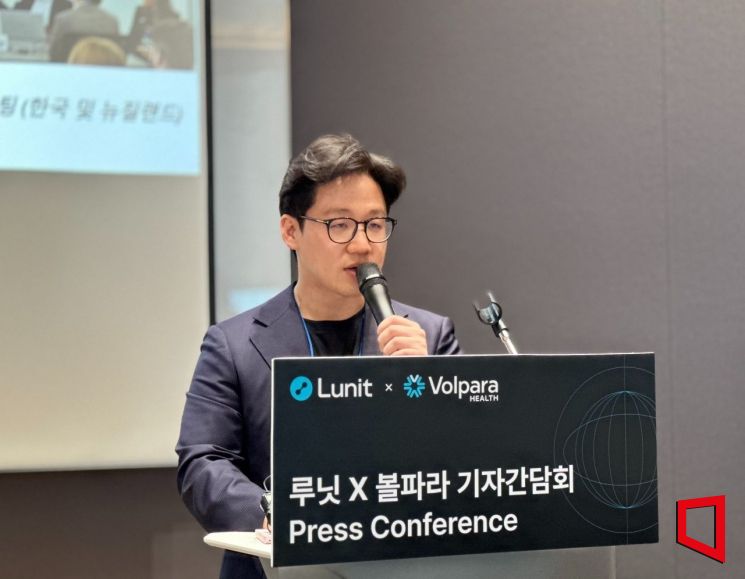 Seo Beom-seok, CEO of Lunit, is revealing the significance of the acquisition and future plans at the press conference announcing the acquisition of Volpara held on the morning of the 22nd.
 [Photo by Lee Chun-hee]
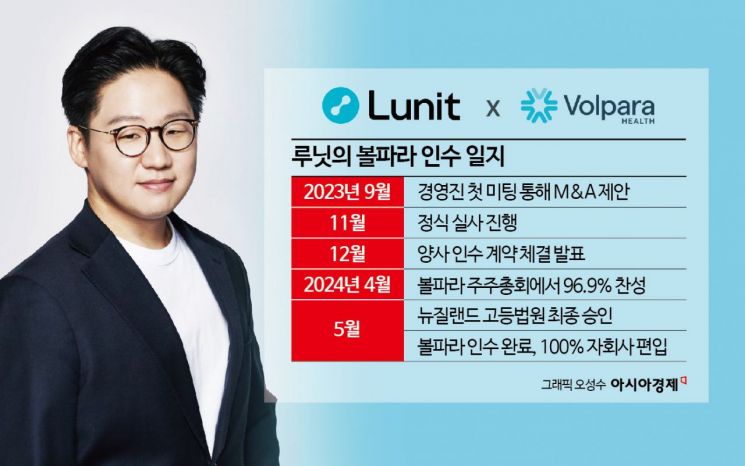
On the morning of the 22nd, Lunit CEO Seobum Seok explained the reason for acquiring Volpara Health Technologies, a New Zealand-based global breast cancer screening solution company, at a press conference: "Two companies with the conviction that AI will play a key role in conquering cancer recognized their synergistic potential and decided to merge." The day before, Lunit paid AUD 292.53 million (approximately KRW 264.7 billion) to acquire 100% of Volpara's shares, making it a subsidiary.
Lunit is a company developing AI-based medical imaging diagnosis and treatment platforms. It is targeting the global market with Lunit Insight, an AI imaging analysis solution for cancer diagnosis, and Lunit Scope, an AI biomarker platform for cancer treatment. Lunit chose Volpara as a partner to accelerate its global expansion, including in the U.S., and has been pursuing the acquisition since last year.
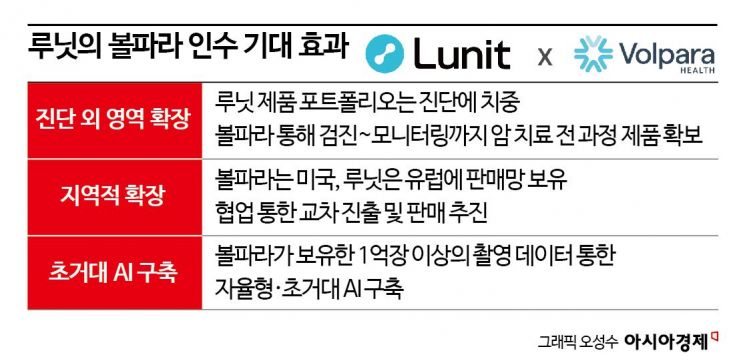
During the conference, CEO Seobum Seok and Volpara CEO Terry Thomas repeatedly emphasized 'synergy.' Among these, the most notable was Lunit's technological capabilities combined with Volpara's vast medical data. CEO Thomas explained, "Volpara can acquire an additional 20 million (mammography) data annually and already holds 117 million images," adding, "This number will increase as our customer database grows." CEO Seok emphasized, "So far, we have used 300,000 images to build our breast screening solution," and added, "We will be able to collect over 70 times more data annually." Previously, data was purchased at high costs from individual medical institutions, but now, with customer consent, data can be easily obtained, enabling rapid and extensive database construction.
Lunit explained that utilizing such data could enable the development of autonomous AI?AI capable of making judgments and diagnoses independently without a doctor's assistance. CEO Seok stated, "Currently, all screening programs are conducted uniformly, but our goal is 99% accuracy, which requires personalized AI," emphasizing, "Through Volpara's large-scale data, developing personalized AI is possible."
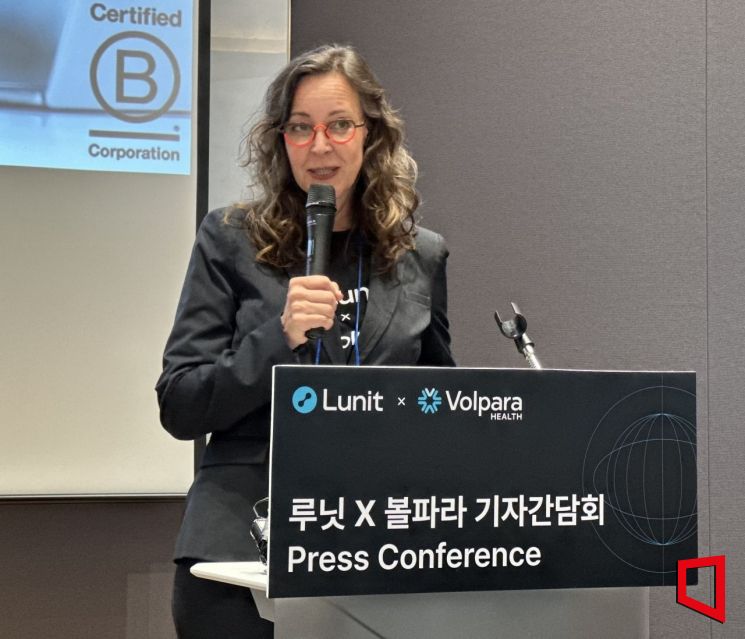 Terry Thomas, CEO of Volpara Health Technologies, is explaining the significance of the acquisition at a press conference held on the morning of the 22nd at Lunit headquarters in Gangnam-gu, Seoul.
 [Photo by Lee Chunhee]
In addition to these fundamental diagnostic functions, Lunit highlighted that through the acquisition of Volpara, it has secured a 'comprehensive solution' related to cancer. CEO Seok said, "There is almost no overlap between our products and Volpara's," and added, "Through collaboration with Volpara, we can provide a comprehensive cancer screening solution covering image collection, analysis, and follow-up before visiting medical institutions." Currently, Lunit's product lineup focuses on diagnostics, but since Volpara possesses such comprehensive products, synergy is expected.
Moreover, although both Lunit and Volpara currently focus on the cancer domain, the acquisition of Volpara has also created an opportunity to expand into chronic diseases such as cardiovascular disease. Volpara is developing a solution to predict cardiovascular disease risk through breast arterial calcification (BAC) measurement in collaboration with Microsoft. CEO Thomas emphasized, "It is a solution that can assess cardiovascular disease with a single MMG scan." The algorithm development is complete, and clinical trials are underway to verify accuracy.
Furthermore, the acquisition has secured a large-scale distribution network to sell the developed products. Although Lunit generates 82% of its sales overseas, its entry into the U.S. market has been sluggish. After obtaining FDA approval for three Lunit Insight products, Lunit began sales through various partners but has yet to achieve significant sales performance.
In contrast, although Volpara is a New Zealand company, it supplies solutions to over 2,000 medical institutions in the U.S., with 97% of its sales generated there. Lunit plans to leverage this distribution network to sell its products in the U.S. CEO Seok explained, "Volpara has direct sales channels in the U.S.," adding, "Since Volpara's brand is strongly established in the U.S., production of Lunit products has started under the Volpara name." CEO Thomas also added, "We will integrate and launch products from both companies primarily in the U.S. and Australia," noting, "There are already places in the U.S. that purchase and use both Volpara and Lunit products together."
CEO Seok stated, "Through this acquisition, both companies aim to achieve KRW 40 billion in sales each, and next year, combined sales exceeding KRW 100 billion," adding, "We will continue to pursue our mission of conquering cancer through AI." If this forecast materializes, Lunit's financial statements, which have consistently recorded losses, are expected to turn profitable starting next year.
© The Asia Business Daily(www.asiae.co.kr). All rights reserved.
![Clutching a Stolen Dior Bag, Saying "I Hate Being Poor but Real"... The Grotesque Con of a "Human Knockoff" [Slate]](https://cwcontent.asiae.co.kr/asiaresize/183/2026021902243444107_1771435474.jpg)


















