15% Decrease Compared to the Previous Year
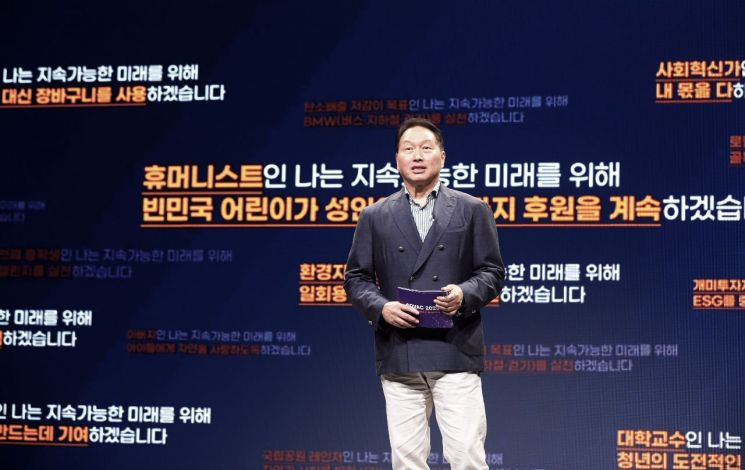 Choi Tae-won, Chairman of SK Group, is delivering the keynote speech at the 'SV Leaders Summit' held last year at Walkerhill Hotel in Gwangjin-gu, Seoul. Photo by SK
SK Group announced on the 22nd that it created approximately KRW 16.8 trillion in social value last year. This represents a 15% decrease compared to the previous year, and the cumulative amount since the first measurement in 2018 has reached about KRW 93 trillion.
Social Value (SV) refers to the value a company contributes to solving and alleviating social issues faced by stakeholders. Pursuing 'Double Bottom Line (DBL)' management that simultaneously realizes Economic Value (EV) and Social Value, SK Group annually measures and discloses its social value creation performance, which was previously evaluated only qualitatively, in monetary terms.
Marking its sixth year, SK’s social value measurement covers three main areas: ▲Economic indirect contribution performance (employment, dividends, taxation) ▲Environmental performance (eco-friendly products and services, environmental impact during production processes) ▲Social performance (products and services improving quality of life, labor, mutual growth, social contribution).
By category, economic indirect contribution performance was KRW 16.6 trillion, environmental performance was -KRW 2.7 trillion, and social performance was KRW 2.9 trillion. Although the total social value created by SK Group last year decreased by about 15% compared to the previous year, the social performance figure among detailed items showed a sharp growth trend.
First, economic indirect contribution performance fell by about 17% compared to the previous year. This was due to reduced dividends and tax payments from affiliates caused by a downturn in core businesses amid the global economic recession. In particular, the decline in operating profits of SK Hynix and SK Innovation due to the semiconductor and petroleum business downturns affected the overall decrease in the group’s economic indirect contribution performance. SK stated, "Economic indirect contribution performance is an area difficult to manage due to many external environmental variables, but we will strive for continuous improvement through strengthening the core business performance."
The environmental performance area remained at -KRW 2.7 trillion, similar to the previous year (-KRW 2.8 trillion). Despite factory expansions due to business growth, SK plans to continuously seek solutions to reduce carbon emissions so that negative outcomes in environmental processes do not increase. Each affiliate is making various efforts to reduce carbon generated during processes, including utilizing zero-carbon power such as hydrogen and renewable energy, and advancing CCS (Carbon Capture and Storage) technology. SK also plans to make visible achievements through products and services such as batteries for electric vehicles in the future.
Meaningful results are also being achieved in the social performance area. Especially in the 'social-related products and services' sector, SK created about KRW 1.5 trillion in social value last year, nearly nine times the KRW 170 billion recorded in 2018, marking an all-time high. This figure also represents a 47% increase compared to the previous year. Notably, SK Telecom’s voice phishing prevention service generated about KRW 357.5 billion in social value last year by blocking calls from and to criminal numbers. Additionally, SK Biopharm contributed about KRW 305.1 billion in social value by improving the quality of life for patients and caregivers with its self-developed epilepsy treatment drug, XCOPRI.
Looking at the six-year performance trend, social value outcomes excluding dividends and tax payments?which inevitably fluctuate with the global economy and business conditions?have shown steady growth. An SK official said, “Each affiliate will continue to innovate its business model so that the business capabilities and infrastructure they possess can be directly or indirectly applied to solving social problems.”
Meanwhile, SK Group plans to set future social value goals and directions based on the advanced social value measurement system it has developed. This is similar to how companies establish mid- to long-term management strategies for sustainable growth. SK aims to more than double the performance through products and services that contribute to the environment and society by 2030.
Experts view that with the global expansion of ESG disclosure obligations, measuring social value in monetary terms will become an indispensable element of corporate management. Major countries are also accelerating their moves. The European Union mandated ESG disclosures in March last year, and the U.S. Securities and Exchange Commission finalized mandatory climate disclosures in April this year. South Korea also released a draft of ESG disclosure standards last month.
In response, SK Group is working with multinational companies and institutions to develop internationally applicable social value measurement standards. SK participates as a vice-chair company in the international corporate alliance VBA (Value Balancing Alliance), engaging in discussions with global companies and accounting firms to establish international social value measurement standards. Additionally, SK plans to strengthen cooperation with China’s State-owned Assets Supervision and Administration Commission and Japanese companies to further refine the measurement system.
SK transparently discloses its social value measurement formulas and related data externally. The purpose is to clearly communicate the authenticity and meaning of the social value SK Group pursues to key stakeholders and to enable other companies to utilize them. This year, detailed social value measurement results will be published on the group’s website in June.
© The Asia Business Daily(www.asiae.co.kr). All rights reserved.

















