Voices Raised for Retirement Age Extension but Also Opposition
Concerns That It Steals Jobs from Youth
There is a growing call within China to statistically redefine the term 'elderly.' As economic growth slows and the issue of pension depletion arises, the need to bring the elderly back into the labor market is also being raised.
According to the state-run Global Times (GT) on the 20th, Ma Jentang, former Party Secretary of the Development Research Center of the State Council of China, proposed adjusting the statistical criteria for the elderly population to define those aged 60 to 70 as 'young elderly.' He argued that even if they have retired, those who are still in good health should receive support to re-enter employment.
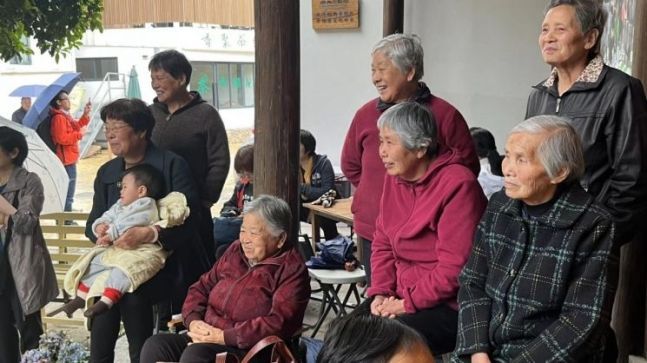 Elderly people are enjoying a performance in a city in Yunnan Province, China. (Photo by Kim Hyunjung)
Professor Guan Xinping of Nankai University emphasized, "A retirement period of over 20 years is very long," adding, "During this time, physical condition, ability, and psychological state vary greatly, and many elderly people are still capable of working."
Professor Guan stated, "Chinese laws and regulations set the retirement age at 60 for men, and those older than that often work part-time," but "in such cases, their rights and benefits are not fully protected." He stressed, "To protect the rights of elderly workers, the legal retirement age should be extended to 65 or 70."
According to the "Report on the Development of an Aging Country" released by China's Ministry of Civil Affairs, equivalent to South Korea's Ministry of the Interior and Safety, at the end of 2022, the population aged 60 and above in China was 280.06 million, accounting for 19.8% of the total population. The population aged 65 and above reached 209.78 million, making up 14.9% of the total population.
A society is classified as an aging society if the proportion of those aged 65 and above exceeds 14%, and as a super-aged society if it exceeds 20%. China officially entered an aging society at the end of the 20th century and reached an aging society status in 2021 when the proportion of those aged 65 and above hit 14.2%. Consequently, some have argued for raising the current retirement age from 60 to 65, but this has not been implemented.
Within China, there is hesitation to extend the retirement age or rehire retirees due to concerns that it might take away employment opportunities from the youth. In response, Professor Guan emphasized, "Equal employment rights should be granted to both the elderly and the youth," and "Competition must be guaranteed in the labor market, where demand and supply can be adjusted through price levers such as wages and labor costs." He added, "While young people tend to gather in industries that are difficult for the elderly, such as advanced technology or delivery services, the elderly can take on jobs that young people are reluctant to do, such as security guards or sanitation workers," explaining, "Where and who gets employed will be determined by market mechanisms."
Meanwhile, according to China's National Bureau of Statistics, the unemployment rate for youths aged 16 to 24, excluding university students, was 14.7% in April, improving by 0.6 percentage points compared to March. The unemployment rate for those aged 25 to 29 was 7.1%, and for those aged 30 to 59, it was 4.0%, both down by 0.1 percentage points from the previous month.
© The Asia Business Daily(www.asiae.co.kr). All rights reserved.

















