Fed, 2023 Annual Financial Well-being Survey
72% of US Adults Say "Financially Okay"...Down from Previous Year
35% of Respondents Cite Inflation as Cause of Financial Hardship
As inflation in the United States becomes entrenched, the proportion of Americans who feel financially satisfied last year dropped to its lowest level in seven years. Despite the strong U.S. economy and steady employment, inflation is putting pressure on households, making President Joe Biden's bid for a second term in November unlikely to proceed smoothly.
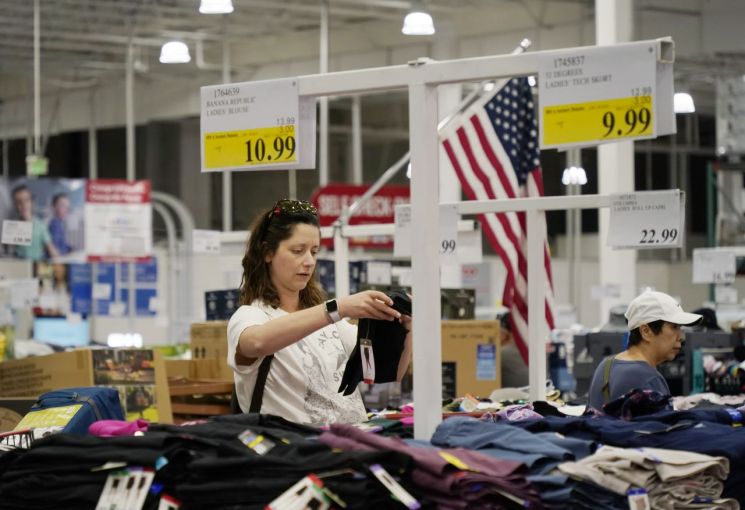
According to the 2023 Annual Financial Well-Being Survey released by the U.S. Federal Reserve (Fed) on the 21st (local time), 72% of all respondents said they were "at least doing okay financially." This is lower than the 78% in 2021, when U.S. households had excess savings from pandemic-related stimulus, and also below the 73% recorded in 2022. It is also the lowest rate in seven years since 2016, when 70% responded that they were financially okay.
Among parents with children under 18, only 64% said they were financially okay. This compares to 75% in 2021 and 69% in 2022.
Inflation is analyzed as the cause of the decline in Americans' financial satisfaction. The proportion of respondents citing rising prices as the main financial problem rose to 35%, up from 33% the previous year. In 2016, only 8% of respondents identified inflation as a problem. Although the U.S. Consumer Price Index (CPI) peaked at 9.1% year-over-year in June 2022 and fell to 3.4% in April this year, Americans still feel that prices are high. According to the April consumer expectations survey by the Federal Reserve Bank of New York, the expected inflation rate over the next year rose by 0.3 percentage points from the previous month to 3.3%, marking the highest level in five months since November last year.
Excess savings accumulated by households during the pandemic have also been depleted. According to the Federal Reserve Bank of San Francisco, pandemic excess savings peaked at $2.1 trillion in August 2021 and were exhausted by March this year. Particularly, low- and middle-income groups have relied on credit cards or Buy Now, Pay Later (BNPL) services after exhausting their pandemic excess savings.
Although the U.S. economy shows robust growth and the unemployment rate has remained below 4% for 27 months?the longest period in half a century?indicating full employment, households' perceived economic conditions remain cold due to inflation. This explains why Americans are critical of President Biden's economic policy, "Bidenomics," as he seeks re-election in November. U.S. voters are giving more favorable evaluations to former President Donald Trump, who is Biden's opponent.
A CNN poll conducted last month among voters found that 55% of respondents believed former President Trump’s term was successful. This is higher than the 41% approval rating Trump had at the end of his term in 2021. In contrast, only 39% of respondents rated President Biden’s term as successful.
Meanwhile, the Biden administration decided to release 1 million barrels of strategic petroleum reserves on the same day to curb gasoline prices before the summer vacation season. This move is seen as an effort to lower gasoline prices ahead of Memorial Day on the 27th and Independence Day on July 4th, when many Americans travel, aiming to win voter support in the November election. Last month, international credit rating agency Moody’s predicted that if gas prices at the pump exceed $4 per gallon (about 3.78 liters), former President Donald Trump would win the presidential election. According to the American Automobile Association (AAA) website, the average gasoline price in the U.S. on that day was $3.598 per gallon.
© The Asia Business Daily(www.asiae.co.kr). All rights reserved.
![Clutching a Stolen Dior Bag, Saying "I Hate Being Poor but Real"... The Grotesque Con of a "Human Knockoff" [Slate]](https://cwcontent.asiae.co.kr/asiaresize/183/2026021902243444107_1771435474.jpg)
















