The Ministry of Education proposed an open dialogue to the medical school student organizations, but the medical student groups rejected the dialogue, stating that the government is not accommodating the students' demands at all.
On the 21st, the Ministry of Education announced that it proposed a dialogue to the Korea Association of Medical Students (KAMS), which represents 40 medical school student organizations.
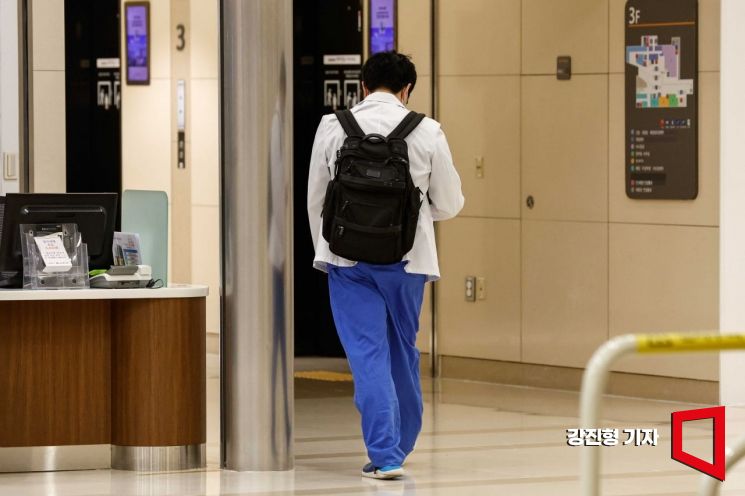 On the 22nd, medical staff were moving at a large hospital in Seoul where some former residents who had left the hospital along with residents in protest against the increase in medical school admissions returned partially. Photo by Jinhyung Kang aymsdream@
This is the first time in about two months since March 11 that the Ministry of Education has proposed a dialogue to KAMS. At that time, the dialogue did not materialize as there was no response from KAMS.
As before, the Ministry of Education had no choice but to propose the dialogue through the media because KAMS did not provide an official contact.
Lee Ju-ho, Deputy Prime Minister and Minister of Education, also met with reporters that afternoon and urged medical students to engage in dialogue, saying, "I believe that meeting medical students directly and discussing government policies in detail can clear up many misunderstandings."
However, KAMS criticized this, stating, "(The Ministry of Education) is speaking as if the issue of increasing medical school admissions, which is only a very small part of the demands to the government, is the entirety of the students' goals," and added, "Under these circumstances, it is difficult to sincerely accept the Ministry's willingness to dialogue."
They further expressed regret over the government’s request for dialogue without even minimally accepting the demands previously presented to the government, effectively indicating their refusal.
In the education and medical sectors, there are concerns that the possibility of collective grade retention is increasing as medical students continue to boycott classes.
As of the 20th, 37 out of 40 medical schools have resumed classes, but it is reported that student attendance remains low.
Deputy Prime Minister Lee Ju-ho said, "The most concerning issues are the possibility of the first-year class doubling in size in the worst case and the national medical licensing exam problems for sixth-year (fourth-year clinical) students," adding, "We are informing students accurately about the potential harm to themselves during one-on-one meetings with professors at their schools and persuading them to return to classes."
He emphasized that the review of changes to the 2025 college entrance examination implementation plan will be completed this week, and once individual universities announce their early admission guidelines by the 31st, the detailed admission plans cannot be reversed. He said, "Admissions must provide sufficient time and information for examinees to prepare, so changes cannot be made after the announcement of the admission guidelines."
© The Asia Business Daily(www.asiae.co.kr). All rights reserved.
![Clutching a Stolen Dior Bag, Saying "I Hate Being Poor but Real"... The Grotesque Con of a "Human Knockoff" [Slate]](https://cwcontent.asiae.co.kr/asiaresize/183/2026021902243444107_1771435474.jpg)
















