Concerns Over Crop Damage from Pests Due to Global Warming
Development of Superior Varieties Resistant to Rice Blast Disease That Ruins Crops
Plans to Plant Rice in Central-Northern Regions to Adapt to Climate Change
The government has initiated the development of rice varieties that can withstand climate change. This is due to concerns that rising temperatures on the Korean Peninsula could disrupt rice production. In particular, they plan to develop and distribute disaster-resistant rice varieties for regions such as Gyeonggi and the central-northern areas. Additionally, recognizing that climate change will have a significant impact on future food sovereignty, research on various grains including soybeans, wheat, and corn has also begun.
According to the implementation plan for this year of the "8th Mid- to Long-term Agricultural Science and Technology R&D Plan," obtained by Asia Economy on the 23rd, the Rural Development Administration will proceed with the development of rice varieties to respond to climate change this year. As temperatures rise, pests and diseases that hinder rice cultivation become more frequent, and the goal is to create varieties that can withstand these challenges. A budget of 6.925 billion KRW will be invested to develop various climate-adaptive agricultural and livestock cultivation technologies, including rice.
Concerns over 'Rice Blast Disease' due to Abnormal Climate... Accelerating Variety Improvement Research
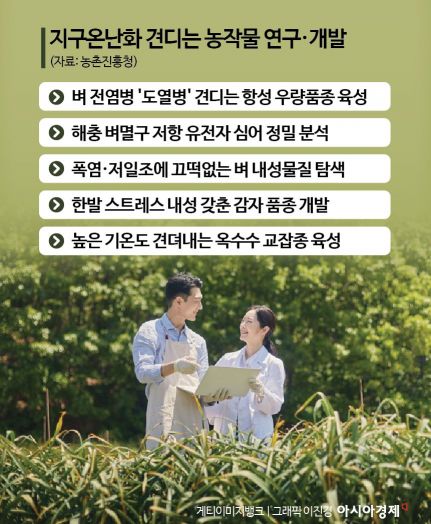
The key to the research is how to prevent 'rice blast disease.' Rice blast is an infectious disease that causes rice to turn brown as if burned by fire. It mainly occurs when there is heavy rain during the heading stage or when summer temperatures are lower than usual. If rice varieties susceptible to rice blast are planted, about 80% of the cultivation area can be devastated. It is considered the biggest headache in global rice farming, and the agricultural and scientific communities predict that rice blast will occur more frequently due to abnormal climate.
The government plans to create 'resistant high-quality lines' that can withstand rice blast using varieties harvested from late May to mid-June. The gene called 'pi21,' found in wild rice, has strong resistance to rice blast, and this gene will be introduced into Korean rice to robustly improve it. Japan already developed its own rice blast-resistant variety using this gene in 2009, and Korea concluded through research by the Food Science Institute in 2021 that it could be effective.
If the research succeeds, it is expected to alleviate the fear of rice blast caused by global warming. Since the 1970s, after developing and distributing unified varieties, Korean rice varieties with similar genes have been considered vulnerable to rice blast. In the 1990s, representative Korean rice varieties such as Jinju rice, Yeongpung rice, Pungsan rice, Cheonma rice, Ilpum rice, and Daesan rice suffered severe damage due to rice blast attacks, resulting in astronomical losses.
Measures will also be taken against the 'rice planthopper.' The rice planthopper is a pest that lives under rice stems and sucks the sap from the rice stalks. It is vulnerable to cold and cannot overwinter in Korea, but due to the warming winters caused by abnormal high temperatures, damage in Korea is increasing. In 2014, 56% of the paddy fields in the southwestern sea area suffered damage from rice planthoppers. The government plans to analyze the introduction of the resistance gene 'Bph3,' anticipating increased rice planthopper activity due to climate change.
Additionally, to reduce rice damage caused by heatwaves or insufficient sunlight, resistant substances will be sought. This work will be conducted through international cooperation with China.
Research on Rice Cultivation in Cold Central-Northern Regions
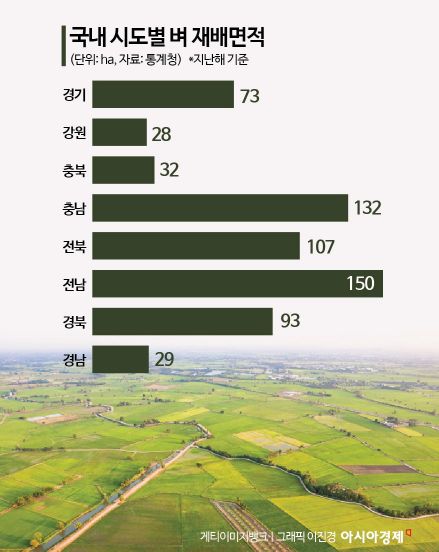
This implementation plan also includes strategies for planting rice in the central-northern regions. Until now, domestic rice production has mainly taken place in Jeonnam, Chungnam, and Jeonbuk, known as the granary regions. The paddy field area in each of these three regions exceeds 100,000 hectares. In contrast, Gangwon Province, where summers are short and winters are long, has only 30,189 hectares of paddy fields. The problem is that global warming may change the cultivation environment. While the southern regions may face difficulties in rice cultivation due to high temperatures, the central-northern regions could become more favorable for rice cultivation. Accordingly, seedling and cultivation technologies suitable for the central-northern regions will be developed, and pilot projects for transplanting rice in response to climate warming will be promoted.
Measures to enhance climate crisis resilience will also be implemented for other crops. Soybeans will have stress-tolerant varieties developed to adapt to climate change, and corn varieties specialized for high temperatures will be cultivated. Additionally, mitigation technologies will be developed to help crops such as buckwheat, potatoes, pears, kiwifruit, persimmons, kiwifruit, and apples better withstand climate change.
Experts emphasize that to effectively respond to the climate crisis, research and development are needed not only in varieties but also in various other areas. Young-A Lim, a research fellow at the Korea Rural Economic Institute, explained, "The speed of the climate crisis is fast, and the situation looks serious as if crossing a point of no return," adding, "Not only variety improvement but also the development of distribution methods, appropriate farming techniques, and related technologies must advance."
© The Asia Business Daily(www.asiae.co.kr). All rights reserved.


















