The Biden administration in the United States is reported to potentially increase tariffs on Chinese-made electric vehicle batteries and components up to 25%, which could add approximately $1,000 (about 1.36 million KRW) to the production cost of Tesla's 'Model 3' in the future.
The Wall Street Journal (WSJ) reported on the 20th (local time) that producing affordable electric vehicles in the U.S. is becoming increasingly difficult, citing this estimate.
First, WSJ pointed out that among the new tariffs announced last week by President Biden, the proposal to sharply raise tariffs on Chinese-made electric vehicles from the current 25% to 100% received significant attention. However, considering that only a very small number of electric vehicles are currently exported from China to the U.S., this realistically would not cause a major change. Instead, the automotive industry explains that the increase in tariffs on Chinese-made electric vehicle batteries and components from the current 7.5% to 25% is more important.
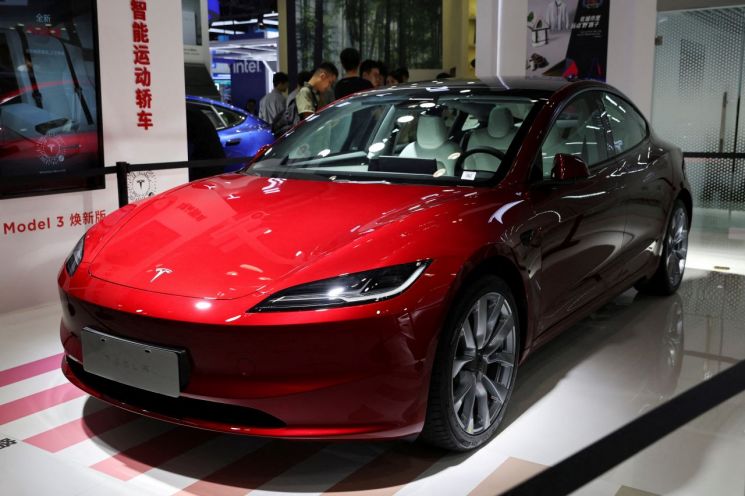
Although detailed information has not yet been clearly disclosed, Tesla is identified as the company that would be most affected by such tariff increases. Tesla's Model 3 uses Chinese-made lithium iron phosphate (LFP) batteries and is produced in Fremont, California. Therefore, if tariffs on Chinese-made batteries rise to 25%, an additional cost of $1,000 per Model 3 is expected. WSJ stated, "While this is not an unbearable level, it inevitably poses greater challenges for Tesla, which is desperately striving to reduce costs."
Ford Motor Company's Mustang Mach-E also uses Chinese-made LFP batteries. Although produced in Mexico, it could be affected by the tariff impact. WSJ emphasized the significant influence of Chinese companies CATL and BYD in the LFP sector, diagnosing that "electric vehicle manufacturers will face difficulties circumventing Chinese companies to diversify their supply chains."
However, companies like China's CATL are reportedly attempting to avoid U.S. sanctions on China by establishing factories in Thailand, Indonesia, and other countries to export products. Ford is reportedly interested in licensing CATL's technology at a new plant in Michigan, but WSJ added that this could be controversial due to connections with China.
© The Asia Business Daily(www.asiae.co.kr). All rights reserved.

















