UNIST and Bundang Seoul National University Hospital Research Team Successfully Develops Red Blood Cell-Superparamagnetic Nanoparticles
Extracorporeal Blood Purification and Sepsis Treatment Possible ... Published in Small Methods on May 17
A technology that can selectively remove only substances that cause inflammatory responses from extracorporeal blood has been developed.
This technology demonstrated excellent therapeutic effects even under experimental conditions similar to those of actual patients, suggesting a new path for sepsis treatment.
 UNIST (from left: Professor Kang Juheon, Professor Joo Jinmyung, Researcher Park Sungjin, Researcher Kim Soohyun).
The research team led by Professors Kang Juhun and Joo Jinmyung from the Department of Biomedical Engineering at UNIST (President Lee Yonghoon), along with Professor Lee Jaehyuk's team from the Department of Emergency Medicine at Bundang Seoul National University Hospital, has developed an extracorporeal blood purification technology based on red blood cell-superparamagnetic nanoparticles. This technology enables rapid and effective removal of sepsis-causing substances by utilizing superparamagnetic nanoparticles. The therapeutic effect and efficacy of the developed blood purification technology were also verified through preclinical experiments using a pig model.
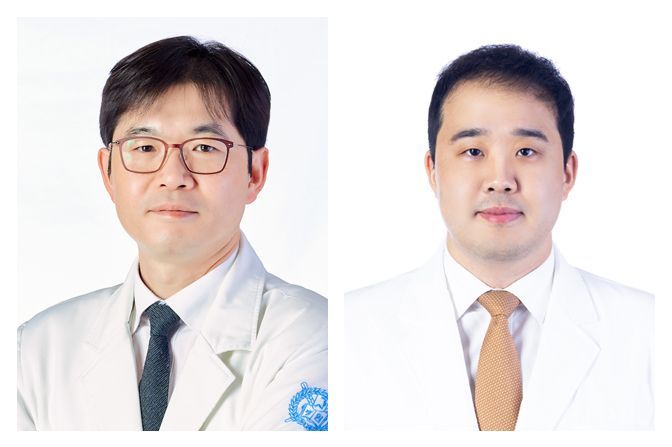 Seoul National University Bundang Hospital (from left, Professor Jaehyuk Lee, Professor Inwon Park).
Professor Kang Juhun stated, "Through this research, we have demonstrated not only a reduction in the levels of sepsis-causing substances in the blood, but also improvements in major cardiovascular and hematological clinical indicators and the recovery of key organ functions," adding, "We achieved groundbreaking therapeutic effects by effectively removing various types of pathogens and inflammatory substances from blood and major organs without prior diagnosis."
Sepsis is a systemic abnormal inflammatory response of the human body to severe infections such as bacteria or viruses. It causes dysfunction in major organs and is associated with a high mortality rate. However, there has been no clear treatment for sepsis until now.
Professor Kang Juhun's team developed a similar technology in a previous study in 2022. They functionalized magnetic nanoparticles such as nickel and iron with red blood cell membranes and reacted them with a patient's extracorporeal circulating blood. The magnetic nanoparticles capture pathogens, and then an external magnetic field (magnet) is used to remove substances causing inflammatory responses from the blood, thereby treating sepsis.
However, the technology developed in the previous study showed technical limitations in actual clinical settings. The magnetic susceptibility, which is the force by which particles are attracted to a magnetic field, was low, making it difficult to purify several liters of extracorporeal blood.
The research team theoretically calculated and predicted the optimal size and size distribution of magnetic nanoparticles required to purify the whole blood of an adult patient within one hour. By developing a new hydrothermal synthesis method, they were able to synthesize superparamagnetic nanoparticles with superior magnetic susceptibility and higher particle uniformity than before.
By coating the newly developed superparamagnetic nanoparticles with red blood cell membrane technology, they created functional superparamagnetic nanoparticles. These can easily remove pathogens from blood even at a fast flow rate of 6L/h, and their therapeutic effect was also verified in a pig sepsis model.
First authors Park Sungjin, Kim Suhyun, and Professor Park Inwon said, "The newly developed superparamagnetic nanoparticle synthesis technology can minimize side effects by ensuring that no magnetic nanoparticles remain in the patient's blood, which will be advantageous in safety assessments."
Professor Kang Juhun emphasized, "We are planning to obtain medical device certification and take additional steps to enable the use of this technology in actual clinical settings. Since it can remove various types of pathogens without prior diagnosis, we plan to develop it as a new concept infectious disease treatment technology that can be used as a health security strategy to respond to new and emerging infectious disease outbreaks."
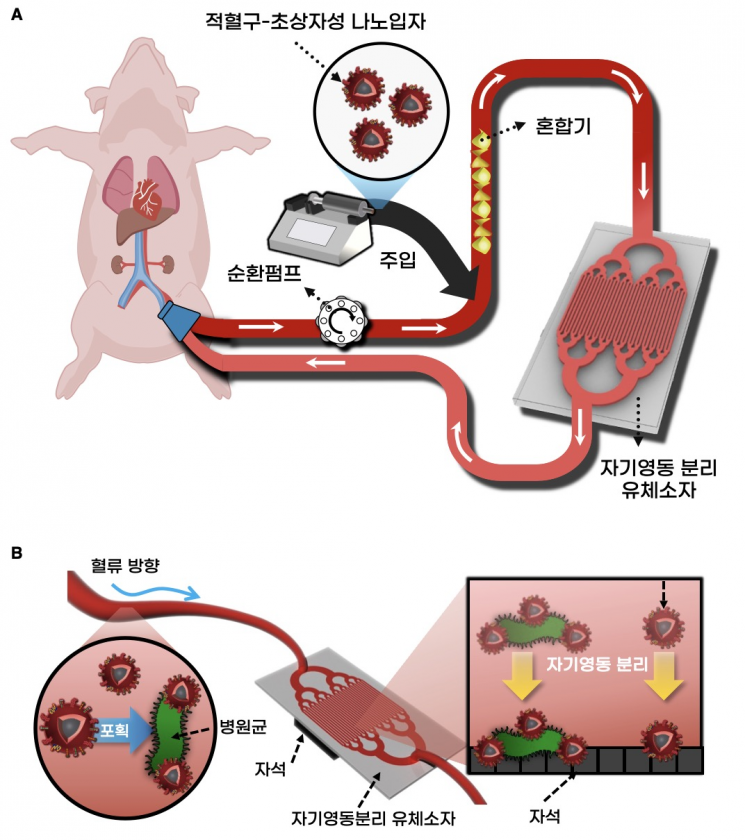 Overview of Research Results on Blood Purification Technology Using Red Blood Cell?Superparamagnetic Nanoparticles
This research was jointly conducted by master's and doctoral integrated program students Park Sungjin and Kim Suhyun from the Department of Biomedical Engineering at UNIST, and Professor Park Inwon from Bundang Seoul National University Hospital as first authors. It was supported by the Samsung Electronics Future Technology Development Center, UNIST, the Basic Research Laboratory Program and Mid-career Researcher Program of the National Research Foundation of Korea under the Ministry of Science and ICT, the Korea Health Industry Development Institute's Dementia Overcoming R&D Project, and the POSCO Cheongam Foundation.
The research results were selected as the frontispiece (cover illustration) of the world-renowned academic journal 'Small Methods' published by Wiley and were officially published on May 17.
© The Asia Business Daily(www.asiae.co.kr). All rights reserved.



















