As the U.S. New York stock market continues to hit record highs, there is a confirmed trend of upward revisions in S&P 500 index forecasts from major Wall Street financial institutions. Mike Wilson, Chief Investment Officer (CIO) of Morgan Stanley, who was considered a representative pessimist, has also turned bullish.
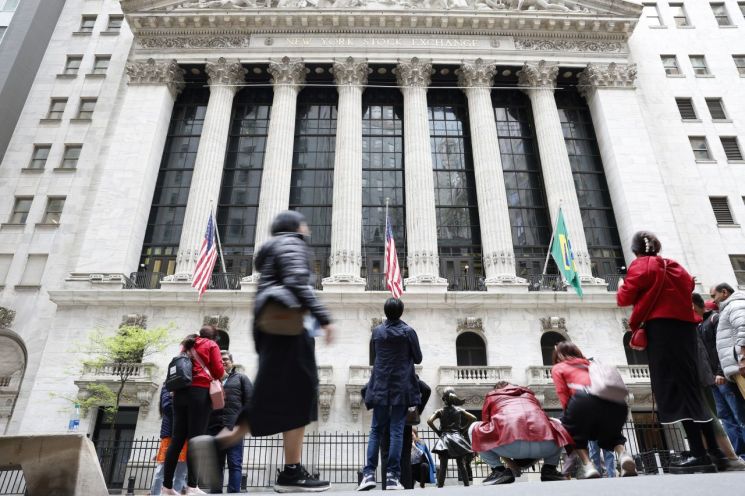
According to MarketWatch and others on the 20th (local time), at least 11 Wall Street investment banks have raised their year-end S&P 500 index forecasts so far this year. BMO Capital Markets and Deutsche Bank raised their year-end S&P 500 targets to 5600 and 5500, respectively, last week. Among these, BMO’s target of 5600 is the highest level proposed by major Wall Street investment banks, implying an increase of more than 5% from the current level. Prior to this, Bank of America (BoA) and Wells Fargo also raised their targets to 5400 and 5535, respectively.
What particularly draws market attention is the fact that even Morgan Stanley, a representative pessimist on Wall Street, has withdrawn its previous bearish stance citing corporate earnings improvements. Wilson, the CIO, presented an S&P 500 forecast of 5400 by the end of Q2 next year. Previously, he had argued in his 12-month outlook that the index would fall to 4500 by the end of this year, but now he has joined the bullish camp. He predicted that "earnings per share will continue to show solid growth."
The main reason behind the series of upward revisions on Wall Street is undoubtedly stronger-than-expected U.S. economic growth and corporate earnings. Vinky Chaddha, a strategist at Deutsche Bank, expects the earnings per share of S&P 500 listed companies to increase by an average of 13% this year.
According to financial information provider FactSet, 93% of S&P 500 companies have reported their Q1 earnings so far, and analysis of their results and earnings estimates suggests Q1 net income is expected to grow by about 5% year-over-year. This would be the largest growth since Q2 2022 (5.8%). It also significantly exceeds the 3.2% forecast released by Wall Street at the end of March ahead of the earnings season.
Additionally, the artificial intelligence (AI) boom is supporting the New York stock market rally. Nvidia, the leading AI stock, has risen more than 90% so far this year. Ahead of this week’s earnings announcement, Stifel, Barclays, and Baird raised Nvidia’s target prices to $1085, $1100, and $1200, respectively.
However, concerns have also been raised. Along with various uncertainties such as the Federal Reserve’s (Fed) interest rate cut prospects and geopolitical risks, there are criticisms that valuations are high. TheStreet pointed out that "there are cracks in the market," adding that "valuation is one of them." According to FactSet, as of the 17th, the forward price-to-earnings ratio stood at 20.7, far exceeding the 5-year average (19.2) and the 10-year average (17.8). Furthermore, the fact that stock prices have been falling more sharply than usual when recent corporate earnings fall short of expectations is also considered a negative factor.
With Morgan Stanley turning bullish today, only JP Morgan Chase remains in the bearish camp. Dubravko Lakos-Bujas, JP Morgan’s Global Equity Strategist, and Marco Kolanovic, Senior Market Strategist, have not revised their year-end S&P 500 target of 4200 since November last year. Lakos-Bujas diagnosed that if economic indicators continue to weaken, corporate earnings in Q3 and Q4 this year may not surge as expected. Kolanovic, in an investor memo today, acknowledged that recent stock price gains have hurt their portfolio but advised against buying stocks due to high valuations, prolonged high interest rates, high inflation, and geopolitical uncertainties.
© The Asia Business Daily(www.asiae.co.kr). All rights reserved.

















