Bank of Korea '2024 Q1 Household Credit (Provisional)'
Reduction in Increase of Mortgage Loans
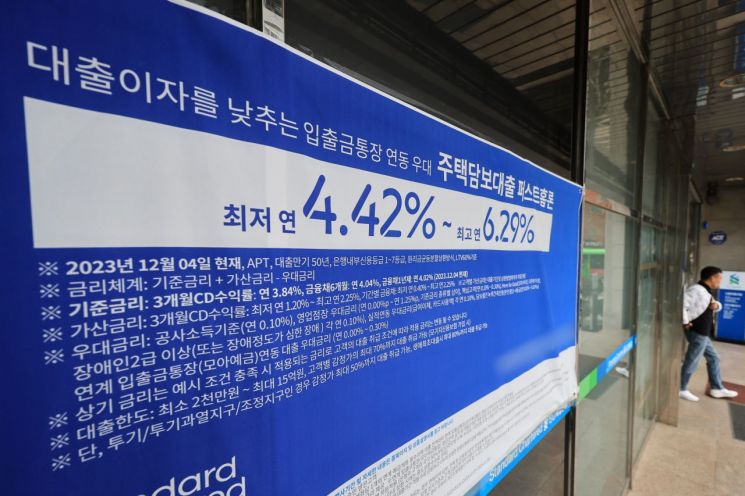
In the first quarter of this year, household credit (debt) in South Korea slightly decreased. This was due to a reduction in the increase of mortgage loans caused by a decline in housing transactions at the end of last year, along with an expanded decrease in other loans such as credit loans.
According to the "2024 Q1 Household Credit (Provisional)" report released by the Bank of Korea on the 21st, the household credit balance at the end of the first quarter of this year was 1,882.8 trillion KRW, down 2.5 trillion KRW from the end of the previous quarter. This marks the first decline in four quarters since Q4 2022.
Household credit refers to the comprehensive household debt, which includes loans received by general households from banks, insurance companies, and lending institutions, plus the amount used on credit cards before payment (sales credit).
The household credit balance reached a record high of 1,885.4 trillion KRW in Q4 last year but decreased in Q1 this year. Household credit had decreased from Q4 2022 through Q1 last year, then increased for three consecutive quarters from Q2 to Q4 last year.
The majority of household credit is made up of household loans, which stood at 1,767 trillion KRW in Q1, slightly down by 200 billion KRW from the end of the previous quarter. Among household loans, the increase in mortgage loans was 12.4 trillion KRW, smaller than the 15.2 trillion KRW increase in the previous quarter. Conversely, other loans including credit loans decreased by 12.6 trillion KRW, a larger decline compared to -9.7 trillion KRW in the previous quarter.
The mortgage loan balance was 1,076.7 trillion KRW, continuing to rise from 1,017.7 trillion KRW in Q1 last year, 1,031.8 trillion KRW in Q2, 1,049.1 trillion KRW in Q3, and 1,064.3 trillion KRW in Q4. However, the rate of increase slowed compared to the previous quarter.
Seo Jeong-seok, head of the Financial Statistics Team at the Bank of Korea’s Economic Statistics Bureau, explained that the reduced increase in mortgage loans was due to "an overall reduction in policy-supported loan supply and the delayed impact of the decline in housing transactions at the end of last year."
By deposit-taking institutions, deposit banks and other financial institutions such as insurance companies increased household loans by 3.2 trillion KRW and 4.6 trillion KRW respectively compared to the end of the previous quarter. In contrast, non-bank deposit-taking institutions such as mutual finance and Saemaeul Geumgo reduced loans by 8 trillion KRW due to strengthened risk management related to real estate project financing (PF).
The sales credit (credit card payments) balance in Q1 was 115.8 trillion KRW, down 2.3 trillion KRW from the previous quarter, turning into a decrease. This was due to a seasonal factor where credit card usage, mainly by credit-specialized institutions, shrank. Sales credit had decreased by 2.8 trillion KRW in Q1 last year and 0.5 trillion KRW in Q2, then increased for two consecutive quarters starting from 2.4 trillion KRW in Q3.
Seo said, "When looking at the household debt ratio relative to Gross Domestic Product (GDP), a downward stabilization trend continues," adding, "The scale of policy-supported loans has been decreasing compared to the previous year since the beginning of this year."
© The Asia Business Daily(www.asiae.co.kr). All rights reserved.

















