"Active Response to High-Capacity Storage Market"
"Strengthening Portfolio Focused on AI Server Products"
Samsung Electronics announced that it will rapidly develop QLC (Quad Level Cell)-based NAND flash products in the second half of the year to actively respond to the high-capacity storage market for artificial intelligence (AI).
 Hyun Jae-woong, Executive Director of Product Planning Office, Samsung Electronics DS (Semiconductor) Division.
 [Photo by Samsung Electronics]
In an interview with Hyun Jae-woong, Executive Director of Product Planning, revealed on the 21st in Samsung Electronics' newsroom about the 9th generation V-NAND planning and development, he said, "Interest in high-capacity storage servers for AI is increasing."
In the AI era, various memory solutions are needed in addition to high-bandwidth memory (HBM) that supports ultra-fast parallel computing. In particular, large-scale data storage space is required for language model data training. High-performance storage is essential for algorithms to operate quickly during the inference stage.
Executive Director Hyun explained, "There are power cost limitations in AI data centers, so high-capacity memory per single storage server is necessary," adding, "The importance of maintaining checkpoints (specific points that save the current state during model training) and the spread of multimodal AI models are also increasing the demand for high-performance storage."
He also said, "Beyond generative AI, more storage space will be needed to process data from machines that learn autonomously," and predicted, "Therefore, from a mid- to long-term perspective, the NAND flash market will show a steady trend."
Executive Director Hyun reiterated that due to power cost limitations in AI data centers, high-capacity memory per single storage server is required. He noted that the importance of checkpoint maintenance and the expansion of multimodal AI models are driving increased demand for high-performance storage.
He stated, "Samsung Electronics is strengthening its portfolio centered on AI server products, and in the mid- to long-term, it is expanding its next-generation application product portfolio including on-device AI, automotive products, and edge devices."
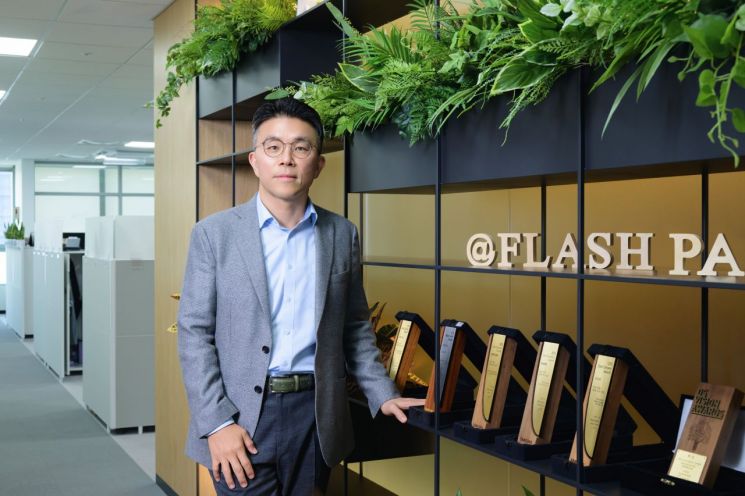 Hong Seungwan, Vice President of Flash Development Office, DS Division, Samsung Electronics.
 [Photo by Samsung Electronics]
Last month, Samsung Electronics began mass production of the industry's first 1Tb (terabit) TLC (Triple Level Cell) 9th generation V-NAND. The 9th generation V-NAND features the industry's smallest cell size and the thinnest mold (the layer that operates the cell). Its bit density is about 1.5 times higher than the previous generation.
Hong Seung-wan, Vice President of the Flash Development Division, said, "NAND technology is evolving to meet demands for high capacity and high performance," adding, "Samsung Electronics will continue innovation through technologies such as minimizing the number of high aspect ratio cell (HARC) etching processes per stack, high metal gate process technology for manufacturing high-performance devices, and various combinations of multi-bonding technologies to support this."
© The Asia Business Daily(www.asiae.co.kr). All rights reserved.


















