Song Miryeong, Minister of Agriculture, Food and Rural Affairs, stated on the 20th that even if the amendments to the Grain Management Act (Grain Act) and the Act on Distribution and Price Stabilization of Agricultural and Fishery Products (Agri-Fishery Act) pass the plenary session of the National Assembly, she will recommend President Yoon Seok-yeol to exercise his veto power.
At a press briefing held at the Sejong Government Complex on the same day, Minister Song said regarding the possibility of the opposition party passing the amendments to the Grain Act and the Agri-Fishery Act at the plenary session scheduled for the 28th, "We are not considering the situation where the laws are enforced at all," and added, "We will strongly recommend the President to exercise the right to request reconsideration."
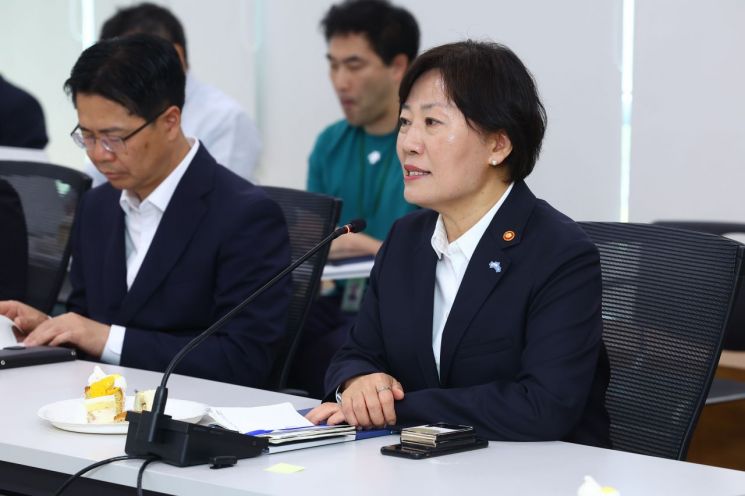 Song Miryeong, Minister of Agriculture, Food and Rural Affairs (right), is speaking at a press briefing held at the Government Sejong Complex on the 20th.
The amendment to the Grain Act requires the government to purchase surplus production when rice prices plummet or are expected to plummet. The amendment to the Agri-Fishery Act centers on a 'price guarantee system' where the government pays producers the difference if agricultural product prices fall below a certain standard.
Minister Song said, "The amendment to the Grain Act was also the first bill for which President Yoon exercised his veto power, and it is regrettable that the amendment has been reintroduced without removing the problematic clauses."
She pointed out that the biggest problem with the amendments to the Grain Act and the Agri-Fishery Act is market distortion, arguing that "(Including rice) production concentration on specific items is inevitable, leading to supply and demand instability and price instability for overproduced and underproduced items." She also criticized the Agri-Fishery Act as "a law that ruins the future of agriculture, the Agricultural Ruin Act," noting that excessive government financial input makes it difficult to address other issues that rural areas need to solve.
Minister Song said that if the Agri-Fishery Act passes, it would be difficult even to estimate the financial cost. She added that the opposition party had previously estimated, based on past data, that it would cost more than 1 trillion won for 16 items including rice.
She expressed regret, saying, "It seems the opposition party is using agriculture as a political issue," and pointed out, "If the President exercises the veto, the opposition will criticize the increase in the number of vetoes, and if he does not, they will claim it as an achievement." She added, "It is very irresponsible."
Minister Song explained that the problem lies in the 'mandatory purchase' in the Grain Act and the 'mandatory difference payment' in the Agri-Fishery Act, while the opposition party emphasizes the obligation, making it difficult to narrow the differences.
As an alternative to induce supply and demand stabilization of agricultural products and stabilize farm income, she proposed the full-scale implementation of the import stabilization insurance, which is currently a pilot project, starting next year. Minister Song emphasized, "Import stabilization insurance guarantees farm income through an insurance method considering both quantity and price, which differs from disaster insurance that only covers reduced production due to disasters. Unlike the Agri-Fishery Act, farmers bear their own insurance premiums, so there is responsibility. By assigning responsibility to farmers while guaranteeing income, it is an alternative that can achieve both supply and demand stability and income stability of agricultural products."
Regarding claims that apples should be imported to stabilize apple prices, she said, "It is not that we do not increase supply because we do not know that prices will fall. We want to conduct sufficient verification because if pests and diseases that have not been verified enter, they can damage the ecosystem, and we also need to consider the domestic industry. A comprehensive judgment is necessary."
© The Asia Business Daily(www.asiae.co.kr). All rights reserved.

















