Many Requests for Work Environment Improvement Including Twice-Weekly Expansion of 'Smart Work'
Chief Justice Cho Hee-dae is reported to have discussed measures to support the 'work-life balance (WLB)' of judges working at district courts during his recent court tour. Unlike in the past, millennial and Gen Z (MZ) generation judges communicated openly with the Chief Justice and demanded improvements in their working environment.
According to the courts, at a meeting held at a district court in the Seoul metropolitan area, a judge reportedly requested the Chief Justice to increase the number of smart workdays to twice a week. The judge also asked for the expansion of the smart work center in the available space at the Seocho-dong Supreme Court building. It is also said that there was a suggestion to relocate the Supreme Court to Sejong and fully utilize the Supreme Court building for smart work.
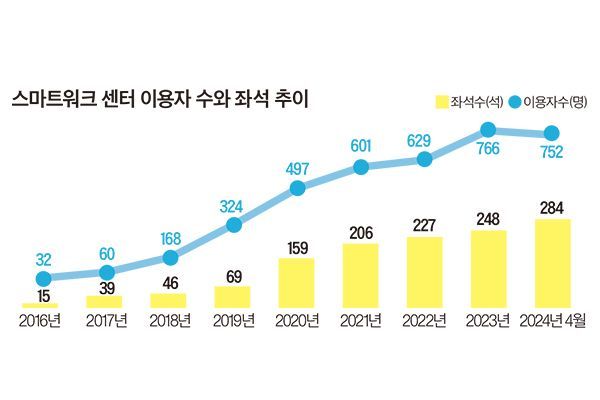
At another district court, some criminal division judges raised concerns about fairness regarding the limited use of smart work. Since electronic litigation has not been introduced for criminal cases, records are still prepared on paper. Accordingly, the Supreme Court has been expanding the implementation of smart work through pilot programs since 2019, using methods such as scanning records for certain cases like criminal panels. However, some areas, such as single-judge criminal cases, have yet to be included, leaving many criminal division judges unable to use smart work.
Smart work is a remote work system designed to help judges balance work and family life. It was piloted at the Patent Court in November 2010 and expanded to courts nationwide in 2016. On days without trials, judges are supported to work at the court rather than their usual workplace. Including expansions scheduled by September this year, the total number of smart work seats planned for this year is 308.
Concerns have also been raised inside and outside the courts about the impact of smart work on work efficiency. There are worries about whether the quality of trials can be maintained with fewer judges physically present at the workplace. One chief judge said, “If judges stop coming to work, the very reason for the court’s existence diminishes, and it could also lower the morale of the staff.”
Supreme Court judicial research officers, who are judges with over 12 years of experience, have consistently been pointed out as a blind spot for work-life balance. To ensure smooth handling of appeals, judicial research officers must quickly study case issues and legal principles and report to the justices. The workload is so intense that there is a saying, “Judicial research officers work overtime 365 days a year.” Especially female judges tend to avoid applying for these positions as the timing often coincides with the period when their children are young. Currently, there are 101 judicial research officers working at the Supreme Court, of whom 72.3% (73) are male and only 27.7% (28) are female. Since the launch of the Cho Hee-dae court, internal discussions have reportedly begun to shorten the judicial research officer term from the current three years to two years.
Park Su-yeon, Legal Times Reporter
※This article is based on content supplied by Law Times.
© The Asia Business Daily(www.asiae.co.kr). All rights reserved.

















