Concerns Over Long-Term Medical Service Gaps Due to 2000 Pharmaceutical Separation
Hospitals "Immediate Resolution Impossible, Will Monitor Trends"
Government "Cannot Prepare Solutions for All Issues"
Residents who collectively resigned around February 20th have not returned as of the 20th of this month, three months later, effectively failing to meet this year's training requirements. Accordingly, the medical community points out that the resigned residents have lost any reason to return within this year. Among them are 2,910 third- and fourth-year residents who will lose eligibility to take next year's specialist qualification exam (some specialties such as internal medicine, surgery, and pediatrics require three years of training before eligibility), and currently, 9,379 residents?94% of the total 9,996 residents nationwide?have not returned (according to the Ministry of Health and Welfare statistics).
Im Hyun-taek, president of the Korean Medical Association, claimed that even if residents return after the 21st, they will be unable to take the specialist qualification exam due to insufficient training periods, and thus the vast majority will not return this year. While there are concerns that the medical service gap could be prolonged until next year, most training hospitals have not devised plans to cope with the confirmed absence of residents. Consequently, both the irresponsibility of the residents who paralyzed the training hospital medical system by solely opposing medical school quota increases and the government's incompetence in finding solutions to this situation are being criticized simultaneously.
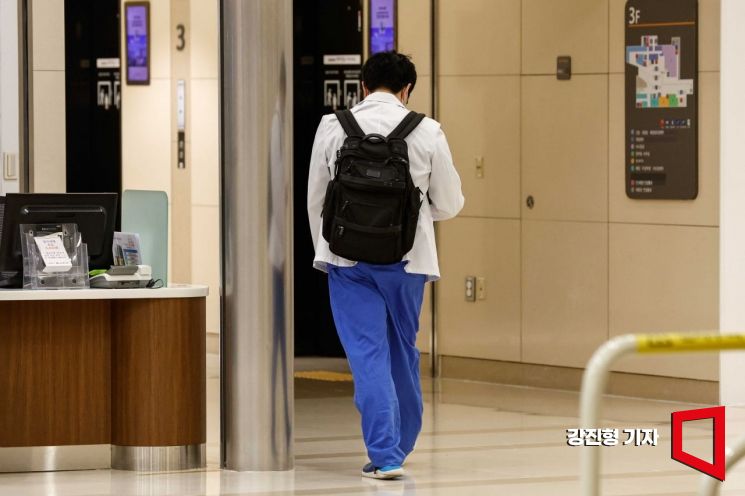 Medical staff are moving at a large hospital in Seoul on the 22nd of last month. Photo by Jinhyung Kang aymsdream@
Training hospitals such as the "Big 5" (Seoul National University Hospital, Asan Medical Center, Seoul St. Mary's Hospital, Severance Hospital in Sinchon, and Samsung Medical Center) are helpless. A Severance Hospital official said, "There is no clear alternative. We continue to hire nurses, but their clinical medical practice authority is limited, so there is a limit to filling the resident gap. Experienced nurses working as physician assistants (PA nurses) receive higher salaries than residents, which further burdens the hospital's finances already strained by the simultaneous departure of residents." The official expressed concern that "even if we post job openings for specialists to work alongside professors, there will likely be no applicants."
An official from Asan Medical Center said, "We are preparing emergency management plans assuming that residents of all years are entirely absent," adding, "Due to ongoing financial difficulties, hiring more specialists to fill the resident gap is not realistic."
A Seoul St. Mary's Hospital official said, "We have not yet had detailed discussions because we do not know whether residents will return," and "We are considering additional hiring of fellows and expanding the scope of PA nurses." At this hospital, PA nurses currently assist in many surgeries that residents used to handle. A Samsung Medical Center official said, "Our hospital's resident resignations occurred later than other hospitals, so a long-term resident gap is not confirmed as of the 20th," but added, "We are closely monitoring the practical situation."
The hospital sector is focusing on cost reduction while preparing for a prolonged resident absence. A Kyung Hee Medical Center official said, "We cannot recruit new residents, and there is no particular way for the hospital to respond. Even if all fellows sign contracts, normalization will be difficult," adding, "We are watching government announcements and other developments." The official further stated, "From the hospital's perspective, the only option until normalization is to endure by cutting costs," and added, "We have stopped volunteer activities and are reducing even minor expenses such as departmental supplies."
However, a medical community official said that domestic hospitals do not consider the resident absence as a permanent situation. This is because using regular staff such as PA nurses, who earn higher salaries than the "low-wage four-year contract" residents, as fixed personnel rather than temporary replacements is burdensome. The government is also not preparing solutions assuming a basic scenario of resident absence, as it is fundamentally impossible to produce specialists without a resident training system in the physician education process.
If the resident absence continues for a long time, patients will undoubtedly suffer the most serious damage. A senior official at a tertiary general hospital expressed concern, saying, "We fear a situation similar to the 2000 medical reform crisis when residents' strike lasted for months," and added, "At that time, prolonged strikes severely disrupted medical services, and patients even filed criminal complaints against hospitals and medical organizations." In fact, on June 24, 2000, the "National Countermeasure Meeting for the Withdrawal of the Medical Community's Collective Closure" filed lawsuits against Kim Jae-jung, then president of the Korean Medical Association, and Shin Sang-jin, chairman of the Medical Rights Struggle Committee, as well as claims for damages against hospital directors, on behalf of Jang Rang-geum, wife of Jeong Dong-chul who died due to lack of proper medical care, and Lee Yu-geun, father of a premature infant who died in Incheon.
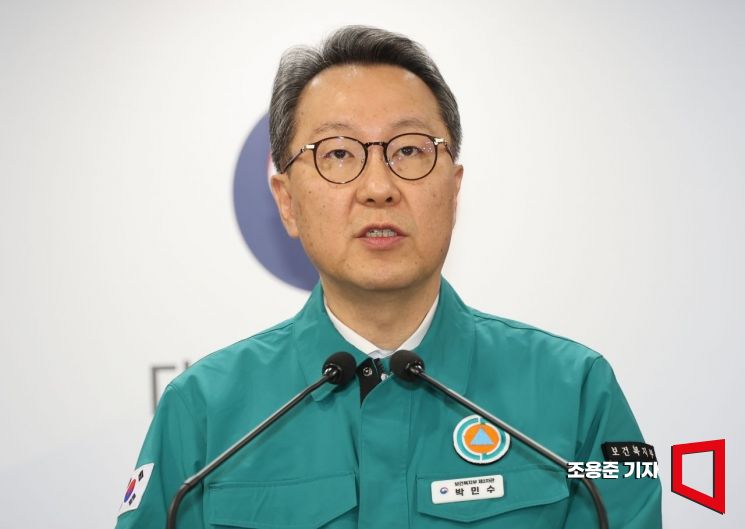
With the difficulty in producing specialists next year, there are expected to be disruptions in the supply of military doctors and public health doctors. However, the government has yet to present any significant countermeasures. On the 20th, Park Min-soo, the second vice minister of the Ministry of Health and Welfare, said at a briefing of the Central Disaster and Safety Countermeasures Headquarters regarding doctors' collective action, "(The non-return of residents may negatively affect the recruitment of military and public health doctors next year, but) since general practitioners are also a resource for public health doctors, there will be no direct impact." The plan is to recruit new doctors graduating from medical schools in February next year as military and public health doctors. However, when questioned about the possibility that there might be no new doctors graduating next year due to most medical students currently taking leaves of absence and not attending classes, Vice Minister Park only said, "The government cannot prepare countermeasures for all problems." He added, "We are making every effort to have medical students return and will do our best to ensure they come back."
© The Asia Business Daily(www.asiae.co.kr). All rights reserved.
![Clutching a Stolen Dior Bag, Saying "I Hate Being Poor but Real"... The Grotesque Con of a "Human Knockoff" [Slate]](https://cwcontent.asiae.co.kr/asiaresize/183/2026021902243444107_1771435474.jpg)












