KIAT Announces Industrial Technology Workforce Outlook
As of 2022, the shortage of personnel in South Korea's secondary battery industry was found to be 2,565 people. The workforce in the secondary battery industry is expected to grow by an average of 7% annually, reaching 110,791 by 2032.
The Korea Institute for Advancement of Technology (KIAT) announced the results of the "Survey and Forecast of Industrial Technology Workforce in the Secondary Battery and Advanced New Materials Industries." KIAT conducts industrial technology workforce surveys targeting 14 promising new industries, and the secondary battery sector was included for the first time in the 2023 survey.
The survey results indicate that the secondary battery industry will see an increase of 54,450 industrial technology personnel over the next 10 years, expanding to 110,791. The projected average annual growth rate is 7%, the highest among the industries surveyed over the past five years.
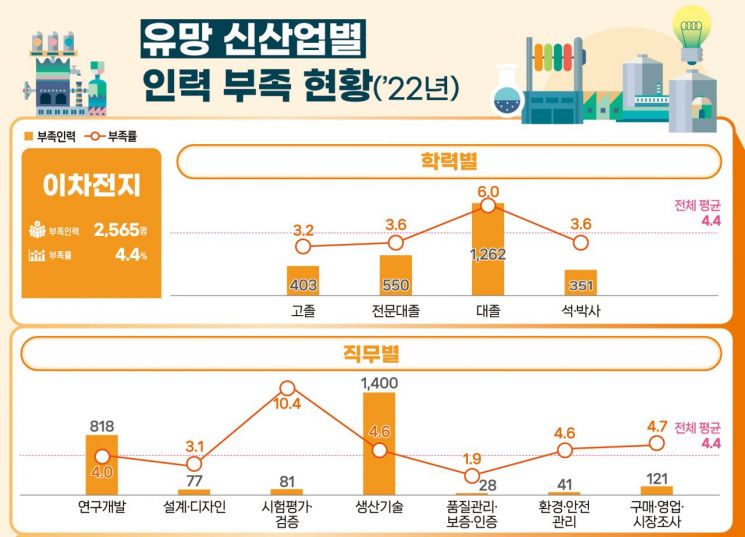
As of 2022, among the 56,340 technical personnel in the secondary battery industry, the proportion of research and development positions was the highest at 35%. The proportion of personnel with master's and doctoral degrees was 16.9%, relatively higher compared to the advanced new materials industry (10.4%). The shortage of personnel in the secondary battery industry was 2,565 as of 2022, representing a 4.4% deficit. Shortages were relatively high in testing and evaluation/verification (10.4%) and university graduate (6.0%) fields.
As of 2022, the technical workforce in the advanced new materials industry increased by 38.4% from 74,287 three years earlier to 102,806. Among detailed sectors, next-generation ceramic materials (98.7%) and advanced chemical materials (63.1%) showed high growth rates.
The shortage of personnel in advanced new materials was recorded at 2,925 (shortage rate of 2.8%). In particular, shortage rates were high in new metal materials (4.0%) and next-generation ceramic materials (4.3%). The technical workforce in advanced new materials is expected to grow by an average of 3.1% annually, reaching 138,870 in 10 years.
Meanwhile, the forecast for industrial technology personnel in promising new industries is jointly surveyed by KIAT, the Korea Institute for Industrial Economics & Trade, and the Korea Research Institute for Vocational Education & Training, supported by the Ministry of Trade, Industry and Energy. The secondary battery sector is scheduled to be incorporated into the parts and equipment field starting in 2025.
© The Asia Business Daily(www.asiae.co.kr). All rights reserved.

















