Falling Behind in Domestic Dispatch System Era
"Want Dispatch for Packaging, Assembly, and Inspection Too"
Need to Lift Dispatch Restrictions by Task
Domestic manufacturing companies have expressed a desire to deploy temporary workers in direct production processes such as packaging, assembly, and inspection. Given that the domestic dispatch system is outdated and the utilization rate of dispatched workers lags behind that of advanced countries, there is a need to ease regulations.
According to the report "Problems and Improvement Directions of the Dispatch System" released by the Korea Employers Federation on the 20th, a recent survey of 117 major companies found that among the 26 manufacturing companies that responded, 21 expressed a desire to use dispatched workers in direct production processes in manufacturing.
Manufacturing companies indicated that temporary workers are needed in direct production processes such as ▲packaging and post-processing ▲input and sorting of raw materials and supplies ▲transportation/loading/unloading/shipment of materials, parts, and products ▲assembly ▲inspection ▲equipment maintenance and repair.
The report pointed out that the current dispatch law is an excessively rigid and outdated regulation. Currently, dispatching is prohibited for tasks such as direct production processes in manufacturing. Dispatching is only allowed for 32 types of work specified by the enforcement decree, including computer-related experts.
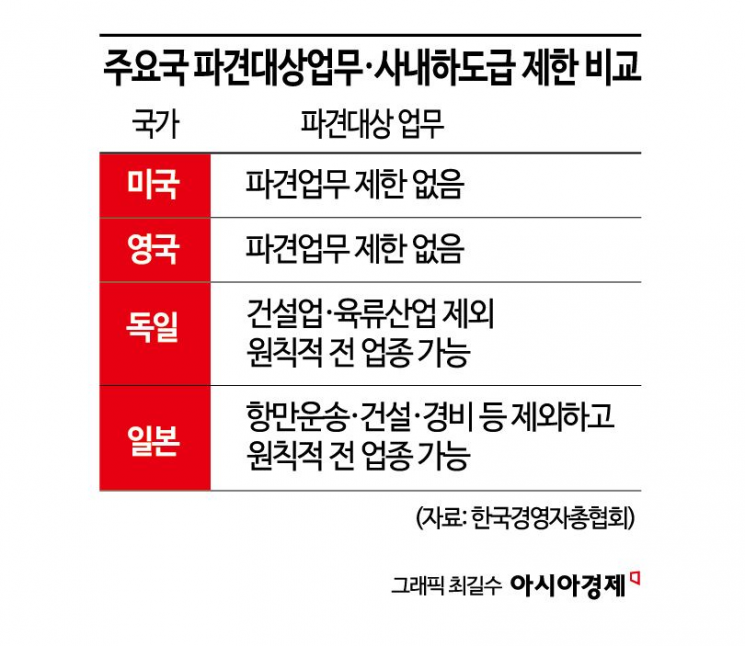
It was argued that the domestic dispatch system falls behind even when compared to advanced countries. In the United States, there is no separate law regulating worker dispatch. The United Kingdom regulates dispatch labor relations through the 1973 Employment Agencies Act and the 2010 Agency Workers Regulations, but does not impose special restrictions on dispatchable tasks. Similarly, Germany does not impose special restrictions on dispatchable tasks except in the construction and meat industries. Japan, which initially allowed dispatching only for some tasks (13 types) when the dispatch law was enacted in 1985, now permits dispatching for all tasks including manufacturing, except for some areas such as construction.
The Korea Employers Federation proposed that policies should be pursued to abolish regulations on dispatchable tasks altogether. Hwang Yong-yeon, head of the Labor Policy Department at the Korea Employers Federation, emphasized, "As the industrial environment rapidly changes, outsourcing personnel and tasks has become recognized as an essential management activity," adding, "The current dispatch system should be improved to enhance management efficiency by guaranteeing various production methods such as subcontracting."
© The Asia Business Daily(www.asiae.co.kr). All rights reserved.
![Clutching a Stolen Dior Bag, Saying "I Hate Being Poor but Real"... The Grotesque Con of a "Human Knockoff" [Slate]](https://cwcontent.asiae.co.kr/asiaresize/183/2026021902243444107_1771435474.jpg)











