Blue Meteor Appears Over Spain and Portugal on 18th
Videos and Sightings Spread on SNS... Debris Not Found
A massive meteor emitting a blue light over hundreds of kilometers was witnessed in the skies over Spain and Portugal, becoming a hot topic.
On the 19th, foreign media including News18 reported that on the previous night, a meteor emitting a blue flash appeared over an area spanning hundreds of kilometers in Spain and Portugal. Many who witnessed this meteor uploaded videos of the meteor and selfies on social networking services (SNS). Notably, the meteor observed this time was characterized by its mysterious blue light. As it fell toward the ground, the size of the light grew tremendously, resembling a huge flame or fireworks.
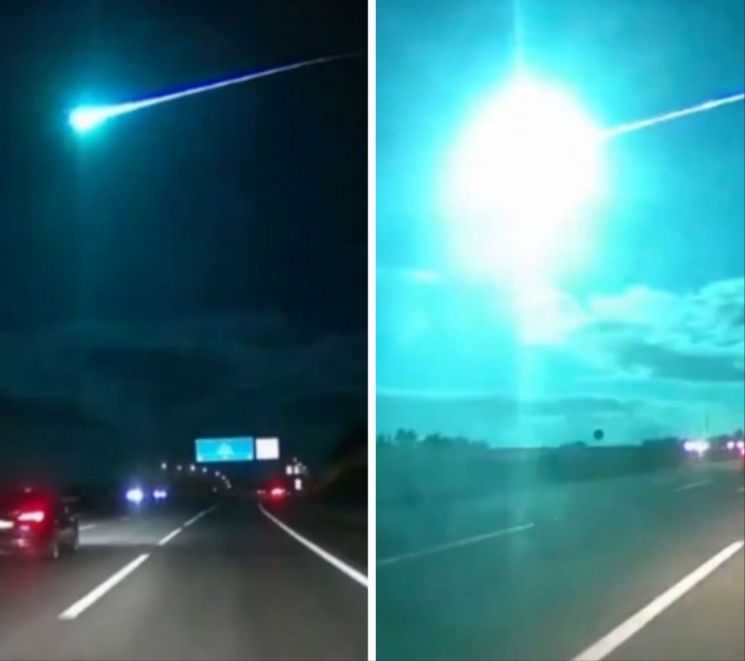 Meteor captured on a vehicle's black box in Portugal
[Image source=Social Networking Service (SNS) capture]
On X (formerly Twitter), videos were shared showing a huge meteor emitting a blue flash rapidly passing over a woman taking a selfie by the roadside, as well as a meteor quickly passing over a building where a party was taking place. In Portugal, a dashcam of a vehicle driving on a dark and quiet road captured the meteor crossing the sky. This meteor emitted a massive light as it fell due to friction with the atmosphere, momentarily illuminating the surroundings brightly as if it were broad daylight.
Locals suggested that the meteor likely fell near the village of Castro Daire or crashed in the Pinheiro area. After receiving numerous reports, local firefighters conducted extensive searches in these areas but did not find any meteorite debris or impact sites caused by the crash. A meteorite is a meteor that survives the friction with Earth's atmosphere and is found on the surface.
Meteors are mostly fragments from comets that enter Earth's atmosphere at very high speeds, creating streaks of light. The reason meteors display different colors is that the actual light-emitting part is not the heated meteor itself, but the atoms and molecules in the atmosphere surrounding the meteor that become ionized and then emit light as they recombine or transition from excited to ground states. This light has unique wavelengths depending on the types of atoms or molecules, which causes the meteor's colors to vary.
© The Asia Business Daily(www.asiae.co.kr). All rights reserved.

















