"Due to Increased Costs, Starting This Year Only 'Aged 75 and Over'"
Raising or Canceling Age Criteria Amid Aging Population
This year, a senior citizens' feast held annually during 'Family Month' at an apartment complex in Dongdaemun-gu, Seoul, where meal vouchers worth 10,000 to 15,000 won were distributed to elderly residents, was canceled due to concerns over management fee burdens, Yonhap News reported on the 18th.
A representative of the apartment residents' association cited the aging of residents as the reason for canceling the senior citizens' feast.

The representative explained, "As the residents are getting older, it has become difficult to cover the costs with the apartment management fees. Although the meal voucher amount may not seem much to the recipients, when it adds up, it becomes a different story," adding, "Even though we raised the participation age from '65 and older' to '70 and older' last year, the burden increased, so there was no choice."
Due to aging, changes are occurring in senior citizens' events in private sectors such as apartment complexes. As the number of elderly residents increases and costs become harder to bear, there are frequent cases of raising the eligible age or canceling the events altogether.
The situation is similar at an apartment complex in Bucheon, Gyeonggi Province. The residents' association significantly raised the participation age for a meal event for the elderly from 65 to 75 years old. In an apartment complex with about 700 households, there were approximately 150 residents aged 65 or older, making the age adjustment an unavoidable measure to reduce the number of participants.
Last year, the population aged 65 and older in South Korea was recorded at 9.73 million, accounting for 19.0% of the total population. The proportion of elderly people in the population has been increasing annually: 13.2% in 2015, 16.4% in 2020, and 18.0% in 2022. It is expected to reach 20% next year, entering a super-aged society according to United Nations (UN) standards.
The UN classifies societies as aging if the population aged 65 and older exceeds 7%, aged society if it exceeds 14%, and super-aged society if it exceeds 20% of the total population.
Some voices express concern about the reduction of elderly welfare in the private sector.
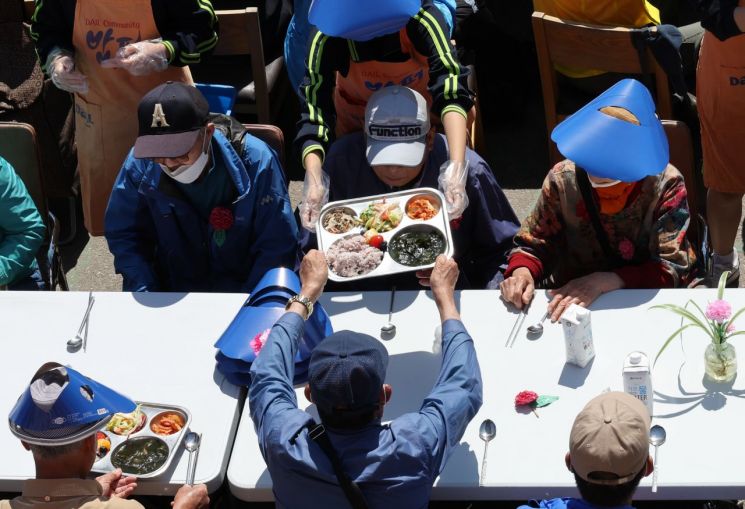 Elderly people are having a meal at a filial piety feast on Parents' Day. This is a stock photo unrelated to the article. [Image source=Yonhap News]
Jeon Yong-ho, a professor in the Department of Social Welfare at Incheon National University, said, "When the number of beneficiaries increases, support inevitably prioritizes those who are economically disadvantaged or in need," adding, "If the eligibility threshold rises, blind spots in elderly welfare may occur."
He further stated, "There is a need for the public sector to actively fill the gaps that the private sector cannot cover."
© The Asia Business Daily(www.asiae.co.kr). All rights reserved.


















