Report on Hanil Hyundai Cement Plant in Yeongwol, Gangwon
Establishment of Eco-friendly Facilities Including ECO Power Generation
“We are striving to transform into an eco-friendly factory by establishing resource recycling facilities.” On the 16th, after a 2 hour and 30 minute drive from Seoul, we arrived at Hanil Hyundai Cement Factory in Yeongwol, Gangwon Province. This place was different from the traditional carbon emission image associated with ‘cement factories.’ Under the slogan ‘ESG (Environment, Social, Governance) 2030,’ they were implementing a carbon neutrality plan. This aligns with the government’s declaration to make South Korea a net-zero greenhouse gas emitter by 2050, known as ‘2050 Carbon Neutrality.’
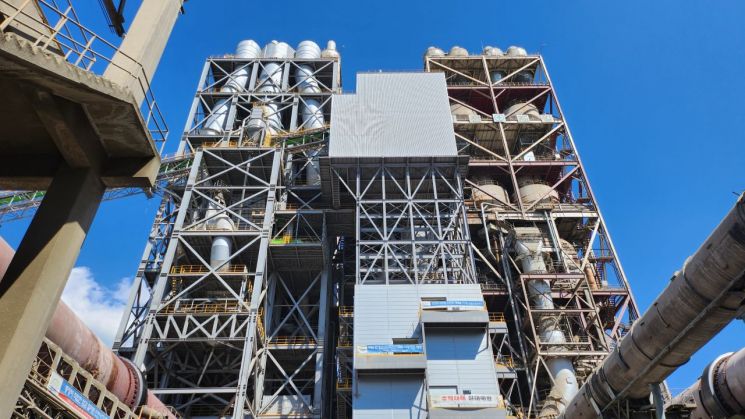 On the 16th, the pyro rotor was fully installed on the upper part of the No. 2 kiln preheater tower at the Hanil Hyundai Cement Yeongwol Plant. The pyro rotor is located on the upper left side.
Factory Manager Park Jin-gyu stated, “We operate the factory focusing on cost reduction through process efficiency and equipment operation that complies with government policies such as environmental regulations,” showing confidence in carbon reduction. The area receiving the most intensive improvements is the calcination process. Cement manufacturing broadly involves mining, raw material production, calcination, and shipping. Calcination is the core process where raw materials including limestone are put into the kiln to produce clinker, the semi-finished cement product. This requires high heat above 1450℃, consuming a large amount of energy. The main fuel is bituminous coal, which emits a large volume of carbon dioxide during combustion. To overcome this, the Yeongwol factory has established eco-friendly facilities such as resource recycling and ECO power generation using waste heat.
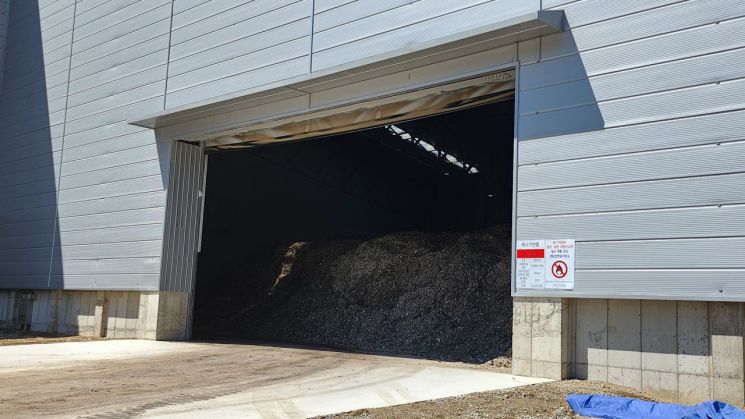
On that day, the resource recycling storage was piled over 3 meters high with waste plastic used as fuel instead of bituminous coal. This waste synthetic resin, suitable for fuel use, is brought in by trucks from specialized sorting companies and stored here. To reduce odor and dust spreading in the air, the recycled resources are fed into an underground inlet, then transported through a sealed transfer passage to the preheater tower.
At the top of the approximately 110-meter-high No. 2 kiln preheater tower, a pyro rotor aiding the complete combustion of recycled fuel was noticeable. Completed in January, the pyro rotor acts as a ‘mini kiln’ to ensure sufficient combustion of recycled fuel before it enters the kiln. Production Management Team Leader Choi Cheol-woon explained, “Existing factory equipment was optimized for bituminous coal combustion and was not suitable for complete combustion of recycled fuel.”
With the complete combustion of recycled fuels enabled, various emissions have decreased. Carbon emissions were reduced by about 7.6%, and nitrogen oxides, which cause fine dust, were reduced by about 11%. Once the modification of the No. 1 kiln preheater tower is completed, the usage rate of recycled fuel will increase from about 36% to 66%.
The ECO power generation facility, completed last month with an investment of 10.5 billion KRW, recovers heat emitted into the atmosphere during the clinker production process in the kiln to generate electricity. The high-temperature exhaust gas passing through the kiln is used to reheat the preheater tower and still maintains a temperature of 300~400℃ afterward. This exhaust gas powers the ECO generation by driving a boiler. The steam from the boiler then turns turbines to produce electricity. Team Leader Choi said, “The ECO power generation facility at Yeongwol Factory can produce about 140,000 MWh of electricity annually, which accounts for 30% of the factory’s electricity consumption. The expected greenhouse gas reduction effect is 64,000 tons per year.”
At Yeongwol Factory, a ‘chlorine dust washing facility’ that processes chlorine dust from the kiln into fertilizer was also completed this month and is currently undergoing test operation. Factory Manager Park emphasized, “Although the cement industry faces challenges such as decreased demand for building materials, carbon neutrality is a task that can no longer delay investment.”
© The Asia Business Daily(www.asiae.co.kr). All rights reserved.
![Clutching a Stolen Dior Bag, Saying "I Hate Being Poor but Real"... The Grotesque Con of a "Human Knockoff" [Slate]](https://cwcontent.asiae.co.kr/asiaresize/183/2026021902243444107_1771435474.jpg)

















