On the 26th at the IBK Chamber Hall, Seoul Arts Center
The Seoul Philharmonic Orchestra (SPO) will hold its fourth chamber music concert of the year at 2 p.m. on the 26th at the IBK Chamber Hall in the Seoul Arts Center.
Pianist Boris Giltburg, who won the 2013 Queen Elisabeth Competition, will perform Brahms' Piano Quartet No. 1 and Dvo??k's Piano Quintet No. 2 together with members of the SPO.
Giltburg was born in Russia in 1984 and moved to Israel as a child, where he studied under Arie Vardi. Since 2015, he has recorded works by Beethoven, Schumann, Rachmaninoff, and Shostakovich under the Naxos label. Notably, his Shostakovich recordings with the Royal Liverpool Philharmonic conducted by Vasily Petrenko received the Diapason d'Or award, and his Rachmaninoff recordings with the Royal Scottish National Orchestra conducted by Carlos Miguel Prieto won the Opus Klassik award.
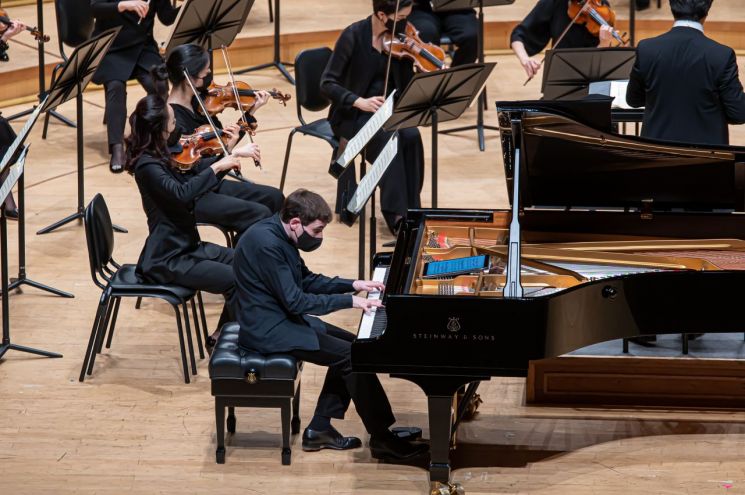 Pianist Boris Giltburg performed Beethoven's Piano Concerto No. 2 with the Seoul Philharmonic Orchestra in December 2011.
 [Photo by Seoul Philharmonic Orchestra]
Giltburg stated that he will emphasize his favorite movements in each piece. Regarding Brahms' work, he explained, "The finale of the Gypsy-style rondo is driving and captivating. It is catchy, realistic, and raw, but definitely fun to play." He added, "In Dvo??k's piece, the second movement 'Dumka' is the core. The viola mainly tells an unforgettable beautiful story. Various episodes are embroidered onto the main melody, making it feel like a captured fragment of life in the notes."
The first half features Brahms' Piano Quartet No. 1, a work imbued with Brahms' characteristic melancholy and solitude, romantic yet technically demanding. It premiered successfully in 1861 in Hamburg with Clara Schumann as the soloist, and in 1862 was performed in Vienna with the Hellmesberger Quartet and Brahms himself as the piano soloist. The final fourth movement, reminiscent of Hungarian dances, is a highlight. The first movement flows with a lonely and somber piano melody, while the cello creates tension between intensity and gentleness. The second movement features muted strings creating a mysterious atmosphere, the third movement’s dreamy grandeur dramatically shifts into a march, and the fourth movement’s melancholic melody rides on a lively rhythm, evoking a rhapsody.
The second half presents Dvo??k's Piano Quintet No. 2. Composed shortly after completing his Symphony No. 7 in 1887, this piece represents the peak of his compositional technique and is regarded as a masterpiece of chamber music bridging Schumann and Brahms. The work incorporates elements of Czech folk music and features lyrical melodies flowing through all four movements, creating a harmonious ensemble.
In the first movement, the cello reveals a captivating voice riding on the loose waves of arpeggiated piano. The second movement is based on the Ukrainian folk ballad dumka, with a poignant piano melody and lyrical themes that captivate the audience. The third movement, a scherzo, enhances the lively and whimsical character by incorporating the Bohemian folk dance Furiant. Notably, the 3/4 dance rhythm is accompanied by an ascending motif that seems to float in the air. The final fourth movement is a fast finale where the composer’s sense of humor is evident in the exchange of nimble sixteenth-note figures in the first half, and the interesting conclusion is marked by a happy ending and a daegu (counterpoint).
Tickets range from 10,000 to 70,000 KRW depending on seat grade and can be purchased through the SPO website and call center. SPO website members can receive a 10% discount for up to four tickets per person, and members aged 24 and under are eligible for a 40% discount for themselves.
© The Asia Business Daily(www.asiae.co.kr). All rights reserved.

















