Various Events Including Rice Ball Sharing... Crowded with Citizens
"May Spirit Should Be Included in the Constitution" Democratic Peace March Held
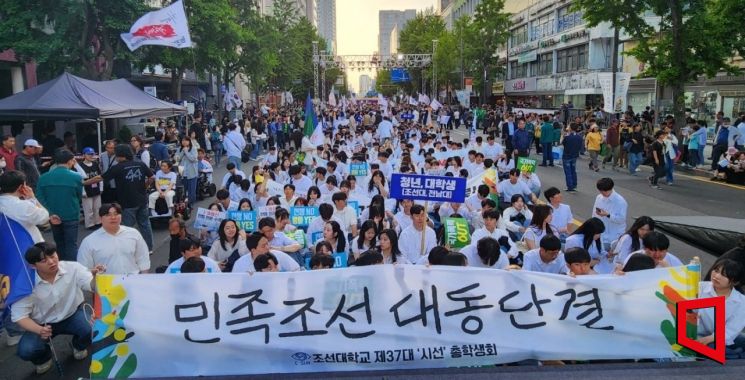 On the 17th, one day before the 44th anniversary of the May 18 Democratic Uprising, citizens are participating in the Democratic Peace March at Geumnam-ro, Dong-gu, Gwangju Metropolitan City.
 [Photo by Park Jin-hyung]
At Geumnam-ro in Gwangju Metropolitan City, where 44 years ago South Korean soldiers mercilessly fired bullets at democratic citizens causing a bloodbath, mourners gathered to honor the spirits of May.
On the 17th, ahead of the eve ceremony, the highlight of the May 18 Democratic Movement commemorative events, various preliminary events (Liberated Gwangju) were held at tent booths set up along the streets, heightening the atmosphere of remembrance.
Among dozens of experience booths, the 'May 18 Jumeokbap Sharing Event' booth, symbolizing Gwangju’s 'Daedong Spirit,' attracted attention. Volunteers poured rice into large bowls, sprinkled sesame oil, sesame seeds, and black sesame seeds, and carefully rolled the rice in seaweed to make jumeokbap (rice balls) with great care.
"Please take one each." A long queue formed in front of the booth, where elderly participants who had joined the protests as part of the necktie unit during the May struggle and the younger generation living under the democratic system preserved through their precious sacrifices came together, reflecting on the jumeokbap as a symbol of the 'spirit of solidarity.'
May songs such as "March for the Beloved" echoed from the stage speakers, and the powerful sounds of samulnori percussion?drums and gongs?created a vibrant resonance.
Kim Jong-seon (70) said, "May jumeokbap is synonymous with Gwangju. It symbolizes the Gwangju community where corner store owners and housewives came out to share food bit by bit with protesters fighting to protect democracy."
Another citizen shared, "Around 1980, demonstrations were held daily in Gwangju. We never dreamed that soldiers would wield bayonets and fire bullets at citizens yearning to escape military dictatorship." He added, "Eating the May jumeokbap, I feel grateful and remorseful for the noble sacrifices of the fallen spirits."
At the 'May Road Urban Sketch' exhibition booth near the old Jeonnam Provincial Government building square, participants were busy coloring sketches of historic sites such as the May 18 Cemetery and May 18 Democracy Square with brightly colored markers.
On the base drawings completed by professional artists, they mixed various colors like blue, green, and yellow to express vividness. The serious atmosphere was palpable as they calmly drew, observing the historic sites while walking along May Road.
Oh Jong-hyo (74, female) said, "Every May around this time, the sweet scent of flowers and spring weather fade into the background as the martyrs who sacrificed for democracy come to mind first." She added, "I filled in the blank spaces of the drawings while honoring their precious spirit of sacrifice."
At the booth prepared by the May Democratic Women’s Association, visitors could experience how precious the value of 'peace' is. It was an art activity where participants cut wooden boards and hanji (traditional Korean paper) and glued them together to create smiling face shapes.
The completed works were displayed outside, each featuring inscriptions such as "Live joyfully," "Live harmoniously," and "Live with a big smile," conveying heartfelt messages.
By around 5 p.m., all experience booths were dismantled, and in their place, a pungmul (traditional Korean percussion) troupe’s lively performance blossomed spectacularly. They played samul instruments like drums and gongs, showcasing cheerful dance moves that energized the crowd, who responded with applause and shoulder dances.
Following this, the Democratic Peace Grand March procession, which started from Gwangju Park and Bukdong Cathedral and arrived at the car-free zone of Geumnam-ro, continued in a long line. This reenacted the street march that began on May 14, 1980, with the student struggle at Chonnam National University.
The participants entered energetically, swinging their arms to the rhythm of "March for the Beloved" broadcast from the Geumnam-ro stage speakers. They raised flags, placards, and large banners calling for the inclusion of the May 18 spirit in the preamble of the Constitution, voicing their demands.
The event concluded with a two-hour eve ceremony on a special stage in front of Jeonil Building 245. The performance, themed "Someday on a Spring Day We Will Meet Again," began with the story of an 88-year-old mother who lost her son during May 18 and searched for him for 44 years. It continued with a reenactment of the citizens’ uprising during May 18 and a narrative that the truth of May will be found like spring when all things come back to life.
© The Asia Business Daily(www.asiae.co.kr). All rights reserved.

















