30-year-old Noland Arbo Reveals in Bloomberg Interview
Submitted Application for the First Time Last September and Underwent Hospital Examination
Adapting at Home After Surgery... Uses Computer Even While Lying Down
Removal Decision to Be Discussed After One Year... "I Want an Upgrade"
"Once you get a taste for using it, you just can't stop."
This is the sentiment expressed by Norland Arvo (30), the first recipient of a brain chip implant from Neuralink, a neurotechnology startup founded by Tesla CEO Elon Musk. On the 16th (local time), Arvo gave an exclusive interview to Bloomberg, marking his first public comments since the chip implantation. He received the brain chip as the first human trial subject of Neuralink on January 28 of this year. About a month after the implantation, he confessed that he became increasingly anxious when some errors occurred during the chip's operation, fearing he might no longer be able to use it. He even thought, "My journey ends here."
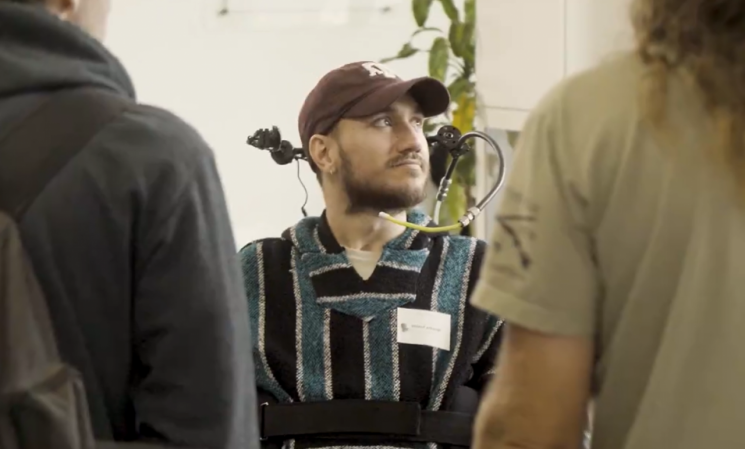
Arvo, the first human trial subject of Neuralink, is a quadriplegic patient. According to Bloomberg, in 2006, when he was a 22-year-old student at Texas A&M University, he jumped into a lake, suffered a severe head injury, and became quadriplegic. He had been athletic since childhood and even participated in military training programs, but his life was completely changed. Afterwards, he had to learn to use a powered wheelchair and operate an iPad by holding a pencil in his mouth. He also inevitably relied on the help of his parents and younger brother, with whom he lives.
In the interview with Bloomberg, Arvo reflected that although he was with family and friends after the accident, he often felt helpless. Graduating from college was difficult due to financial issues, and finding a job was also challenging. He said, "It was hard to do many things. I became certain that I would live with my parents as long as they could take care of me," adding, "At some point, I thought I would be left alone, unable to do anything."
While feeling frustrated with these thoughts, in September last year, his friend Greg Bain informed him that Neuralink was looking for the first brain chip implant recipient. At that time, Arvo was unaware of Neuralink's existence. After hearing his friend's explanation, he thought, "This might be pretty good," he revealed in the interview. With his friend's help, Arvo filled out an online application. The day after submitting the application, he had a phone interview with Neuralink, and weeks later, he was contacted to undergo tests measuring the thickness of his skull and the space between his brain and skull.
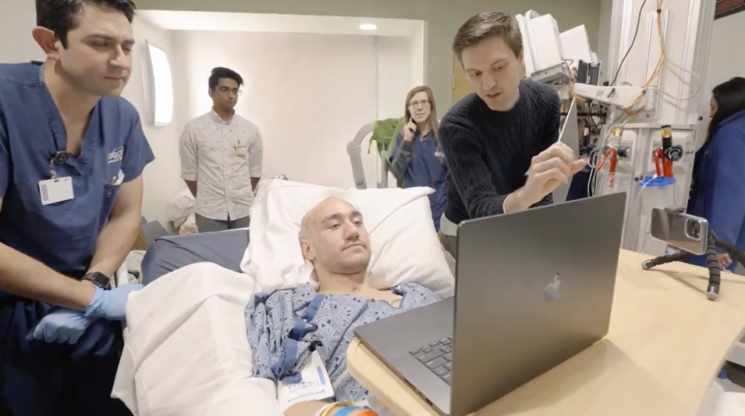
Recalling the hospital tests before the chip implantation, Arvo said, "It was really cool because you could tell how excited everyone was. You could feel that energy," adding, "(The medical staff) kept telling me how honored they were to meet me and how I was doing the greatest thing in the world. It was truly surreal." Although it was not confirmed that he would be the first trial subject until the testing phase, Neuralink officially notified him of his selection in January after the tests.
Arvo was not entirely at ease before the brain chip implantation. His acquaintances reportedly debated for hours, sharing various opinions. One friend even shared negative results from animal experiments. However, Arvo confided to Bloomberg that all the processes, including his cessation of drinking and smoking after the accident, which made him a suitable candidate, and his successful completion of the tests, were possible thanks to divine help.
On the day of the implantation, January 28, Arvo initially planned to meet Musk before the surgery. However, Musk was delayed due to issues with his private jet and could not arrive on time, so they spoke via video call. Musk arrived at the hospital during the surgery. The operation took less than two hours. Upon waking, Arvo joked with his mother Mia Neely, who was by his bedside, saying, "Who are you? I don't know who you are." He added, "I wanted to tell her everything was okay and reassure her."
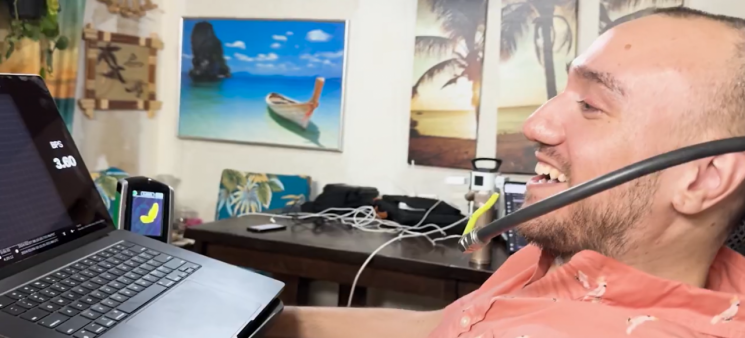
After the brain chip implantation, Arvo adapted at his home in Yuma, Arizona. Initially, he had to learn how to adjust the Neuralink software to match his brain patterns. On weekdays, he participated in research sessions using the chip, and on weekends, he used it for leisure purposes. He mainly used it to quickly control the computer cursor to play chess or Super Mario games. Since he could move the cursor by thinking, he could use it even while lying in bed. He reportedly used the chip for 10 to 12 hours a day, only not using it while charging or sleeping.
Bloomberg reported that Arvo wants to find a way to use this experience to support himself financially. He said, "My younger brother has taken care of me for eight years. It's time for him to live his own life." He also expressed a desire to earn money and build a house for his mother if possible.
Neuralink will receive Arvo's brain chip activity data for one year. Afterwards, they plan to discuss with Arvo whether to deactivate or remove the brain chip. Arvo said he does not know if he can keep it if he wants to or if it can be upgraded to the next version. He said, "I want to upgrade it," and added, "I hope to be on the final list."
Founded by Musk, Neuralink has been developing brain-computer interface (BCI) technology that implants devices into the brain to enable people with physical disabilities who cannot use their limbs to control various devices. The BCI device is a round container about the size of a 25-cent coin, resembling an ice hockey puck, containing a data processing chip, battery, and communication devices. It has 64 threads attached, each with 16 electrodes. The thread tips, thinner than hair, are inserted into the motor cortex of the brain, connecting the BCI to the brain.
© The Asia Business Daily(www.asiae.co.kr). All rights reserved.
![Clutching a Stolen Dior Bag, Saying "I Hate Being Poor but Real"... The Grotesque Con of a "Human Knockoff" [Slate]](https://cwcontent.asiae.co.kr/asiaresize/183/2026021902243444107_1771435474.jpg)


















