Reducing Gas Emissions in Production Processes
Increasing Renewable Energy Every Year
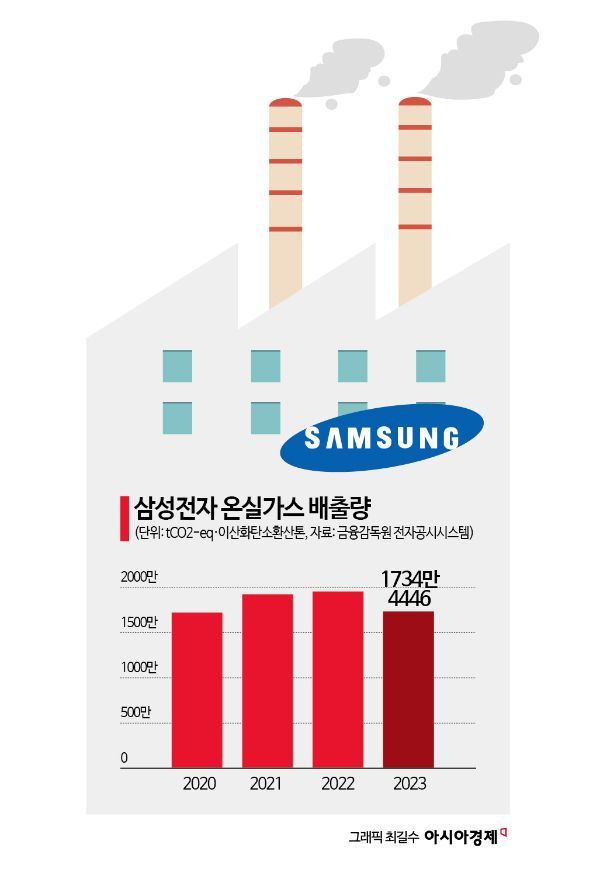
Samsung Electronics reduced its greenhouse gas emissions by 10% compared to the previous year. This is a remarkable achievement in managing greenhouse gas and carbon emissions since declaring its 'New Environmental Management Strategy,' which focuses on joining RE100 (100% renewable energy) and carbon neutrality by sector.
 A pond created with purified water from the 'Green Center (Wastewater Treatment Facility)' at Samsung Electronics Hwaseong Campus.
 [Photo by Samsung Electronics]
According to the first-quarter report disclosed by Samsung Electronics on the 17th, last year's greenhouse gas emissions amounted to 17,344,446 tCO2-eq (tons of CO2 equivalent), a reduction of 10.1% (1,941,091 tCO2-eq) compared to the previous year. This level has returned to that of 2020 (17,234,522 tCO2-eq).
Samsung Electronics' greenhouse gas emissions have noticeably decreased since around the time the new environmental management strategy was announced. This is interpreted as being influenced more by reductions in gases during the production process and improvements in manufacturing process and equipment operation efficiency, rather than the COVID-19 pandemic.
Samsung Electronics is a greenhouse gas energy target management company under the Carbon Neutrality and Green Growth Basic Act (Carbon Neutrality Basic Act) for responding to the climate crisis. This means it is a carbon-intensive company required to submit emission statements to the government. If emissions exceed the government-allocated emission allowances, the company can purchase additional carbon emission rights based on market prices, but Samsung Electronics has long implemented a management policy to reduce emissions itself.
Under the Carbon Neutrality Basic Act, greenhouse gases include carbon dioxide (CO2), methane (CH4), nitrous oxide (N2O), hydrofluorocarbons (HFCs), perfluorocarbons (PFCs), and sulfur hexafluoride (SF6). Among these, it is important for Samsung Electronics to reduce perfluorocarbons and sulfur hexafluoride emissions. Perfluorocarbons are emitted during cleaning and etching processes, while sulfur hexafluoride is emitted during the deposition process. Etching and deposition are essential processes included in the 'eight major semiconductor processes.' The quarterly report does not disclose reduction status by specific greenhouse gases.
Samsung Electronics' greenhouse gas reduction achievements are also linked to its RE100 membership. The more renewable energy is used, the less coal-fired power, a major source of greenhouse gases, is consumed. According to the sustainability management report announced by Samsung Electronics in July last year, renewable energy usage increased annually from 4,030 GWh in 2020, to 5,278 GWh in 2021, and 8,704 GWh in 2022. The 8,704 GWh is roughly equivalent to the average monthly electricity consumption of about 20,384,074 four-person households.
The fact that the 'New Environmental Management Strategy,' which declares company-wide carbon neutrality by 2050 (and by 2030 for the DX division), has been progressing smoothly over two years makes this greenhouse gas reduction achievement even more remarkable. Samsung Electronics has committed to investing more than 7 trillion KRW by 2030 in reducing process gases, collecting and recycling waste electronic products, and conserving water resources, excluding the cost of procuring renewable energy.
Additionally, Samsung Electronics follows global standards by establishing a Scope 3 disclosure system, an international reporting standard that covers carbon emissions not only from product manufacturing but also from the consumption stage. The Scope 3 emissions disclosed for the first time in the 2022 sustainability management report amounted to 124,715,000 tCO2-eq. This means the company has a system to manage emissions from domestic manufacturing sites, office buildings, company-owned and leased buildings, as well as partner companies and carbon emissions after customer product use.
Han Jong-hee, Vice Chairman and Head of Samsung Electronics' DX (Device Experience) Division, stated in March, "Samsung Electronics continues efforts to achieve carbon neutrality, including transitioning to renewable energy and applying resource-circulating materials."
© The Asia Business Daily(www.asiae.co.kr). All rights reserved.


















