Among Government Ministries and Agencies, First to Raise
"Need to Lower the Base Interest Rate"
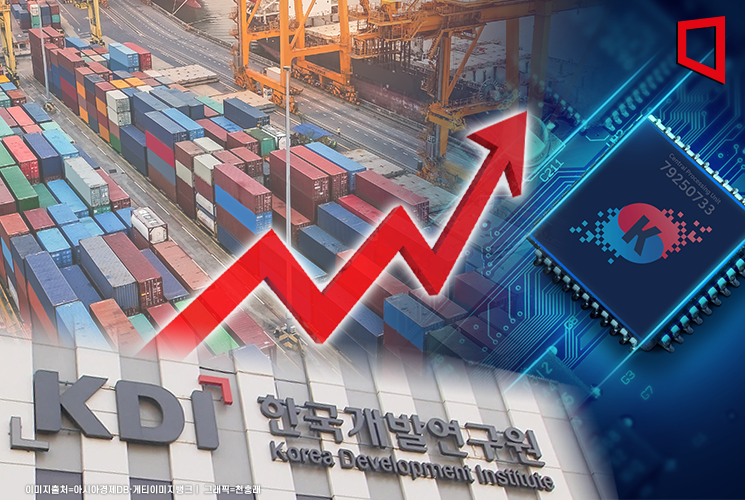
The Korea Development Institute (KDI) has raised its economic growth forecast for this year from 2.2% to 2.6%. This revision reflects the surprising 1.3% growth rate recorded in the first quarter, driven by strong exports including semiconductors.
In its "2024 Mid-Year Economic Outlook" released on the 16th, KDI projected South Korea's economic growth rates for this year and next year at 2.6% and 2.1%, respectively. Until February, KDI had forecasted this year's growth at 2.2%, which was in line with projections from the government and the Bank of Korea. Earlier, the Organisation for Economic Co-operation and Development (OECD) also raised its growth forecast to 2.6% after the preliminary first-quarter growth rate was announced at 1.3%.
KDI assessed that exports, centered on semiconductors, continue to recover and are easing the economic downturn. However, it noted that the economic recovery driven by export expansion has not yet translated into domestic demand. Private consumption this year is expected to increase by only 1.8%, similar to last year, due to the impact of high interest rates.
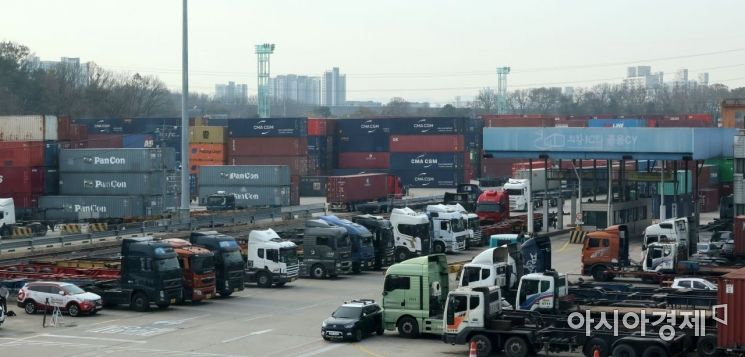
The consumer price inflation rate for this year is forecasted at 2.6%. This is 0.1 percentage points higher than the previous forecast (2.5%) due to rising international oil prices amid recent Middle East geopolitical risks.
The inflation rate is expected to slow from 3.0% in the first half of the year to 2.3% in the second half. Next year, it is projected to record 2.1%, close to the inflation stabilization target of 2.0%. The core inflation rate, which reflects the underlying trend of prices, is expected to converge to 2.3% this year and 2.0% next year.
Reflecting this, KDI also suggested the need to lower the current benchmark interest rate, which stands at around 3.50%. It emphasized the importance of gradually easing the current tightening stance toward a neutral level.
KDI stated, "As the core inflation rate continues to decline and approaches the inflation stabilization target, concerns about sustained high inflation have largely eased."
At the same time, it pointed out that the high interest rate environment is exerting downward pressure on domestic demand by increasing delinquency rates on household and small business loans, recommending a gradual adjustment of the tightening policy.
Jung Kyu-chul, head of KDI's Economic Outlook Division, said, "If inflation stabilizes to some extent, the high interest rate stance will gradually move toward neutrality, and we expect our economy to return to a normal level. Fiscal policy is currently somewhat expansionary, but if the economy returns to a normal trajectory, the fiscal deficit will also shrink, and fiscal policy should follow a normal path."
KDI reiterated that the need for additional economic stimulus is not high. This is because domestic demand is expected to gradually improve as the tightening monetary policy stance is eased amid economic recovery.
In its analysis titled "Factors Behind Recent Domestic Demand Weakness" on the 2nd, KDI recommended refraining from large-scale domestic stimulus measures that could disrupt price stability. In its "High Inflation and Consumption Weakness" analysis on the 13th, it also forecasted an improvement in private consumption this year, arguing that short-term stimulus measures are unnecessary. This was interpreted as a direct critique of the opposition party's proposed 250,000 won livelihood recovery support fund.
KDI stated that as the need for economic stimulus decreases, the deficit in the managed fiscal balance should also be gradually reduced. It emphasized the necessity of restructuring expenditure in consideration of rapid demographic changes such as aging. To curb the rapid increase in national debt, it is essential to control welfare spending demands through expenditure restructuring and expanding the revenue base.
© The Asia Business Daily(www.asiae.co.kr). All rights reserved.
![Clutching a Stolen Dior Bag, Saying "I Hate Being Poor but Real"... The Grotesque Con of a "Human Knockoff" [Slate]](https://cwcontent.asiae.co.kr/asiaresize/183/2026021902243444107_1771435474.jpg)

















