Bank of Korea's 'March Money and Liquidity'
Increase Mainly in Demand and Savings Deposits
Household Investment Waiting Funds Significantly Rise
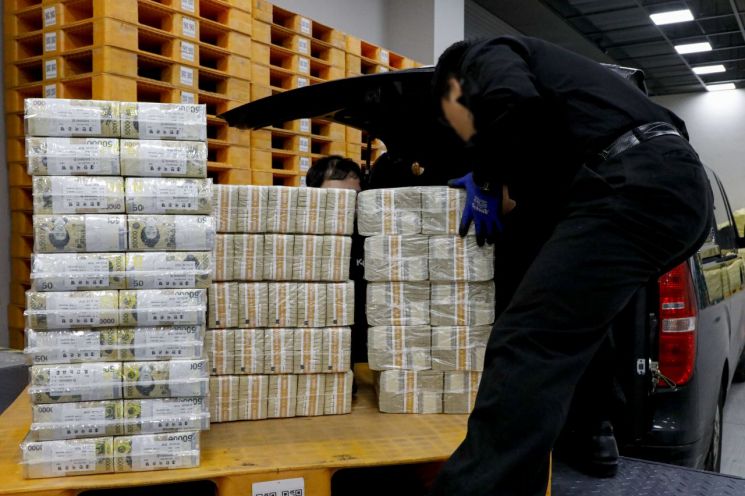
The amount of idle funds waiting for investment opportunities has increased, leading to a rise in the money supply for the tenth consecutive month. The growth rate also surged to 1.6%, significantly higher than the previous month's 0.1%.
According to the "March 2024 Money and Liquidity" report released by the Bank of Korea on the 16th, the broad money supply (M2, seasonally adjusted, average balance basis) in March reached 3,994 trillion won, an increase of 64.2 trillion won compared to the previous month. The growth rate was 1.6%, markedly higher than the 0.1% recorded in the prior month. The money supply has been rising for ten consecutive months since June last year, when it increased by 0.4%.
M2 is an indicator used to represent the amount of money circulating in the market. It includes narrow money (M1), which consists of cash, demand deposits, and checkable savings deposits, as well as financial products such as money market funds (MMF), time deposits under two years, beneficiary certificates, negotiable certificates of deposit (CD), and repurchase agreements (RP).
Looking at the breakdown by product, checkable savings deposits showed the largest increase. Compared to the previous month, checkable savings deposits rose by 18.6 trillion won, time deposits by 12.9 trillion won, MMFs by 10.7 trillion won, and beneficiary certificates by 9.2 trillion won, while market-type products decreased by 4.9 trillion won.
Checkable savings deposits increased due to payment delays caused by holidays and the inflow of idle funds waiting for investment, while time deposits grew as banks continued efforts to attract idle funds.
Lee Ji-seon, a manager of the Financial Statistics Team at the Bank of Korea's Economic Statistics Bureau, explained, "Funds maturing from products like the Youth Hope Savings have increased as they search for investment destinations, leading to a rise in idle funds. Although there are many investment options, the increase reflects the process of deciding which investment is best."
Meanwhile, MMFs increased due to the inflow of government surplus funds and subscription deposits, and beneficiary certificates rose as stock-type funds grew amid expectations of domestic and international stock price increases. On the other hand, market-type products decreased, mainly due to negotiable certificates of deposit.
By economic agent, households and non-profit organizations saw a significant increase. Households and non-profit organizations increased sharply by 35.6 trillion won, mainly in time deposits; other sectors rose by 9.8 trillion won, also centered on time deposits; and corporations increased by 7.5 trillion won, mainly in checkable savings deposits. Conversely, other financial institutions decreased by 6 billion won, primarily in time deposits.
Lee explained, "Households saw a large increase mainly in idle funds waiting for investment, such as checkable savings deposits and demand deposits."
Meanwhile, M1 (seasonally adjusted, average balance basis) reached 1,244.8 trillion won, an increase of 27.2 trillion won from the previous month. With increases in cash currency, demand deposits, and checkable savings deposits, the growth rate turned upward from -0.3% in the previous month to 2.2%.
© The Asia Business Daily(www.asiae.co.kr). All rights reserved.

















