Annual return rate rises by 5.24%p from last year to 5.26%
Proportion of pension receiving accounts surpasses 10% for the first time
Last year, the retirement pension reserves surpassed 382 trillion won, doubling in size over five years.
According to the '2023 Year-End Retirement Pension Reserve Operation Status Statistics' released on the 16th by the Financial Supervisory Service and the Ministry of Employment and Labor, the retirement pension reserves last year recorded 382.4 trillion won, an increase of 46.5 trillion won (13.8%) compared to the previous year. The retirement pension reserves have shown steady growth, rising from 190 trillion won in 2018 to surpassing 300 trillion won for the first time in 2022.
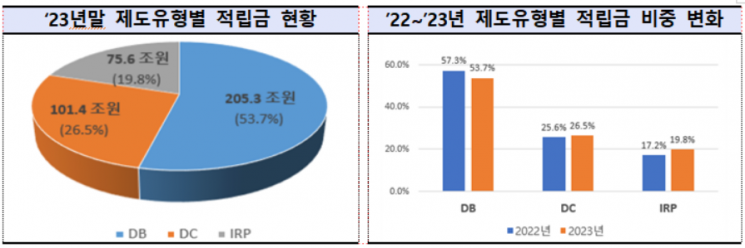
By system type, the reserve amounts were 205.3 trillion won for Defined Benefit (DB), 101.4 trillion won for Defined Contribution and Corporate IRP (DC), and 75.6 trillion won for Individual IRP (IRP). Reserves increased across all systems. The year-end increase amounts were 13 trillion won (6.7%) for DB, 15.5 trillion won (18.1%) for DC, and 18 trillion won (31.2%↑) for IRP. IRP showed a high growth rate due to expanded tax benefits and transfers of retirement benefits to IRP.
By management method, among the total reserves, principal-guaranteed funds accounted for 333.3 trillion won (87.2%), and performance-based funds accounted for 49.1 trillion won (12.8%). The proportion of performance-based management increased across all systems including DB, DC, and IRP compared to the previous year-end, driven by last year's stock price rise. The overall share of performance-based management increased by 1.5 percentage points compared to the previous year-end.
The annual return rate of retirement pensions last year was 5.26%, improving by 5.24 percentage points from the previous year. The annualized returns over the recent 5 and 10 years were 2.35% and 2.07%, respectively, rising by 0.84 and 0.14 percentage points compared to the previous year. By system type, DB recorded 4.5%, DC 5.79%, and IRP 6.59%, with IRP, which has the highest proportion of performance-based funds, achieving the highest return rate.
By management method, principal-guaranteed funds recorded a 4.08% return, while performance-based funds recorded 13.27%. Due to last year's stock price increase, the return on performance-based products significantly outperformed that of principal-guaranteed products compared to the previous year.
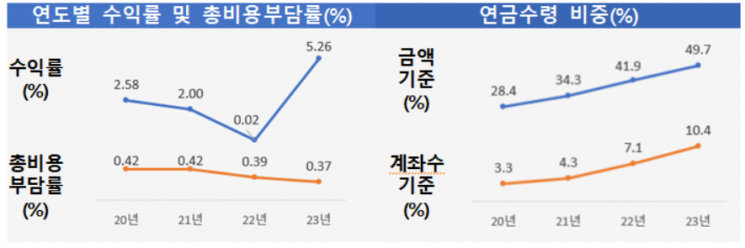
The total cost burden rate, indicating the level of cost burden on subscribers, was 0.372%, down 0.02 percentage points from 0.392% the previous year. By system type, DB was 0.323%, DC 0.508%, and IRP 0.318%. IRP saw the largest decrease due to fee discounts aimed at attracting subscribers. By financial sector, banks had 0.412%, life insurance 0.333%, financial investment 0.325%, non-life insurance 0.306%, and the Korea Workers' Compensation & Welfare Service 0.078%. Banks showed the highest total cost burden rate due to the highest management and asset management fees.
Among the accounts that began receiving retirement pension payments in 2023 (529,664 accounts), the proportion of pension receipts was 10.4%, up 3.3 percentage points from 7.1% the previous year. This is the first time the pension receipt rate has exceeded 10% since the introduction of the retirement pension system. In terms of amount, 49.7% (7.7 trillion won) of the total 15.5 trillion won received was in pension form, showing a significant increase compared to the previous year. The pension receipt proportion has been steadily increasing from 34.3% in 2021. The average amount received per pension account was 139.76 million won, while the average amount per lump-sum receipt account was 16.45 million won.
© The Asia Business Daily(www.asiae.co.kr). All rights reserved.
![Clutching a Stolen Dior Bag, Saying "I Hate Being Poor but Real"... The Grotesque Con of a "Human Knockoff" [Slate]](https://cwcontent.asiae.co.kr/asiaresize/183/2026021902243444107_1771435474.jpg)


















