Children's, Electrical, and Household Products Must Obtain KC Certification
Fair Trade Commission to Begin Consumer Protection Duty Inspection This Year
Reviewing Reform of Small Item Tax Exemption System Amid 'Reverse Discrimination' Controversy
The government has decided to completely block overseas direct purchases of children's products, electrical goods, and household chemical products that do not meet safety standards. This is due to side effects such as threats to consumer safety arising from the increased use of various low-cost overseas platforms known as 'Altesh' (Ali, Temu, Shiin). Eight ministries, including the Fair Trade Commission, have launched a high-intensity fact-finding investigation to prevent damage, and the Ministry of Economy and Finance will also consider reforming the small-amount duty exemption system, which has been controversial for reverse discrimination.
Children's and Electrical Products Must Have KC Certification for Direct Purchase
On the 16th, Prime Minister Han Duck-soo held a meeting of ministers related to national affairs at Incheon Airport Customs and announced the 'Consumer Safety Enhancement and Corporate Competitiveness Improvement Plan' based on these points. Prime Minister Han emphasized, "We will prioritize consumer safety above all else," and added, "We will take strict and swift action against any legal violations through comprehensive fact-finding investigations."
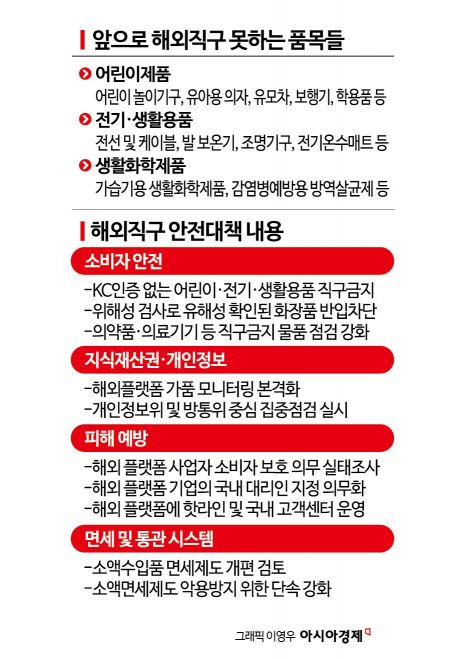
First, the government decided to ban overseas direct purchases of products without safety certification. The target products are those requiring special management, such as products for children under 13 years old and electrical and household goods that pose risks of fire or electric shock. From now on, these products can only be purchased through overseas direct purchase if they have obtained KC certification. Household chemical products will also require reporting and approval due to the increased risk of harmful substances.
According to this measure, products that will no longer be available for overseas direct purchase include 34 children's products such as children's playground equipment, infant chairs, strollers, walkers, and school supplies; 34 electrical and household goods such as wires and cables, heaters, lighting fixtures, and electric heated mats; and 12 household chemical products such as humidifier chemicals and disinfectants for infectious disease prevention. Prohibited items can be checked through the Fair Trade Commission's 'Consumer24' service.
Although not banned, procedures have been established to block the import of products confirmed to be harmful. Cosmetics and hygiene products come into direct contact with the skin, but overseas direct purchases are currently imported without separate inspections. The Ministry of Food and Drug Safety will monitor whether prohibited ingredients are included in cosmetics or hygiene products and conduct risk assessments to decide whether to block imports. Harmfulness of household chemical products such as accessories and deodorants exceeding standards for lead, cadmium, etc., will also be confirmed through monitoring.
Fair Trade Commission and Other Ministries Launch 'High-Intensity Fact-Finding Investigation'
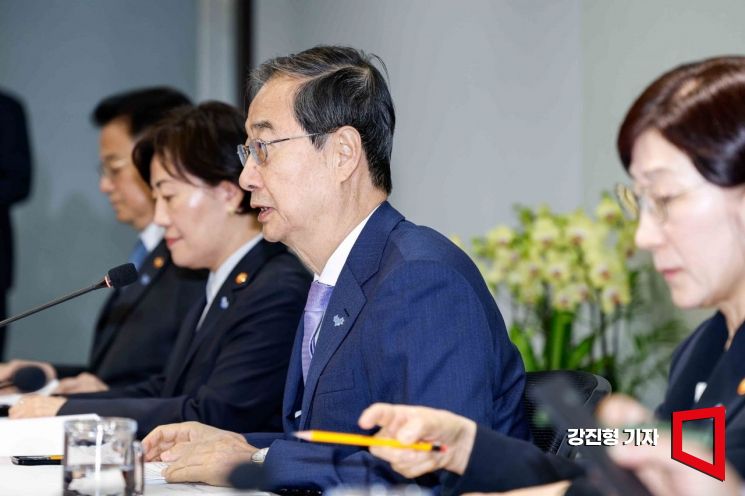 Prime Minister Han Duck-soo is delivering opening remarks at the Ministerial Meeting on National Issues held at the Incheon Airport Customs Express Logistics Center on the 16th. Photo by Kang Jin-hyung aymsdream@
The government is promoting measures against counterfeit goods and personal information threats alongside consumer safety. Currently, counterfeit monitoring focuses on domestically distributed products, leaving overseas platforms outside surveillance. The government plans to intensify counterfeit inspections on overseas platforms and jointly introduce a 'Smart Customs Clearance System' with the Korean Intellectual Property Office and the Korea Customs Service to block counterfeit goods. Additionally, the Personal Information Protection Commission and the Korea Communications Commission will conduct focused inspections to prevent personal information leaks on overseas platforms. Results for the first half of the year will be announced, and businesses found lacking will be required to take corrective actions.
The government will also conduct fact-finding investigations on overseas platforms. The Fair Trade Commission plans to investigate the compliance status of consumer protection obligations by overseas platforms within the third quarter of this year. Eight ministries, including the Ministry of Trade, Industry and Energy and the Ministry of Environment, will conduct comprehensive inspections to check for any issues in product and information management on overseas platforms.
If consumer damage is confirmed, related systems will be improved to allow for relief. Since overseas platforms do not have addresses or offices in Korea, consumers have found it difficult to receive compensation even when disputes arise. Accordingly, the designation of a 'domestic representative' for overseas platforms will be made mandatory. To facilitate smooth handling of consumer complaints, the establishment of hotlines and domestic customer centers has also been recommended.
The Ministry of Economy and Finance will consider reforming the small-amount import duty exemption system, which has been controversial for reverse discrimination. Currently, the government exempts taxes on self-use goods up to $150 (up to $200 for goods from the U.S.). As a result, overseas direct purchase items are exempt from customs duties and value-added tax, while general businesses must pay taxes, raising fairness concerns. Recently, cases have emerged where the small-amount exemption system was abused by intentionally splitting shipments to attempt duty-free clearance. Lee Hyung-cheol, Director of Customs Policy, explained, "We plan to comprehensively consider issues such as reverse discrimination against domestic businesses, overseas cases, and public opinion to review whether to reform the system."
© The Asia Business Daily(www.asiae.co.kr). All rights reserved.


















