Expected to be held in Seoul on the 26th-27th... First under Yoon government
'Expansion of Free Trade' Statement Possible... Concerns over US Discord
China's Security Stance Differences... Different Announcements During Diplomatic Talks
Ahead of the first Korea-China-Japan summit under the Yoon Suk-yeol administration, it has been reported that differences among the countries remain unresolved in the economic and security sectors. Regarding the agenda of 'expanding free trade,' both Korea and Japan cannot ignore their relationship with the United States, which is leading the restructuring of supply chains, while China shows a clear difference in stance on issues related to North Korea and Taiwan.
According to diplomatic sources on the 16th, the three countries?Korea, China, and Japan?are coordinating the draft of a joint statement ahead of the summit scheduled to be held in Seoul on the 26th and 27th. The issue attracting the most attention is the economic and trade sector. The three countries are reported to share a consensus on economic cooperation and agree on the necessity of joint responses to various challenges such as global supply chain instability.
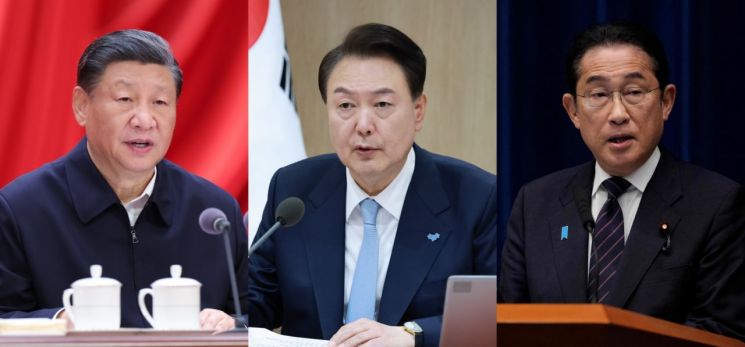 Leaders of Korea, China, and Japan. President Yoon Suk-yeol, Chinese President Xi Jinping (left), and Japanese Prime Minister Fumio Kishida (right)
In this context, the first idea that emerged was the promotion of 'expanding free trade.' The Japanese Asahi Shimbun, citing multiple government officials the day before, reported, "Although decoupling is progressing between Korea, Japan, and China in advanced technologies such as semiconductors, there is agreement on promoting free trade," and added, "The three countries plan to draw cooperation in these areas of consensus at this summit." It is also known that China wants the joint statement to include the position of 'strengthening free trade and reforming the World Trade Organization (WTO).'
The problem is that such content could be perceived as being out of sync with the United States. The international economic order has been reshaped into 'protectionism' amid fierce US-China hegemonic competition. Although competition among countries over subsidies for export and strategic industries has overheated, the WTO has failed to properly perform its dispute resolution role. China uses this as a justification to attack the United States. On the surface, China advocates free trade and the restoration of multilateralism through WTO reform, but it is using this as a means to counter US export controls on advanced technologies such as semiconductors. Korea and Japan also agree on the need for cooperation to stabilize supply chains and WTO reform, but since they participate in the supply chain restructuring led by the US, there are reportedly differences in the level of wording in the draft. This is because it could be seen as siding with China's logic against the US.
The US State Department, in response to related foreign media commentary requests, stated a principled position: "We respect each country's ability to make sovereign decisions in their best interests," and "Just as the United States takes measures to responsibly manage its relationship with China, so do our partners."
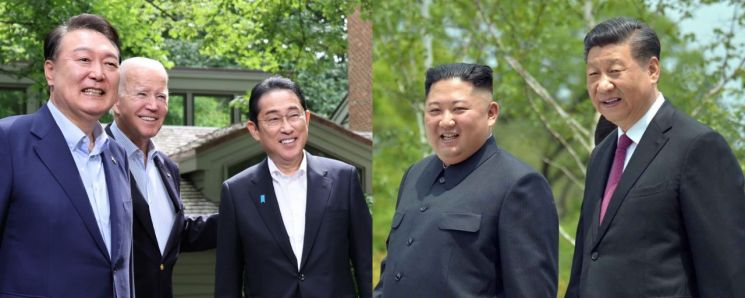 The leaders of South Korea, the United States, and Japan (left), North Korean Supreme Leader Kim Jong-un, and Chinese President Xi Jinping
There are also clear differences in positions between Korea, Japan, and China on regional security issues. Korea has emphasized China's 'constructive role' regarding the North Korean issue, but each time China has reiterated its stance of aiming for 'peace on the Korean Peninsula' and shown a retreating attitude. Regarding the Taiwan issue, Korea and Japan oppose 'changing the status quo by force,' but China dismisses other countries' involvement as 'interference in internal affairs.'
A recent example of this gap was revealed during the Korea-China Foreign Ministers' meeting held on the 13th. The Korean Ministry of Foreign Affairs announced that Minister Cho Tae-yeol pointed out the issue of large-scale forced repatriation and requested, "We hope China will take special interest and cooperate so that North Korean defectors are not forcibly repatriated and can go where they wish." Conversely, China included Foreign Minister Wang Yi's remarks, "We hope to consolidate the political foundation of bilateral relations by properly and prudently handling the Taiwan issue while adhering to the One-China principle." Korea did not mention the Taiwan issue, and China did not mention the forced repatriation of North Korean defectors. Each side excluded sensitive issues for the other and announced the meeting results focusing on matters important from their own perspective.
Meanwhile, the Korea-China-Japan summit was suspended after the meeting held in Chengdu, China, in December 2019. This upcoming summit is the first under the Yoon Suk-yeol administration and the first in four and a half years. The last time the trilateral summit was held in Korea was in November 2015 during the Park Geun-hye administration. During the Moon Jae-in administration, the summits were held only in Japan and China. Also, since the first summit in December 2008, China has downgraded its representation from the President to the 'Premier of the State Council.'
© The Asia Business Daily(www.asiae.co.kr). All rights reserved.


















